Introduction

Winemaking: The Continuation of Terroir by Other Means.®

Welcome to the Amalie Robert Estate Farming Blog, aka FLOG. By subscribing, you will receive regular FLOGGINGS throughout the growing season. The FLOGGING will begin with the Spring Cellar Report in April. FLOGGINGS will continue each month and detail how the vintage is shaping up. You may also be FLOGGED directly after the big Cluster Pluck with the yearly Harvest After Action Report. Subscribe now and let the FLOGGINGS begin!

Rusty

"This is one of the Willamette Valley’s most distinguished wineries, but not one that is widely known."

- Rusty Gaffney, PinotFile - September 2016

Josh

"Dena Drews and Ernie Pink have been quietly producing some of Oregon's most elegant and perfumed Pinots since the 2004 vintage. Their 30-acre vineyard outside the town of Dallas, abutting the famed Freedom Hill vineyard where Drews and Pink live, is painstakingly farmed and yields are kept low so production of these wines is limited. Winemaking includes abundant use of whole clusters, which is no doubt responsible for the wines' exotic bouquets and sneaky structure…"

- Josh Raynolds, Vinous - October 2015

David

"...Dallas growers Dena Drews and Ernie Pink... showed me this July three of their reserve bottlings and thereby altered my perception of their endeavors. Since these are produced in only one- or two-barrel quantities, they offer an extreme instance of a phenomenon encountered at numerous Willamette addresses, whose really exciting releases are extremely limited. But they also testify, importantly, to what is possible; and what’s possible from this site in these hands revealed itself to be extraordinary!... And what a Syrah!"

- David Schildknecht, The Wine Advocate - October 2013

Wine & Spirits

"Finding that their whole-cluster tannins take some time to integrate, Pink and Drews hold their wines in barrel for up to 18 months - so Amalie Robert is just releasing its 2008s. And what a stellar group of wines: Bright and tart, they possess both transparency and substance, emphasizing notes of rosehips and sandalwood as much as red berries. The pinot noirs alone would likely have earned Amalie Robert a top 100 nod this year. But the winery also produces cool-climate syrah that rivals the best examples from the Sonoma Coast. And the 2009 Heirloom Cameo, their first attempt at a barrel-fermented chardonnay, turned out to be one of our favorite Oregon chardonnays of the year. Ten vintages in, Amalie Robert has hit its stride."

- Luke Sykora, Wine & Spirits Magazine – September 2011

Copyright

© 2005 – 2021 Amalie Robert Estate, LLC

Wednesday, July 31, 2013

Amalie Robert Estate Climate Update: 2013 July

Hello and Welcome,

This is the climate update for the month of July 2013.

July brings with it the busiest time in the vineyard. The vines are literally growing out of control despite our best efforts to position their shoots and clip them into the wires. It seems we are “all out there steppin’ and fetchin’ like our heads are on fire and our grasses are catchin’.” (A little inspiration from the Charles Daniels band there.)

But then there is the hedging. This machine is the vineyard’s great equalizer. The vines take up as much soil moisture as they can and use it to grow shoots and leaves. The more soil moisture they have, the more of this behavior they exhibit. This is where you can learn a lot just by looking around. The parts of the vineyard that are showing only moderate shoot growth are low on available soil moisture and more likely than not to ripen their fruit earlier than areas with more available soil moisture, ceteris paribus.


However things are never really what they seem, specious maybe, but certainly not ceteris paribus. The hedging, however, makes a good first cut at returning all of the shoot growth to an equal level. At Amalie Robert Estate, we like to see a 7 ½ foot tall canopy, because our rows are 7 ½ feet wide. This maximizes the potential sunlight absorption of the canopy. Really.

For about a week or so after the first hedging pass, it is pretty quiet out there. The vines seem to be shocked into submission. Hardly. What they are doing is preparing for a second offensive. Along each shoot that we have so gingerly tucked into the trellis, there are several lateral buds. Inside these buds lie the potential for a lateral shoot, aka the second offensive. However, these buds will only push and grow that lateral shoot if the growing tip is cut off by the hedger or otherwise removed (usually by some foraging deer, like this one.)

The laterals are useful in growing additional leaf surface area. Something we were very much encouraging in 2010 and 2011. We needed all the leaf surface we could get in those cold vintages. However, in a warmer year like we seem to be experiencing now, too much leaf surface can have less than positive results. One of those is building excess sugars and the other is transpiring what little soil moisture we have too quickly. This combination leads to high sugars before the aromas and flavors in the skins can catch up. As a side note, we go through this every year with Viognier. Such a troublemaker.

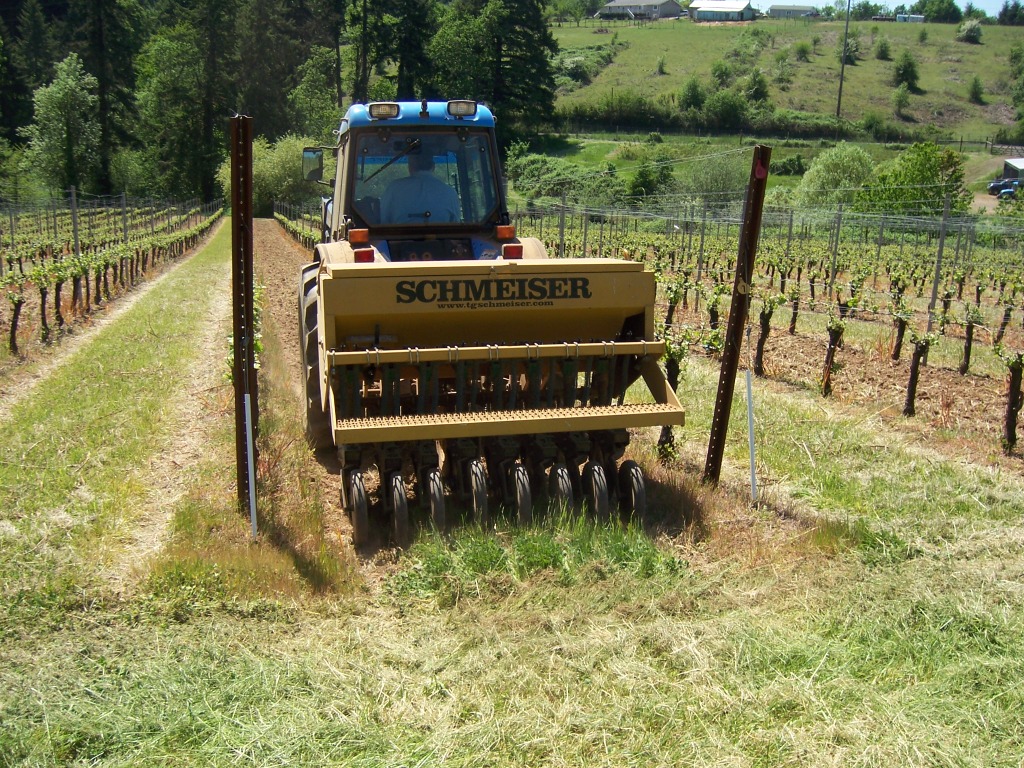
There are a couple of things we can do about this. The first is to check the crystal ball to learn what our rain pattern will be this year. The next best alternative is to set the hedger just a little bit lower than 7 ½ feet, but higher than the top of the posts, which are 6 feet – good to know. This will remove a little extra leaf surface and slow down the accumulation of sugar as well as preserving our precious soil moisture. Next, we put a really tight trim on the grass between the rows. Ernie set the flail mower and hedger on the same tractor so he does this in a single pass. What a guy!
Check out the new flail mower – it swings both ways!


After all of this, we venture out into the great unknown – how much crop do we leave on the vine? Our crop load, or fruit set, is not heavy this year and here is the rub. The lower the yield per vine, the faster it will ripen. The faster it ripens, the less chance we have of really great aromas and flavors developing in the skins. Note that there are two kinds of ripening going on here. One is increasing sugars and decreasing acids. The other is flavor development in the skins. Both of these ripening curves depend on water.

Let’s have a closer look at what is happening at the very top of row 66. The clusters on this vine are for the most part still green, except for the guy at the very end. Those berries are almost fully colored. How can this be? Water, or more accurately put - sap. Look closely and you will see the first catch wire is cutting into the shoot. Wires, like the IRS, are unyielding things and the shoot has no where to go. Don’t let this happen to you, have someplace to go, comrade.

This has the effect of cutting off the sap to the shoot and specifically the cluster. The result is the berries getting the message, quite clearly, “RIPEN YOUR SEEDS NOW.” And in so doing, the cell walls of the skins and pulp around the seeds starts to break down. The berry uses its malic acid as an energy source which reduces the acid in the fruit. The dark berries are then spotted by a wandering animal and the seeds are deposited “way the Hell and gone” over the next hill. This is all well and good for the vine; they have seen this movie before. But from a wine quality point of view, we do not have the aroma flavor development yet.

What does this mean and why should I care? Ah yes. What we have just seen with this cluster will happen to the remaining clusters, but naturally. The vine will shut off the sap to each and every cluster, forcing the ripening process to begin. That is when things get interesting.

If we end up with warm breezes from the east, our berries desiccate and make raisins. So leaving a little extra crop will slow down the desiccation and accumulation of sugars and allow for more time on the vine. Another dynamic is in play here. If the vine cannot get water from the soil, it will dip into the clusters. So leaving a bit more fruit is really a hedge to slow down ripening, dilute sugars and increase aroma and flavor development.

If we get a weather pattern from the coast, it is going to rain. But the crystal ball was somewhat elusive in showing us exactly when and how much. Note here that sap and water are not the same things in the vine world. While the vine cuts the cluster off from the sap of the Phloem, it is still connected to the Xylem.

The Xylem, that’s where the water is. If we get rain, the berries on the cluster will absorb that water if the moisture makes it down to the root zone. If this happens, the berries can split and rot in situ. Not all is lost here, the seeds will still have ripened.

But a little moisture is what we are looking for as it also brings cooler temperatures to slow down ripening. A little shower here and there is usually taken up by the grassed rows and not really a big deal. Grasses are the most opportunistic of the plant world, they just wait like crocs at the watering hole. It’s as if they know it will rain. Maybe we should go chat them up…

Either way, the wings are coming off. The wing is the back up plan in case the main cluster does not set much fruit to ripen seeds. It is the back up plan because it sets fruit a week after the main cluster and therefore ripens a week later than the main cluster. We would rather leave a few more clusters and take the wings off, than just take a few clusters off and leave the rest of the clusters with their wings. Call us crazy but, it seems to be working…

Amalie Robert Estate 2010 Wadenswil Clone Pinot Noir earns 93 points from the IWC!

“Bright red. High-pitched cherry and Asian spice aromas are deepened by notes of sassafras, woodsmoke and cola. Stains the palate with sappy red and dark berry flavors and tangy acidity adding lift and cut. An exotic floral nuance emerges with air and carries through a long, sweet and persistent finish. While this energetic pinot is built to age, it has a lot of immediate appeal. 93 points.”

- Stephen Tanzer's International Wine Cellar, July/Aug 2013


For those of you who trusted your palate and purchased this wine as futures, well done! Please note we have very limited availability at the winery. Please Email Dena to place your order while we retool our fulfillment solution.

As for our late release 2009 iPinot, there were also some very nice things to be said.

 “Vivid ruby-red. Sexy, spice- and floral-accented aromas of raspberry and cherry-cola, with a smoky topnote. Offers sappy red fruit and floral pastille flavors and notes of gingerbread and white pepper. Shows a silken character, with real back-end energy. Weightier on the gently tannic finish, which strongly echoes the raspberry and floral notes. 92 points.”

- Stephen Tanzer's International Wine Cellar, July/Aug 2013


This wine is in good supply and is providing great pleasure now $38 by the bottle and $34 on 6. It gets better if you’re on the A-List. What’s the deal with the A-list?


Well who knew? The lady likes to go fast! It seems Mother Nature has hit top gear and is just rolling that power on! Looking good, sunshine!

We now present the July 2013 numbers from Amalie Robert Estate:
The month of July accumulated a very enjoyable 543.5 degree days, had a high of 92.7 (recorded July 2 at 2:40 pm) and a low of 45.0 (recorded July 22 at 5:40 am) with no farming rain at all. This brings the 2013 growing season up to 1,212.9 degree days from April 1 through July 31. Rainfall for the growing season remains at 6.24 inches.

The race is far from over, as we have heat accumulations for August and September yet to log (and rain, yes we will have rain.) These two months combined are typically in the 600 to 900 degree day range, except when they are not. To wit:

For those of you getting the first taste of the 2010 and 2011 vintages, please bear in mind each of those very cool vintages logged less than 1,800 degree days. Combine that low heat accumulation with an extended ripening window providing hang time into November and you have a couple of vintages for the record books. And many folks thought the 2007 vintage was “special.”

Here is what July 2012 looked like:
We have recorded about 449 degree days for the month of July, providing a total of 929 degree days since the beginning of the growing season on April 1st. This compares with 381 degree days last July and a comparative total of 689 degree days for 2011. During July, our highest high was 90.9 and our lowest low was 43.9 degrees Fahrenheit. 

We received no measurable precipitation for the month of July. July 2011 brought the gift of 1.02 inches of rain. Rainfall from April 1st through July 31st was 8.96, and is 0.40 inches less than last year's growing season to date rainfall of 9.39 inches. Timing is everything.

The trend seems to be warmer and drier than last year. Hard to believe it could be wetter and colder, though as we now know, anything is possible. Mother Nature, while not very reliable, is somewhat predictable, and seems to be turning on her charm

Kindest Regards,


Dena & Ernie

Sunday, June 30, 2013

Amalie Robert Estate Climate Update: 2013 June

Hello and Welcome,

Happy 4th of July!

This is the climate update for the month of June 2013.
 
Just when you thought you had all of the questions figured out, the legislature starts changing the answers. If you would have asked us what a “Wine Growler” was a few years ago, we would have said it is a guy who grows grapes for wine that is not all that happy with the current growing season, or maybe a wine reviewer.
 
Today in Oregon, a Wine Growler is a container that you can take to your locally enlightened alcohol purveyor who will, for a modest fee, fill your Growler with Oregon wine. Typically, these wines have been filled into kegs by a bonded winery and are being dispensed in a manner similar to beer or hard cider. 
 
Ecologically speaking, this removes all of the glass, labels, protective foils, pesky corks and screwoffs that get in the way of enjoying Oregon wine. In fact, you can rinse out your soda bottle, get it refilled with Pinot Gris du jour, and continue on your merry way. Another advantage of the Growler system is that you do not have to have a keg setup at your home or place of business, but you could. We predict an uptick in the used refrigerator market very soon.
 
Whaddya know, the 2013 vintage is now “on the vine.” After a fairly nice Spring and relatively early bloom period, we are the proud stewards of little pea sized berries! It is still a little early to tell what the crop load will be, but it seems more likely than not that we may have a “low drama” harvest. Ernie is thinking it could be a little early, maybe somewhat similar to 2009. That vintage is just starting to show off a little something above the knee.
 
June gave us the full complement of weather including the “June Gloom” which proceeded to arrive on the longest day of the year. The June Gloom typically vacations here from the Gulf of Alaska. It brings with it a full contingent of dark, overcast skies that blot out the sun and very humid temperatures with a spot of rain. It is pretty typical slug and fungus weather, and certainly not as fun as our favorite fall weather - duck and fungus.
 
 
The cover crop took full advantage of the 1.24 inches of June rainfall. The Buckwheat has started to flower and we are seeing all manner of insects looking for a little free pollen lunch. The Vetch is on a slower trajectory, but it has more to do. As you read this, it is pulling Nitrogen out of the air and putting it in the soil. And there it will remain until mid-September when Ernie tills it into the soil. The Nitrogen will then help breakdown the Buckwheat and Vetch green material. All of this organic matter will become natural fertilizer for our vines in the fall.
 
Now, the vines don’t miss much. Not only are they burning through all that easy to get soil moisture, they are also sporting shoots that are overgrowing the trellis. This time of year is really hard to keep pace with 44,155 not so little winemakers. But persevere we must, until we have trapped all of the shoot growth in 3 sets of catch wires. These wires are important to growing great wine because they help separate the leaves and the fruit. This separation allows for sunlight penetration and air circulation in the canopy. This in turn dries out any excess moisture that can lead to Mildew and Botrytis that will compromise our grape clusters. Clean, disease free fruit allows for increased hang time in October, and that can put the finishing flavor and aroma touches on the 2013 vintage.
 
We save the numbers for last, so you can skip all the fluff and wade right into the analytical minutiae of winegrowing.
 
The month of June accumulated a whopping 387.4 degree days, had a high of 95.2 (recorded June 30 at 3:40 pm) and a low of 43.0 (recorded June 14 at 3:20 am) with 1.24 inches of rain. This brings the 2013 growing season up to 668.8 degree days from April 1 through June 30. Rainfall for the growing season is now up to 6.24 inches. Well now, we may just have a “contender” vintage on our hands here.


And this is what it looked like in 2012: The month of June accumulated 244.2 degree days, had a high of 86.6 and a low of 37.2 with 2.92 inches of rain. This brought the 2012 growing season up to 480.3 degree days since April 1. And yes, we did receive exactly 2.92 inches of rain last June. We would say this is odd, but it is divisible by 2. Was it sampling error? Ah yes, the “human” terroir factor.
 
Kindest Regards,
 
Dena & Ernie


Friday, June 7, 2013

Amalie Robert Estate Vintage Update: 2013 June Flowers


Hello and Welcome,

We have flowers! The first sign of a potential harvest window appeared on June 6, 2013 – Day 157 of the Julian calendar. Typically, we are asking for about 105 days from flowering to harvest. So we will be looking to open the harvest window on day 262, or September 19.  Someone once remarked that this is just like clockwork, but when you are in business with Mother Nature, nothing you set out to do is as simple as that.


The part of the plant that is flowering (or “in bloom”) is called an inflorescence. When we are looking for flowers in the vineyard we are doing reconnaissance. Once our work is complete, we issue a status. Ergo, our IRS is that we are flowering Right Farming Now!

Weather during bloom is about as perfect as anything in agriculture can be – thanks Mom. We are seeing highs hit the low 80s and we are cooling off into the 50s at night. A refreshing breeze blows by from time to time and a few wispy clouds add texture to an otherwise endless sunny blue sky. And just when you thought it couldn’t get any better, consider this: Wine grapes are self pollinating!


If we continue on our current trajectory, we could have a bountiful crop that could be clear to harvest in late September. Since there’s a lotta “Cs” there to consider, we better not slack off. But today the sun is on our backs and the breeze is lifting our spirits. The world, for now anyway, seems to be spinning in greased grooves.

While there is more we could say about the IRS, there seems to be plenty of other folks out there with great information to share. We really aren’t looking for that much attention anyway.

Kindest Regards,

Ernie & Dena

Saturday, June 1, 2013

Winegrowers You Must Try (Lyrics)

Amalie Robert Estate
Winegrowers You Must Try
Sung to the tune of "Ghost Riders in the Sky"

From books and school to the corporate world we began
Living life in black & white and working for the man

We shared some wine on a weekend rendezvous
Our fate was sealed by Pinot Noir, and life began anew

Yipie Meunier, Yipie Pinot
But for the grace of God, this could be you

Now we're at the seasons' end with winds and rain, you bet
We've got to pick those grapes, but they aint ready yet

It seems like forever that we wait for this one day
Detailed plans we make, but Mother Nature leads the way

Yipie Meunier, Yipie Pinot
Satisfaction Syrah and Amalie's Cuvee

Our brand is now on fire, our presence you will feel
You may not have tried our wine, but soon we're sure you will
You've had to wait this long, and you must wonder why
Swirl carefully for if you spill a drop, with us you will cry

Yipie Meunier, Yipie Pinot
Wine growers you must try

Past the TSA and in this tiny tube we must fly
Hurtling with all Godspeed through the moonlit sky
Travelling across the plains pouring for those we have not met
We're working hard to sell this wine, cause we aint sold out yet

Yipie Meunier, Yipie Pinot
It's your whistle we aim to wet

We are coming to your town and mister you will see
An Oregon Pinot Noir with the brand of Amalie

Taste the wine and read the spam you cannot resist
Within a month you'll be receiving wines, direct from our A-list.

Yipie Meunier, Yipie Pinot
Please don't reply "cease and desist"

- Apologies to song writer Stanley Jones. Any inconvenience is regretted.

© 2011 Amalie Robert Estate, LLC

Friday, May 31, 2013

Amalie Robert Estate Climate Update: 2013 May

Hello and Welcome,

This is the climate update for the month of May 2013.

If anything describes the trials and tribulations of growing Pinot Noir it was the month of May. We enjoyed the most amazingly stunning April where we were burnin’ diesel overtime to harness explosive vine growth and condition the vineyard floor for our Spring Cover crop. Ernie got the seeds drilled in and set about the arduous task of waiting for rain, and wait he did. In case you have not met Ernie, this is something he is not very good at.


He just needed a tenth to a quarter inch of precipitation to achieve that magical event called germination. But instead it was wall to wall sunshine and dry for the first half of the month. For everyone who was visiting from somewhere other than here, don’t be fooled. You were simply caught up in a cruel hoax perpetrated on the farming community at large.

To wit: We just burned through our harvest weather. You see, every year we get about the same amount of wind, sun and rain. We like to see rain early in the season, not during harvest, but the thing is we never know just when we are going to get what. It kinda throws a spanner in the works, but hey that’s farmin’.

That is until the evening of the 12th. Ernie had been waiting for nearly 3 weeks for a spot of rain. He had just spent “several” quality hours of his life getting the vineyard floor ready to accept 1,500 pounds of cover crop seeds. You may be interested to learn that it takes about 1,500 seeds of buckwheat to weigh a pound, and we like about 50 pounds to the seeded acre. So that would be 1,500 seeds x 50 pounds per acre x 15 seeded acres gives us a whole lotta buckwheat!

The evening of the 12th provided the proverbial shot across the bow with a brief drizzle. Slug and fungus weather is what that’s called. The remainder of the month delivered the goods, and we had germination! Those last 2 weeks also tallied up the second wettest month of the year at a whopping 2.78 inches. The full month of March was only 2.87 inches.

Looking at the growing season to date, this was a pretty fortuitous event. We have had a very dry spring and that does not bode well for the dry farmed vineyard at Amalie Robert Estate. The warm stretch in April and early May invigorated the grass as well as the vines. Grass, while it doesn’t seem to be doing much, is a voracious consumer of water. The taller it grows, the more rapidly it depletes the available soil moisture. In some parts of the vineyard, grass is a tool we use to eliminate excess soil moisture. In some parts of the country, grass is grown for other purposes.

But here is the thing, available soil moisture leading up to harvest has a very significant impact on wine quality. In the final analysis, a berry is composed of seeds, skin, pulp and water. The most significant contributor to berry weight, and yield expressed as tons per acre, is water. In a perfect year, there is just enough available soil moisture to satisfy the demand from the leaves and allow the vine to partition carbohydrates (send reserves to the roots) as it prepares for the dormant season. This is commonly referred to as “making the vine struggle” to ripen the fruit. But be aware, the leaves can exert a very strong hydraulic pull from the roots to extract the water they need from the soil.

However, you cannot get a refund from a used equipment dealer, so if there is too little available soil moisture the vine dips into the berries for the water it needs. This condition results in a desiccated berry (raisin) with the potential for overdeveloped skin phenolics (bitterness) and aggressive and unresolved tannins. Combined with concentrated sugars, this could lead to the unfortunate crescendo of over extracted and high alcohol port style wines whose best meal pairing may well be with leftovers in the kitchen sink. Or perhaps, the latest wine flash site d’jour.

Fortunately, we had a bit of rain in May.

Along with the cover crop drama, which germinated into a fine stand of young succulent plants, the first set of catch wires are up and clipped into place. The only exception is the rule of block 12. The Viognier shoot growth is once again lagging behind. Ernie set a trap, or is doing an experiment – yeah that’s it, for block 12 this year. Watch this space in the coming months, and the Harvest AAR (After Action Report) for how things work out.

Alas, the part you have all been waiting for, the numbers. And here they are: 8675309

However, if you were a Pinot Noir vine grafted onto, let’s say 44-53M rootstock, May would have seemed more like this:

The month of May accumulated 229.7 degree days, had a high of 84.6 and a low of 35.8 with 2.78 inches of rain. This brings the 2013 growing season up to 281.4 degree days from April 1 through May 31. Rainfall for the growing season is now up to 5.00 inches.


As we head into what appears to be a vey nice summer, please remember olive oil, sea salt and fresh cracked (fracked?) pepper is not a substitute for sunscreen. Be sure to “get some onya!”

Here is what we had to say last year:

The month of May accumulated 196.32 degree days, had a high of 88.0 and a low of 31.7 with 2.92 inches of rain. This brings the 2012 growing season up to a very respectable 236.08 degree days from April 1 through May 31. We are significantly warmer than 2011’s heat accumulation of 37.61 degree days by nearly a factor of 10! Rainfall for the growing season is 6.04 inches, which is less than the 2011 ark building rains of 7.71 inches.

Clearly, we are seeing warmer and drier growing conditions than we have experienced in the last couple of vintages. But are the differences really farmin’ significant?

Kindest Regards,

Dena & Ernie

Tuesday, April 30, 2013

Amalie Robert Estate Climate Update: 2013 April


Hello and Welcome,

This is the Climate Update for the month of April 2013.

April has turned out to be a fine month indeed. While the numbers are clearly subject to interpretation, we can report with great confidence that everything felt just about right as we entered the 2013 growing season.

April is the time when all of the previous growing season’s wear and tear becomes evident. Our summer clothes have shrunk, again. Those nice new “Georgio Farmani” boots from last year are looking more like the “Claude Hoppers” of our misspent youth. And for some reason these glasses seem to drift in and out of focus.

The equipment is also looking for a little preventive maintenance, or percussive as the case may be. The flail mower is a piece of equipment that has a very hard life. The flail mower, while not an independent agency, is responsible for mowing all of the vineyard rows, headland spaces at the end of the rows, all roadways, open ground, small and sometimes large tree branches, and the front yard. This implement is also responsible for the majority of Ernie’s repairs and maintenance budget. It eats grease, bearings, flail blades, nuts and bolts, diesel and time, lots and lots of time. But when the flail is dialed in, it can really put down a nice trim.

After a recent gearbox seal replacement Ernie had to refill the gearbox with gear oil. Of course the fill plug is on the side, not the top of the gearbox. Apparently, this is the preferred design of Bondioli & Pavesi. At the same time, the “3 Point” mounting brackets were being reattached and reinforced by a really great friend (people who know how to weld are, by definition, great friends.)

Ernie is now scouring the shop for a funnel with a 90 degree bend and 3/8” outlet. But much like the Grinch searching for Reindeer, there were none to be found. However, after 14 years of farming, Ernie has seen this movie before. As if standing at the top of Mt. Crumpet (where wine critics said to take the 2007 vintage and dump it) he quite proudly announced to his welding buddy:

“Hey, I just made a funnel out of an old business card!” The reply was delivered dry and in perfect cadence: “Yeah, we’re really farmin’ now.”

Which leads us to this inescapable axiom: Farmin’ is what you are doing when you are not growing great wine.

Another curious thing happened this Spring, the vineyard grew! In size that is. Yep, after wishing and waiting and farmin’ all of these years, Ernie finally pulled the trigger and planted a wee little bit of the very fine Gewürztraminer. While this is all very exciting, it will be another 2 years (or more if the deer discover it) before we have wine to enjoy.

As is par for the course, the grassed vineyard rows have received the brown canes and shoots from last year where the flail mower found them and promptly returned them to the soil along with some nice green grass clippings. The “Alternate” rows are where we plant cover crops to feed our vines.

That process is a bit more involved and includes not only the obligatory flail mowing but a pass with the chisel plow as well to open things up. We then hook up the roto-tiller to turn last years cover crop back into the soil and prepare a nice fluffed-up seed bed. The last step is to fill up the seed drill with a summer blend of Buckwheat and Vetch and drill it in. Then there is a bit of tried and true farmin’ – we wait for rain.


These are Buckwheat and Vetch cover crop seeds before and after being drilled into the “Alternate” rows. We consider the soil to be the plants’ stomach. By planting cover crops that add nitrogen to the soil and promote overall soil health, we can avoid the use of chemical fertilizers. These cover crops also provide a nice habitat for beneficial insects (think carnivores) that can help manage the populations of non-beneficial insects (think dinner.)


However interesting these acts of farmin’ may be, the vines are dedicated to a singular purpose: Making us work for it! And that is what’s up next. Each of these precious little “wine makers” are in for a little shoot thinning and trunk suckering. Then we start bringing up the catch wires and clipping their fruit bearing shoots into place. This is followed by more farmin’ as we hope for nice weather while the vines are flowering and hopefully setting a nice crop of wineberries. Wouldn’t that be somethin’?

Well, here are the farmin’ numbers so far this year.

We entered the growing season on April 19 (day 109 of the Julian Calendar) with Budbreak. This is the first marker from the season that lets us know that harvest is happening in the southern Hemisphere and we are a scant 6 months away here.

We look at April in two halves because the first half is usually pretty cold and we have the technology to separate the data. The first half of the month gave us 0.0 degree days, a high of 68.8 (told you it was nice) and a low of 34.9 degrees F.

The second half of the month gave us 51.7 degree days, a high of 80.6 (How’s that for April showing off?) and a low of 32.4 degrees F. Rainfall for the month was 2.22 inches.

Here’s what we had to say last year: “We have recorded about 52.9 degree days from April 1st through April 30th. All of this heat accumulation occurred in the second half of the month. We checked at April 15th, but we had nothing. We reached a high of 81.5 and a low of 31.9 with 3.12 inches of rain directed mostly at Ernie as he drove his crawler through the vineyard.”

Hmm, seems like we may have seen this farmin’ movie before.

If you missed the 2013 Spring Cellar report, you can find that right here: Amalie Robert 2013 Spring Cellar Report

Kindest Regards,

Dena and Ernie

Wednesday, April 24, 2013

Amalie Robert Estate: 2013 Spring Cellar Report

Hello and Welcome,

This is the 2013 Spring Cellar Report aka “Vit Lit.”

Introduction:
This fall and winter have been a tough slog here at Rancho Deluge. Why just the other day the sun came out and everyone thought it was just another exploding meteorite. Alas, when we finally did locate the sunscreen it was all for not, not even a rainbow to mark the occasion. We were, however, thankful when our eyesight returned.

......

Springtime is when the vines wake up and we get back to work in the cellar. The Pinot Noirs and Syrah from that great 2012 vintage are just completing their Malo-lactic conversion, and the stainless steel fermented Chardonnay and Viognier are queued up for bottling. Meanwhile, the 2011 vintage Pinot Noirs are ready for blending trials. This really is the most rewarding part of winemaking for us, blending our single vineyard wines for complexity.

Marketing:
Throughout the growing season we are doing our best to grow our wines on the vine. We think of those grape skins as tannin packed flavor and aroma packets. Our job as winegrowers is to understand the style of wines we want to produce and take specific actions in the vineyard to shape the development of those flavors, aromas and tannins. “Human Terroir” if you will.

This means we pay attention to how much sun exposure the grapes receive by removing just a few leaves for air circulation, but leave enough that provide partial shade. We also thin off the wings that ripen later than the main cluster and can impart green or unripe flavors. The last, most important decision is always harvest. Once the sugars and acids are within acceptable ranges, we start to taste the berries. Specifically, we are tasting for skin development and monitoring the ripeness of the seeds.

The Back Story:
Once in the winery, we ferment some of the grapes on the stems. We also use the yeast they brought with them from the vineyard. This is known as whole cluster fermentation with indigenous yeast. We know that this fermentation style protects the character of the vineyard and will add stem tannin to the finished wine. This tannin is “alive” and will continue to develop character with bottle age. In the cellar we fill the wine into a combination of new and previously filled French oak barrels. We are also experimenting with Hungarian and Russian oak, but don’t tell anybody – it’s a secret!

Think of the barrels as our spice rack. Each cooper has a style, and in fact each individual barrel will impart a unique aroma, flavor and texture profile to the wine. Add the variable of time, and the wines will mature from the aggressive tannins of freshly fermented juice into nuanced and interleaved aroma, flavors, textures and a lengthy finish. That is how we put the “F” in fermentation - it is in the finish.

So, do we engineer our wines? Maybe. But our point is we actually thought about the styles of wine we want to enjoy, and learned the farming and winery practices to create them. Of course, this winegrowing structure is superimposed over Mother Nature’s prerogatives. We know she is never going to be reliable, but she is predicable. Our job is to be ready in a moments notice to snatch our grapes from the jaws of defeat, or 3 inches of rain in week, ceteris paribus.

As we taste the wine in barrel, we review not only the vintage, but how we grew, fermented and barrel aged our wines. We evaluate the aroma, texture and weight on the palate. When we make our blends we seek to present our entire vineyard terroir as well as the human terroir that we have contributed to the wine. A point of clarification here: Don’t ever agree to go barrel tasting in anyone’s cellar. Barrels do not taste good. You want to taste the wine in the barrel. That’s where the action is.

What does this mean and why should I care?
What this means, is we thought about creating our Amalie Robert Estate wines in our own particular idiom – yes, it is the year of the snake, a Python if you will. You should care because in the world of wine, very few wines are offered that represent this level of care, stewardship and dedication by the founders and owners who still are able to do the work.
It was our first piece of intellectual property in the wine business, and we stand by it today: “Wines true to the soil, Wines true to the vintage.” We invite you to experience Amalie Robert Estate wines with friends, food and in moderation.

Current Events:
While we try very hard to be politically tone deaf, it is really difficult to ignore the shenanigans in our great nation’s capital. These “self inflicted wounds” remind us that the fewer facts you have, the more general your knowledge, until you reach the pinnacle of politics whereby you know nothing about everything. This is, in fact, a late life bi-polar response to adolescence where you know everything about nothing.

It was Benjamin Disraeli who said “It is much easier to be critical than correct.” Perhaps true, however it would leave us all significantly less entertained, wine writing included. So in this year of the snake, we take to heart some of the more interesting, and potentially irreverent, concepts of the British comedy troupe Monty Python. To wit: “Message for you sir!” - “Strange women lying in ponds distributing swords is no basis for a system of government!”

For those unfamiliar with this artform, you may view the unofficial script of “Monty Python and the Holy Grail” at this link. You will, of course, have to improvise the audio and video. Note: A fine glass of Pinot Noir may help you in your quest.

Today’s Feature Presentation: Fluid Transfer
While laughter may be the best medicine, wine it is said, is the essence of life. And that brings us to the concept of “Fluid Transfer” which in fact is the essence of life. And as we all know, life is a sexually transmitted condition which may be the result, in certain cases, of consuming wine – perhaps in excess. We will now set about to prove wine is the essence of fluid transfer.

The grail of wine you savor most likely came from a 4,200 degree F. heat formed molten silica sand package - aka a glass bottle. The fluid contents of which were sequestered in said package by a curious piece of tree bark known as a cork, or natural stopper for those into the “natural wine” movement. Clearly there is no fluid here and not the point of today’s commentary. The wine however is fluid, and that is where we begin our journey. (Note: Until man learned how to heat sand to 4,200 F., goat skins were used to package wine – perhaps this is the origin of the natural wine movement. Even today in your local wine purveyor, some wines are sold in a box containing an unnatural plastic bladder that holds “wine.”)


Our 30 acre vineyard is a southern leaning coalition of wine grape vines that strive to transfer water, and with it the essence of the soil, into roughly 750,000 clusters of wine grapes. This is no small task that they are preprogrammed to achieve, however they have from April through October to get the job done. Mother Nature does her part by providing roughly 45 inches of rainfall per year. This fluid transfer from the Heavens to the earth is really the seminal event of the growing season. And there is more than enough to go around.

At an average rainfall of 45 inches per year, we receive about 45 inches x 27,154 gallons/inch per acre = 1,221,930 gallons of water per acre of land. Now on that typical acre of land, we plant about 1,452 vines. That means each vine, in theory, has access to about 845 gallons of water per year. Our typical crop yield results in about a single 750 ml bottle of wine per vine, or about 0.198 gallons. The remainder of the 845 gallons is either leached through the soil, taking our hard earned Nitrogen with it, or transpired through the canopy to cool the leaves during the growing season. However, during the winter months we are slogging through the soil and depend on high quality footwear, aka “work boot style rubber overshoes” or “Wellies”

As the growing season progresses, the vines are ripening up the year’s vintage without too much drama, however we all know “closing time” is on the way. Late September is when all manner of things can happen. We could get a little sprinkle on the fruit that may cause wine reviewers to panic. We could get warm dry days with a little breeze that will desiccate our fruit, aka reverse fluid transfer. Or, things could be just hunky dory – a condition not seen in our lifetime.

We could get a bad “pre-harvest review” from an otherwise intelligent person on the periphery of the wine “business.” This seems to happen more often than not and can clearly point to a very lucrative political career (see above.) Not so much fluid transfer there, but we would recommend keeping your wallet in your front pocket. Please see the harvest review from 1957.

Then before you can say Waft The Fruit, there you are in the biggest cluster pluck you can imagine! Plant by plant is harvested by hand into 5 gallon buckets weighing about 20 pounds – more if the soil is wet and the buckets get muddy. This hand job goes on from sunrise until just after midday. When it is all said and done we will have transferred about 15 tons of skins, seeds, pulp, stems, bugs, mud and grape juice from the vineyard to the winery. It is, in a word, rapture.

What started as an innocent, if not carefree, shower in the spring has produced a beautiful bounty of fruit. While we are basking in the afterglow of a fine performance, there is much work to be done. We begin at the beginning with our first step: “Get the fermentation out of the way!”

Once our grapes have made it to the winery, we believe our job is stewardship. If you have seen our stained hands and bleary eyes in November and December, you can easily understand this is not a hands-off affair. We are to take the fluid from the grapes, ferment the sugars into alcohol, infuse tannins, textures and aromas from the skins, stems and barrels over a period of 18-24 months and then transfer the essence of our vineyard into 750 milliliter bottles, each individually sealed with a cork and capsule (SWACC.)
If wine is the essence of fluid transfer, then variety is the spice. Not only do we grow our own Pinot Noir, we also dabble in Chardonnay, Pinot Meunier and Viognier. If these wines seem to leave you unfulfilled, we encourage you to seek a glass of Satisfaction, Syrah that is.

We are almost there. All that is left now is to put the stem on the apple, or more accurately, pull the cork from the bottle. Here is where you can get hands-on with wine. If you have read this far, you understand they are all a little bit different. It is not only the shape and size of the bottle but whether or not it has been fitted with a natural cork or a synthetic closure. Some bottles are fitted with a “roll on tamper evident” closure known affectionately as a screwcap or, again for the natural wine movement, a screwoff. Call it what you will, but it costs the winery about 15 cents.

And then there is the capsule. It used to be the case that corks were protected with lead foils or “capsules” during ocean going transport. The idea was to keep shipboard pests from nibbling out the corks and releasing the wine prematurely. Well (a hole in the ground with water in it,) lead is no longer used for this purpose because wine is shipped in sealed, temperature controlled ocean going containers and, more importantly, seamen are afforded shore leave on a more regular basis.

But still to this day, not everyone uses a protective capsule. If you are sure of the brand, and have been enjoying it for some time, the capsule may not be all that important to you. However, if you are trying a new brand for the first time, we encourage you to select a package that has a nice looking, form fitting and functionally protective capsule. Note: Some capsules have little holes in the end that facilitate automated, high throughput installation via electrical appliance. Choose wisely.

Perhaps you are new to the joys of wine, and are not all that familiar with the equipment. With the excitement of trying a new brand, you may well pull the cork right through the capsule. Over time, and with more practice, you will be able to master control. Also, you can avoid significant embarrassment and social stigma by not using a corkscrew on a “roll on tamper evident” screwoff closure before your guests arrive. It will be obvious to everyone right away.

While it has never happened at Amalie Robert Estate, we have heard of wineries sometimes forgetting to put the cork in and just applying the capsule over the top of the bottle - faking it. While there is no way to know this at the time of sale, it is an unfortunate and hopefully uncommon occurrence that can significantly change your perception of that brand.

Fetchez la Vache! This is supposed to mean “Bring me a wine glass.” Instead, it means “Fetch me the cow.” Occasionally Pinot Noir grown in the Burgundy region of France has what is know as “the cows arse” in the aroma, so maybe that is how this got lost in translation.

Much like the differing shapes and sizes of wine bottles, there is virtually an endless array of elegant, sophisticated shapes and styles of glasses designed specifically to receive wine. Most of these glasses are referred to as stemware due to the elongated stem that separates the foot of the glass from the voluptuous bowl. While we often evaluate the complete package, we pay keen attention to length of the stem and specifically the shape of the bowl.

It is a widely accepted fact that sophisticated wine “stems” are high maintenance. To compensate for the extra effort of maintaining the integrity of these delicate stems, a new style of wineglass has been introduced. It is called a “stemless” glass and has all of the virtues of a voluptuous bowl. It is however, lacking the elongated stem and herein lies the issue – there is no place to touch this glass that will preserve its inherent beauty. By the end of the evening, the glass has clearly been well groped and only a forensic lab may be able to determine the interloper.

We are rounding third base and heading for home. While it has been a subliminal exercise for the reader, you should by now have in front of you the following items: a fine bottle of wine from a brand you respect and trust, the proper tool (or in the case of a vintage port, tools,) that can be used to release the wine in a controlled manner (especially important for the disgorgement of sparkling wine,) clean stemware commensurate for the anticipated experience, soothing background music and the swoon worthy embers of a warm fire.

After the potentially awkward moment of pulling the cork, or disgorging as the case may be, the wine gently flows into the elegant and voluptuous stemware. A quick twist of the wrist and the wine swirls and rises to its zenith and gently recedes. The heady aroma fills the air, nostrils flare.

The sophisticated stemware directs the wine to the most sensitive part of your aroused palate. The rush of the aromas, flavors and textures triggers a pulse quickening, primal reaction. You swallow, then slowly a tingling sensation begins to come to the fore of your consciousness. It is your brain reminding you it is time to breathe!

The svelte tannins and lingering acidity continue the full frontal lobe assault. It is at this moment your heightened senses are alerted to the first drops of rain from a spring shower gently pattering against your window. Significant meteorological phenomena are about to be released.

This simply cannot be just any wine; it is the essential wine - Pinot Noir. Ergo, our work here is complete: There can be no doubt that Pinot Noir is the essence of “Fluid Transfer.” Join us next time as we cleverly explain why Chardonnay is the catalyst to “Spontaneous Combustion.” Think Blanc de Blanc.

Kindest Regards,

Dena & Ernie