Introduction

Winemaking: The Continuation of Terroir by Other Means.®

Welcome to the Amalie Robert Estate Farming Blog, aka FLOG. By subscribing, you will receive regular FLOGGINGS throughout the growing season. The FLOGGING will begin with the Spring Cellar Report in April. FLOGGINGS will continue each month and detail how the vintage is shaping up. You may also be FLOGGED directly after the big Cluster Pluck with the yearly Harvest After Action Report. Subscribe now and let the FLOGGINGS begin!

Rusty

"This is one of the Willamette Valley’s most distinguished wineries, but not one that is widely known."

- Rusty Gaffney, PinotFile - September 2016

Josh

"Dena Drews and Ernie Pink have been quietly producing some of Oregon's most elegant and perfumed Pinots since the 2004 vintage. Their 30-acre vineyard outside the town of Dallas, abutting the famed Freedom Hill vineyard where Drews and Pink live, is painstakingly farmed and yields are kept low so production of these wines is limited. Winemaking includes abundant use of whole clusters, which is no doubt responsible for the wines' exotic bouquets and sneaky structure…"

- Josh Raynolds, Vinous - October 2015

David

"...Dallas growers Dena Drews and Ernie Pink... showed me this July three of their reserve bottlings and thereby altered my perception of their endeavors. Since these are produced in only one- or two-barrel quantities, they offer an extreme instance of a phenomenon encountered at numerous Willamette addresses, whose really exciting releases are extremely limited. But they also testify, importantly, to what is possible; and what’s possible from this site in these hands revealed itself to be extraordinary!... And what a Syrah!"

- David Schildknecht, The Wine Advocate - October 2013

Wine & Spirits

"Finding that their whole-cluster tannins take some time to integrate, Pink and Drews hold their wines in barrel for up to 18 months - so Amalie Robert is just releasing its 2008s. And what a stellar group of wines: Bright and tart, they possess both transparency and substance, emphasizing notes of rosehips and sandalwood as much as red berries. The pinot noirs alone would likely have earned Amalie Robert a top 100 nod this year. But the winery also produces cool-climate syrah that rivals the best examples from the Sonoma Coast. And the 2009 Heirloom Cameo, their first attempt at a barrel-fermented chardonnay, turned out to be one of our favorite Oregon chardonnays of the year. Ten vintages in, Amalie Robert has hit its stride."

- Luke Sykora, Wine & Spirits Magazine – September 2011

Copyright

© 2005 – 2021 Amalie Robert Estate, LLC

Showing posts with label hedging. Show all posts

Tuesday, June 30, 2020

Amalie Robert Estate Climate Update: June 2020 and Salud Pinot Noir Auction


Hello and Welcome, 
  
This is an Amalie Robert Estate Climate Update: June 2020 and Salud Pinot Noir Auction. A FLOG communication from Dena and Ernie. Amalie Robert Willamette Valley Pinot Noir. 
  
iPinot COVID-19 Pivot Pricing is still in effect at $120 on six bottles with domestic ground shipping included. Just click on the Big Blue Button to browse available vintages and collect your favorite! 


You will not need a promo code to activate pricing. The pricing will automatically adjust when you select six bottles of iPinot and there is no further discount on iPinot. The shipping will be adjusted upon confirmation of your order. This is our contribution to the human condition, yours and ours. If you have any questions or need assistance, please E-mail Dena at Cuvee@amalierobert.com.

You don’t have to be crazy to grow Pinot Noir, but it helps. June has been quite the rollercoaster, but all in all we will log it as a positive in the vineyard journal. Cool and rainy was the beginning and the end of the month. The midsection was pleasant and sunny. This vintage is not quite sure who it wants to be. Not too much to complain about here at the vineyard though – not too much heat, or rain or pestilence upon the land, just yet.


Speaking of pestilence, we have a COVID-19 update. We opened the winery to outside tasting for one day last month. We are not going to name names, but you know who you are. Thank you for joining us. All went well and we learned what worked and what we could improve upon.

For the month of July, the winery will be open by appointment for personalized tastings. We will also have Saturday and Sunday weekend hours of 10 am to 3 pm for wine tasting and call ahead wine order pick up. We ask that you contact Dena at Cuvee@amalierobert.com to reserve your time. If you can’t join us, we can arrange shipping on your behalf. And we have upped our game with insulated shippers to extend our reach.

We have adopted the following outside tasting protocol. Upon arrival you will be offered your choice of barrel station under our new sun shade canopy. Each barrel station is at least 6 feet away from any other barrel station and is equipped with a bottle of sanitizer to be used on your hands. Lip sanitizer, by definition, is part of the tasting program.

Your barrel station will include a new Amalie Robert Riedel tasting glass (they make these just for us) for each person in your party and an unopened bottle of water that you may share among your party to rinse your new stemware. There will also be a double-sided all-in-one tasting program and order form. We may also include some laminated marketing SWAG that is sanitized before and after your tasting appointment. The tasting fee is $20 with $15 refundable on any two bottle purchase per person. The now christened Amalie Robert Riedel tasting glass is yours to keep and may be rinsed again.


Vineyard tours are available based on Ernie’s availability. Lately the tractors have sprung some very interesting leaks in some not so easily accessible places. Nonetheless, the vines are on their trajectory to ripeness and we would like to show them off. They have just been freshly hedged and look quite smart. Our rows are socially distant accessible at 90 inches apart. So, either dress for a walk in the vineyard to see the vines or bring your overalls for an “under the tractor” exposé. Yes, there is a difference between 4 millimeters and 3/16”.

The Amex Shop Small promotion is in effect. Amalie Robert Estate is a Shop Small business. The promotion is good for the entire month of July, August and into September. A qualified purchase of $10 or more will earn you a statement credit of $5. And you can use this offer up to 10 times. Please visit the American Express site for more details and to enroll your card. Do it today, don’t delay or you may miss the boat!


Now the fun stuff.


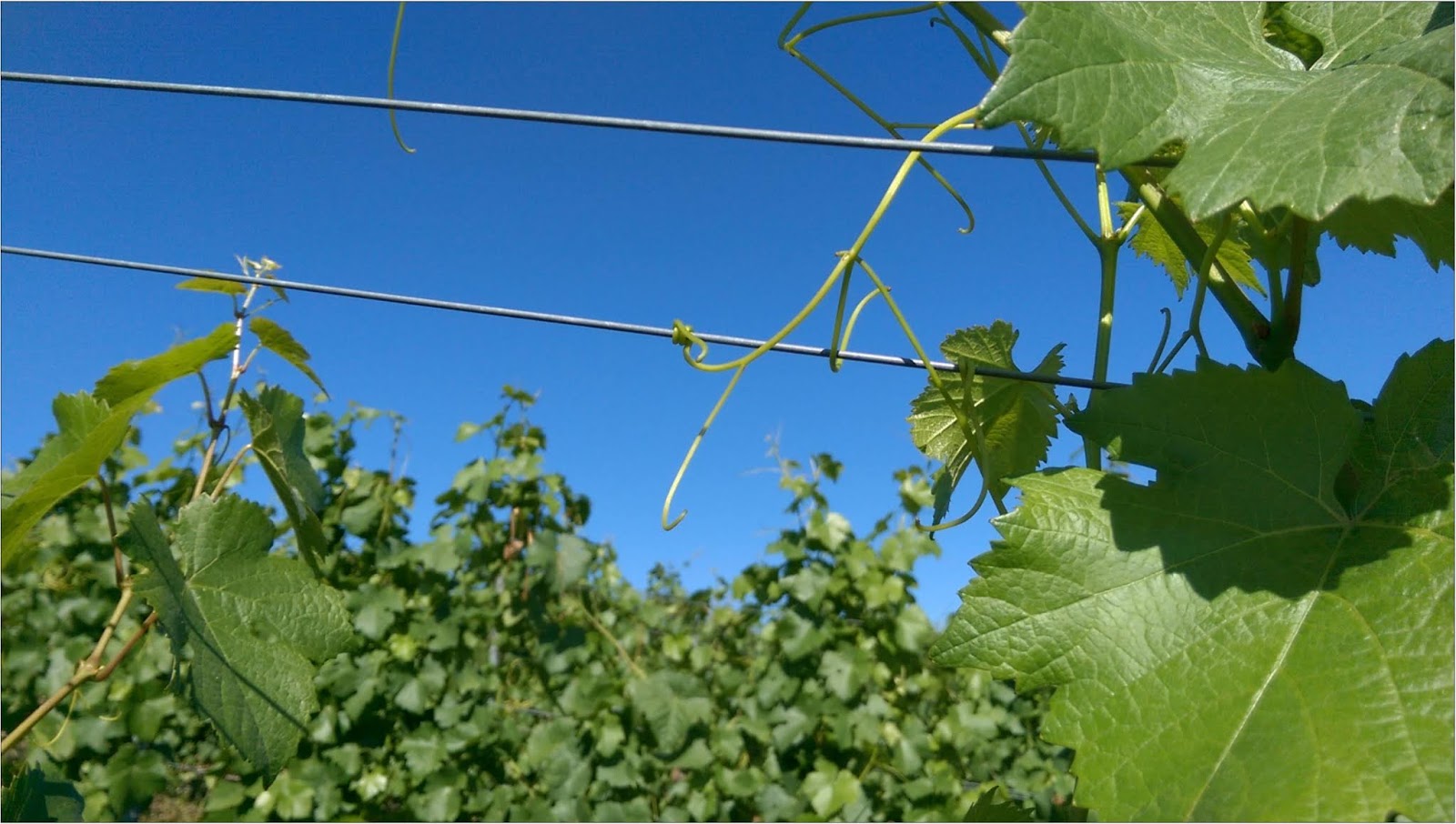
Miles and miles of hi-tensile trellis wires. We run three sets and the goal is to capture the vines’ growth at the most opportune time. Of course, the vines are keen to our plan. Some shoots grow quickly as if to escape our grasp. Others more slowly as if lying in wait to set upon us when we least expect it. Remind you of anyone? Perhaps someone with just three fingers?


Wouldn’t it be nice if Wile E. Coyote were to show up with one of his ACME products that self-installed trellis wires. Wouldn’t that be something? From the Jet-Propelled Pogo Stick to the Dehydrated Boulders, the ACME mail order catalog was his go-to source for new and innovative products. Makes you wonder what shipping costs would be on a box of dehydrated boulders. And hey, can you throw in a couple of supernovas? Kinda like Cracker Jacks. You can view the entire ACME catalog offering here.


Well, that’s not how it works. A crew of 5 highly trained and specialized vineyard workers are responsible for raising our trellis wires in vintage 2020. Oh sure, we have a coyote come through the vineyard from time to time. Not all that wily looking, mostly just trying to sniff out members of the Rodentia class of varmints. However, the bobcat that comes through block 14 always seems to have a purpose, a look of intention. He or She has the face of a Bengal tiger and we enjoy observing this cat from the safety of our kitchen.


The first set of trellis wires comes up when we have about 12 inches of growth, mostly. Just before we finish that set, the next set of wires at about 40 inches are ready to come up. About this time, Ernie is mounting the hedger on his pearl essence, powder blue Landini Rex 100 GT. (It’s Italian, what can we say.) And the third set of wires is where you discover the labor pool you have is about 4 hands short of what you needed to finish on time. At the end, the shoots are out of control and now they have the leverage. It is not a pretty sight. Total time to raise three sets of catch wires is 99,902 minutes, or about 117.178 seconds per vine. Just about the amount of time you need for the 2-minute warning.


But the hedger, aka The Enforcer, comes onto the scene right behind that third set of wires. What was all chaos and confusion is now rigidly enforced discipline. Any shoot caught outside the confines of the trellis wire will be summarily “removed”. And much like the wire regime, there will be a second and third hedging pass that is just as strict. If we have excessive soil moisture that encourages more growth, there is the option of a fourth hedge. It keeps Ernie off the streets, but it would sure be fun to run the Landini Rex 100 GT with hedger blades slashing up and down I-5 during rush hour!


It’s that time of year for the Summertime ¡Salud! Pinot Noir Auction. This year brings the COVID-19 edition where all bidding and virtual tasting for that matter, will occur online. If you want to see what you look like during a ZOOM virtual tasting, just position yourself in front of a mirror. Your backdrop may give away more than you know. We recommend the red SOLO cup for a spit cup. Much better than the glass alternative.

Amalie Robert Estate has been a contributing member of the Vintners Circle since 2006. The top 35 like-minded Oregon wineries produce a special cuvée just for the ¡Salud! mission. There are only 5 cases produced from each winery, and the only way to get one is to be a successful bidder at ¡Salud!
You can preview the auction lots here. Note we are number 3 of 35 wineries on offer this year.

The ¡Salud! mission is a good way to give back into the community that makes world Class Oregon Pinot Noir a reality. To learn more about the ¡Salud! mission and register to bid, please visit their website at  website here: http://saludauction.org/mission/ As noted above, those trellis wires do not raise themselves. But Ernie does have a call into the ACME company. No word back as of yet.


The numbers. While he does have the X and Y axis correctly identified, he is missing the Z axis – Speed. Trajectory, as Wile E. Coyote never seems to recall, is dependent upon thrust, or speed. In the vineyard construct, our Z axis is heat units. The hotter it is the faster the wine berries build sugar. Heat units are not just a reflection of the high temperature of the day. The vines are out there 24 x 7 and experience the cool nights as well as the warm days. And Ernie’s 3,600 data points per 30-day period approximate the curve quite accurately, every 12 minutes. Yeah, he’s got some kinda spreadsheet for that.
 

The month of June accumulated 341.2 Degree Days bringing vintage 2020 to a growing season total of 732.1 Degree Days. The first half of the month provided 122.6 Degree Days and 0.98 inches of rain. The second half of the month added 218.6 Degree Days and 0.59 inches of rain. The grass noticed the rain and Ernie got an unexpected extra mowing pass. The high temperature for the month was 89.6 degrees recorded on June 23rd at 2:36 pm. The low temperature was 38.1 recorded June 4th at 12:36 am.


Kindest Regards,

Dena & Ernie

Wednesday, July 31, 2019

Amalie Robert Estate Climate Update: July 2019


Hello and Welcome, 
  
This is the Amalie Robert Estate Climate Update: July 2019. A FLOG Communication
  
The best way to describe farming wine berries during July in the Willamette Valley can be summed up in a Lyle Lovett lyric. To wit:

“Like two backseat lovers, can't wait to get started
Knowing everything's over too soon”
                                - Memphis Midnight/Memphis Morning

First, we were racing to get the trellis catch wires up to harness the explosive vine growth. Then it was running the rows to clip the wires and the shoots into place. Ernie was in hurry up and wait mode because he can’t start hedging until the wires are secured. Block by block the vineyard started to take discipline.
  

Load in another 200 gallons of diesel and then the “Enforcer” is trimming a tight canopy. The first pass gets the vines attention and the second pass actually starts reprogramming their behavior. And then when it’s over, you get to sleep. But by then it’s August.


The whole concept of hedging is quite simple. We want to redirect the vine from growing more leaves to ripening their seeds and in so doing ripening the aroma and flavor packet that holds those seeds. That’s what we want, nice and easy ripening of the wine berry skins which is where all of the aroma and flavor is. Our interpretation of Pinot Noir is a silky, supple, sultry, svelte and sublime wine and to end up that way, you need to pay close attention to how you ripen the wine berries while they are still on the vine. That’s Ernie’s summer job and he is sitting on about 100 tons worth of silky, supple, sultry, svelte and sublime.

But there is more to it. After paying attention to the last few vintages, Ernie has done some figuring. He figures that hot vintages give you high alcohols. And he knows that the more leaf surface the vine has, the more sugar the vine will pump into the wine berry. This in turn will ferment into higher alcohol potential. So, he figured he would cut a much shorter canopy this year. He is about 6.5 feet tall instead of the standard 7.5 feet tall canopy. Much lower and you are trimming the tops of the posts off. Not so good, they don’t grow back.


Click on the image above to watch the video: Looking out the tractor window – A dog’s point of view.

Now, about those aroma and flavor packets, aka wine berry skins. Too much sun exposure during hot days has a tendency to create very bitter skin tannins. Have you ever had a wine that tasted like black licorice in the mid-palate? That is from over exposure to the sun and it is not pretty. So this year, Ernie figured he will not pull leaves. Oh sure, there will be some leaf casualties when we get to thinning and that’s fine. But other than that, he skipped the whole sordid affair.

But if you want to be bad, you’ve got to be good. We are talking about good canopy management and shoot spacing. The risk of developing mildew or botrytis is much higher if you do not pull some leaves out of the fruit zone. This is where 20 years of experience farming your own piece of dirt pays some handsome dividends. By focusing a tremendous amount of effort in our canopy management, we are able to provide shade to protect our silky, supple, sultry, svelte and sublime aromas and flavors.


Everything we have done so far in vintage 2019 is cumulative. Our goal is to be in the best possible position that allows us to choose when to harvest. And we want to make those harvest decisions based on ideal aroma and flavor in our wine berries. Yeah, it’s going to rain, we just don’t know when. But we feel confident that the timely actions we have taken with the vines will carry us through in silky, supple, sultry, svelte and sublime fashion. Just like vintage 2007…

Let’s dig into the numbers. The big news to report in July is that there is no big news to report. The month of July was very moderate and that portends what could be the most stunning vintage since 2007! Yes, that’s right, 2007. It is clearly too soon to start putting down money, unless you had to buy barrels for this fall, or pay for some vineyard labor, or replace a farming tractor tire…

We received and recorded 501.4 Degree Days for the month of July. The high temperature was 94.5 degrees recorded on the 26th at 3:00 pm. The low temperature was a respectable 46.0 on July 19 at 5:48 am. The growing season-to-date Degree Days @AmalieRobert stand at 1,308.9. While the growing season took off like a twin-turbo Hemi powered speed racer, it appears Mother Nature missed a shift as she was burning down the avenue. And we are all the better off for it.


And tinkle, tinkle, we had a sprinkle. Very rare for measurable precipitation in July, but yet here it is. We experienced two mutually exclusive and collectively exhaustive rain events. The first was on the 10th where we logged 0.51 inches of rain. The second event was on the 15th where we logged an additional 0.33 inches for a month total of 0.84 inches of rain.

Compare and contrast to July 2018 graphic, where we had a high temperature of 106.9 and a monthly accumulation of 611.1 Degree Days. And no rain.


Of course, we have records back to 2007 and actually were able to retrieve them. July 2007 logged 557 Degree Days and 0.39 inches of rain. How do you say less is more in wine writing speak?

So, you may be wondering where all of that heat went this year. Well, it followed the Jet Stream and went north – to Alaska.


Anchorage hit an all-time record high on the 4th of July, 90 degrees Fahrenheit. That’s some serious Baked Alaska! The historical high temperature for Anchorage on the 4th of July is 65 degrees Fahrenheit.

Here on the farm, we crossed the 90-degree line for just a few minutes at about a quarter to 5 that afternoon. Just past Bier:30, Ernie noted in his daily log, as he refreshed his Adult Recreational Beverage. It was burgers and dogs and Happy Birthday to the USA!

Clearly, we need to be having some serious speaks with whomever is driving the Jet Stream. It could be that Alfred E. Neuman character. He has been out of a job for a while now…


So, there it is. August brings us the dog days of summer. Our thoughts naturally turn to Rosé wines. The Pinot in Pink in particular. But Ernie is keeping a close eye on the color development of the wings in block 1. That is where the Pinot Meunier lives. And soon, he will be bringing those wings in along with some Pinot Noir wings to make our Blanc de Noir Bellpine Pearl Rosé. Very exciting!

Kindest Regards,

Dena & Ernie

Sunday, June 30, 2019

Amalie Robert Estate Climate Update: June 2019


Hello and Welcome, 
  
This is the Amalie Robert Estate Climate Update: June 2019. A Flog Communication
  
June is the month that the vines typically flower, and they did. It was a pleasant month, with some absolutely amazing weather during bloom. We are expecting a full fruit set, and then some, so we may need you to check your roller bag. Note: Wine flies free on Alaska Airlines flights out of Portland. Of course you, or your designated handler, will need to accompany it.


This outrageously fantastic weather means we are most likely sitting on about twice as many wine berries as we can optimistically hope to ripen. But that depends on the months of July, August and September – if we can hold out that long. Ernie’s block 2 midnight naked rain dance has been less and less effective each passing year. However, it does seem to keep the deer fascinated. Maybe he needs some new moves.

And we have equipment maintenance redux with our newfound best friend Ray the welding man. Ernie picked up on checking his lug nuts each and every farming day. But what have we here? Yep, it’s a case of broken spokes. But only 4 out of 5.


Have you ever noticed that when you start a project everything is exciting and new, but as you work your plan it can become a shlog? Never enough time to wrap it up completely before the next big thing comes along. If Ernie just spent a little more time mowing that day, why he could have snapped that last spoke. Sometimes it is good not to finish. But thanks to Ray and an afternoon of welding, it is not only as good as new, it is significantly more better!

And June means wires. Miles and miles of high tensile wires. And humans to tuck those shoots and raise those wires. Fortunately, the weather was quite moderate, mostly topping out in the 70s during the day and a chilly mid 40s at night. Makes you appreciate a steaming cup of morning accelerant and a cold post-shift beer. The diurnal cycle of caffeine and ethanol, what kind of world would we have without it?

And it was Dena’s birthday. Happy Birthday Dena!!

Next up is hedging and 5 sets of oil changes. Let’s talk about hedging. The concept here is that you trim off the shoot tips so the vines redirect their energy from growing longer and longer shoots to ripening their wine berries. So that we in turn may cluster pluck them from within the safety of their catch wires and ferment the sugar out of them. That is what we want. The vines just want to ripen their seeds and make new little vines. We can take cuttings and graft new vines. A medieval form of cloning if you will, but sometimes the old ways are the best. Just ask Dolly the sheep.

Vine Row Before Hedging

Vine Row After Hedging

And we have two sets of numbers to report on. The first comes from Vinous Media, where Josh Raynolds, Oregon’s correspondent, published his much anticipated and long overdue report on Oregon Pinot Noir. Our entire Pinot Noir portfolio (one exemplar each) spanning 3 vintages, 2013 – 2015, was reviewed. While they were a tight grouping, 92-94 points is a good group to be tightly grouped in with.


Now, on to the farmin’ numbers!

June’s high temperature was 98.8 degrees recorded mid-month on the 12th around 4:12 pm. The low temperature for the month was up from May’s 34.3 degrees to 43.0 recorded on June 8th at around 1:00 am. It was quite a time to be up viewing the stars and recording temperatures. Too early (and cold) for the first rain dance.

Once again, the diurnal shifts in the first half of the month were wider and produced a higher average temperature of 64.83 compared with the second half of the month at 61.53 degrees.

Degree Days for June were 406.4 with the first half of the month registering 229.5 and the latter period 176.9 Degree Days. The growing season to-date Degree Days stand at 806.7 for 2019 compared with 784.3 Degree Days for 2018. Clearly, we can see the breakaway in Degree Days from the last growing season beginning to manifest itself.


Climatically speaking, the big surprise was the blast of artic air, and corresponding 0.35 inches of rain that came toward the end of the month. Nice to have that in your back 40 going into summer, as it could be the last measurable precipitation we receive until a harvest window opens up. Total rainfall for June 2019 was 0.40 inches compared with June 2018 accumulation of 0.91 inches.

That’s what it was like at our house.

Kindest Regards,

Dena & Ernie

Friday, August 31, 2018

Amalie Robert Estate Climate Update: 2018 June, July and August


Hello and Welcome,  
  
September Spoiler Alert: 
  
It looks like the first two weeks of September are giving us a spectacular finish to vintage 2018. Our temperatures have moderated down to the low to mid 70s during the day and are dipping into the 30s at night. And get yourself some of this - we have logged a half inch of rain! Surely, you are going to need more Rosé.

Not that we can read the tea leaves, but if we could they would be Darjeeling. We are experiencing a cool weather pattern extending hang time to build elegant aromas and flavors in our wine berries while keeping our sugars in balance. Even the Satisfaction Syrah, which is a manly-man wine, is getting in touch with its feminine side. Well Mr. Beauregard, I do declare!

As a dry farmed vineyard, after so many dry farming days, a half inch of rain is pretty farmin’ nice! Yes, we can break that down using farmer math. There are 13,577 gallons of water in 0.50 inches of rain over 1 acre of land (and Greg, that much rain weighs in at 56.5 tons spread over 43,560 square feet). We have 1,452 vines in any given acre of vineyard, providing a cool and refreshing 9.35 gallons of water per vine. Add some clear skies with a cool breeze and Bob’s your uncle.


And to put that in perspective, we are looking to produce about 1 bottle of wine per vine. That is 25.4 ounces of wine per vine! In case you are new to this FLOG, Ernie is the dry farming farmer who dry farms our vines. And the humor, well, it is as dry as a kidney filtered bottle of Pinot More.

Which is a great segue into the mid-September numbers. We logged 183.76 degree days through September 15th providing a growing season to date total of 2,138.24 degree days. The high temperature was 96.4 degrees on September 5th and the low temperature was a chilly 37.5 degrees on September 9th. Yay SeptemBERRR!

Note: The 2,138.24 degree days represents a total of 20,160 data points. Guess who has been out wading through the minutiae. You know, why be difficult, when with just a little more effort you can be impossible?

And the rains came! We logged 0.51 inches of rain which broke a dry spell all the way back to June 11th and provided a growing season to date rainfall of 7.84 inches. Tune in next time when Ernie will explain how many raindrops that really is. This is excruciating! Yeah, we know…

Now without further ado, onto your regularly scheduled (albeit belated) FLOG.


This is the 2018 June – July – August Climate Update from Amalie Robert Estate. A FLOG communication.

It’s been a while since we have shared this cyber space. And it is a good thing, because two physical objects cannot share the same physical space at the same time. That is why auto insurance was invented.

We hope you enjoyed your respite and are ready for a ONE, a TWO, a THREE month, action packed Amalie Robert Estate Climate Update! To provide added perspective, this Climate Update is being penned from 35,000 feet above the vineyard floor in an Airbus A320 which was built in 1992. Yeah, Ernie doesn’t get off the farm much in the summer, but he does have a keen eye for the esoteric. So, buckle-up, pull a cork and set your mobile device to vineyard mode. Here we go!


The month was June. The season was progressing just fine and then it was time for miles and miles of high tensile wires. We use 14-gauge high tensile wires for our trellis catch wires and we run three pair – Chug-a-lug, Chug-a-lug! The first set is not so bad. The wires are clipped into our conveniently pre-notched galvanized steel posts at 8 inches above the 30 inch fruiting wire providing a comfortable 38 inch working height.

The fruiting wire is where one lucky shoot from last year is wrapped and tied down. All the new shoots for 2018 emerge from this fixed position located 30 inches above the vineyard floor. Except the ones that don’t. Those are called water shoots in most viticultural textbooks. As a practical matter in the vineyard, they are called suckers and emerge from the rootstock graft union that is about 3 inches above the vineyard floor. One deep knee bend later and they are forcibly removed with all the precision and care a sucker can reasonably expect.

Right. Our focus in June is 38 inches off the vineyard floor. We are positioning our shoots in a vertical orientation with wires bedangled to our posts and then and only then do we use New Zealand fence clips to pinch our catch wires together. And we mean close together as a New Zealand fence clip is just one inch wide (that’s 2.54 centimeters or 25.4 millimeters for the metrically oriented among us.) Once those shoots are positioned and clipped into place they have about 4 inches of space to move laterally within the trellis wires. And that’s all they get for the rest of the growing season. Now behave! (Or what?)


We could bore you with how many lineal miles and thousands of clips we deploy (a lot!), but that is not the real focus. The real focus of these catch wires and clips is to contain all of the vine’s growth in a stable and linear trellis design so that Ernie can go and hedge their shoot tips off! But not until all of the shoots have been positioned and the one, the two, the three sets of wires are clipped into place. The last wire is clipped at the top of the post which is 72 inches above the vineyard floor. We give the vines another 18 inches of growth to match the 90” wide rows for a perfect 1:1 vine height to row width ratio.

Shoot positioning is a very important part of canopy management that, if done properly and on time, leads to fully developed wine berry aromatics and flavors at harvest. Canopy management is a means to an end that ends up with a 90 inch tall canopy, unless you are a Viognier vine. Then Ernie has a special program just for you.

And now it’s July, oh my, how the time does fly. A vineyard is quite simply a physical implementation of a mental construct. And Ernie’s mental construct now includes 55,000 vines planted in 44 blocks covering 35 acres over a 20 year span – more or less. Focus and attention to detail can only get you so far. Not knowing what is not possible is the driving force behind any great and monumental endeavor. And luck does favor the prepared mind. Remind me again, how did we get here? And, where exactly is here?

Which brings us to the first hedge of the season. Ernie’s mental construct does not allow for a lot of farmin’ around. During the growing season, time is more of a continuum than a fixed schedule. Up before the sun, or is that a full moon? A steaming bowl of pre-dawn gruel with the obligatory quart of dark monster morning accelerant and he is off burning diesel. Actually, that is bio-diesel in Oregon. So, it should be a surprise to no one that he has the hedger mounted in the front of the tractor and the mower mounted off the back. And then get this, he only drives every other row because his hedger does both sides and the top of the 90 inch tall canopy in a single pass! And he mows the grass and vine cuttings as he goes! Very effective, and more importantly, highly farmin’ efficient.

 Click on the image to watch Ernie in action, hedging and mowing
Click on the image to watch Ernie in action, hedging and mowing.

Time waits for no man, and neither do the vines. Just about as soon as Ernie covers the entire vineyard (about 50 lineal miles over 4 days) with that first hedge, it is time to get back out there – and maybe change the oil. To understand the vine’s growth habit is easy, they are natural born climbers. Vines have tendrils and apical dominance. As humans, we have opposable thumbs and varying degrees of critical reasoning capability as exemplified by our duly elected representatives – from either side of the aisle.

What this means for the vine is that the shoots at the very end of the cane are going to get the most energy (apically dominant) to climb whatever they can find and attach themselves with their tendrils. What this means for the humans is that the first hedging pass just takes off the most intrepid climbers. Once those shoot tips are taken off, the next set of shoots grow into their space at 90 inches above the vineyard floor. Oh my, how you have grown. So, Ernie saddles up for another hedge and mow pass. Rinse and repeat until the vines redirect their energy from growing more leaves to ripening their seeds so they can reproduce. And we can make wine.


August brings a mixed bag of weather conditions and with it a crash course in the jet stream. For those not living on the west coast, you may not get to experience the amazingly stunning sunrises, sunsets and moon shots during fire season. Fire is like water - something to respect and also harness its great power. Left unchecked, these forces of nature are devastating.


Now the jet stream is also what used to be known as the trade winds. The trade winds powered great sailing ships across the vast oceans to new lands where goods (and some inherent services) were traded. Sitting where we do in Oregon, the jet stream is of significant importance to the growth and production of fine wine. Note: Those French oak barrels we use for aging wine are from repurposed oak forests destined to become ship’s masts. That’s why fiberglass and composite metals were invented that eventually evolved into jet aircraft. Giddy-up!

From right after harvest through April, we call the jet stream the Pineapple Express. This is because the winds are blowing from the west, starting just around the island of Kauai, picking up quite a bit of moisture and depositing it onto the freshly burned acreage of the West Coast. We average about 45 inches of rainfall during those months. Timing is everything.

Now the jet stream vacillates quite a bit from as far south as San Francisco and spanning the entire West Coast up to Seattle in the lower 48. Occasionally it is as far north as the Strait of Juan de Fuca and that is when the Canadians get theirs.

The jet stream is the arbiter of nighttime temperatures in the Pacific Northwest. The farther north the jet stream points, the more heat is brought up from the central valley of California. If the jet stream is aimed farther south, this opens up the locker of cold air from the Gulf of Alaska moderating our temperatures and promoting an onshore flow of cool air and humidity.


During the month of August, the jet stream has more impact on our vines and resulting wine than most any other event we can think of, and we do not think of volcanic eruptions – that is right out. The last one was May of 1980 courtesy of Mt. St. Helens and that was a big ash mess!

If the jet stream points north of us, we also experience the after effects of California’s wildfires. The smoke that emanates from hundreds of square miles being burned each year is trapped in the atmosphere. This particulate matter has a whole host of effects including contributing to global warming due to the heat being unable to escape our atmosphere.


The particulate matter, while not smelling of smoke, also contributes to global dimming. The particulate matter prevents the full effect of the sun’s rays from reaching the surface, thus providing less natural light. Have you noticed that every new crop of smartphones has bigger and brighter screens? They seem brighter, right? Or is it just less bright during the day?

In the vineyard this means high daytime, and more importantly, high nighttime temperatures leading to increased growing season heat - aka degree day accumulation. The vine’s response to heat is to increase the rate of sugar accumulation. However, aroma and flavor development is a function of time on the vine. The goal is to plant wine berry varieties in a climate where the wine berry’s sugar accumulation and aroma and flavor development are commensurate. This means harvesting fully expressive aromas and flavors at moderate alcohol potentials (sugar concentrations) at the end of the region’s growing season. Our growing season ends in November when we harvest our Northern Rhône clones of Syrah and Viognier.

The one saving grace is that the smoke aroma has dissipated before the particulate matter gets to Oregon. And, we hope this year our neighbors choose not to light their burn piles until we finish harvesting our wine. Enough, is in fact, enough.

Now let’s swing the other way. If the jet stream points south to San Francisco, we get the cool to cold air coming down from Alaska via Canada and Seattle. This makes for a more classic Oregon vintage. Cool mornings with a bit of onshore flow create fog or a “Marine Layer.” And that tells us that the nighttime temperatures were slowing down the rate of sugar accumulation in the wine berry, thus enabling longer hang time for aroma and flavor development.

But when Canada has wildfires burning, as far away as Saskatoon, we see what’s coming, and check out the moon. And that is how Seattle got pegged with some of the worst air quality on the planet in 2018. The West Coast was burning from both ends and the jet stream delivered all of that particulate matter right to Elliot Bay in Seattle.

And that was pretty much what captivated our attention these past three months, vintage 2018. Oh, and we did pull off a few leaves, some varieties more than others, but not too much and certainly all at the right time. As you read this we are thinning off fruit that we do not want to end up in our fermenters. The wings, of course, are destined for the Bellpine Pearl Rosé


And now, we present the numbers. We are going month by month with rainfall included as we go, concluding with a growing season to date Degree Day chart as a cherry on top. As some of the more astute readers may have noticed, there are times when our numbers are, ah… a little less than precise. A little bit of the fudge you might say. There are three reasons for this:

Rounding Error – This is where numbers with different sets of decimal precision (sig figs) are added together resulting in less than 2 decimal precision. Truncation is also a problem, as most of us know pi to be the two digit 3.14, not the full expression out to 1 million sig figs which you can view here: https://www.piday.org/million/. Check it out on March 14th – national pi day, 3 /14. Or January 23rd, national pie day.

Sampling Error – This covers a wide range of issues, but most often it reflects a bad read from the weather station. We are pretty sure it was not 20 below in July. Or as most engineers will tell you, any data point that is 3 or more standard deviations out of the norm is categorically classified as “Sampling Error” and summarily discarded from the final analysis. What happened to that hockey stick?

Calculation Methodology – In determining our Degree Days, Ernie has devised an awesome set of formulas that calculate degree days from every 12 minute reading the weather station transmits, corrected for sampling error as explained above. The typical month provides 3,600 datapoints (30 days x 24 hours x 5 reads per hour) to better model the 24 hour temperature curve. February provides a new term “Systemic Variability” due to the phenomenon called Leap Year.

That is Ernie’s world. You just get one number to worry about. This may cause some incompatibility when trying to compare our degree day numbers with those who just average the high and low point of the day. Why just average when you can ride the curve?

June was fairly moderate with a high temperature of 98.6 degrees recorded on June 24th and a low temperature of 37.9 degrees recorded on June 1st. The rain was early and often with 0.91 inches failing over three days ending June 11th and another 0.09 inches to close out the month on June 25th. Total rainfall to date was 7.33 inches.

June logged 392.05 degree days, which when added to the 392.30 degree days from April and May gives us a 784.35 degree day growing season total. With that many 392s, there has got to be a Hemi convention going on somewhere.


Now July was a different matter. Our high temperature peaked at 106.9 degrees on July 29th and our low temperature was 41.0 degrees captured on July 3rd. Our rain gauge was dry; we got a whole lot of nothing. July piled on a whopping 611.13 degree days, providing a growing season to date degree day accumulation of 1,395.48. And this is about the time that those forest fires shifted into high gear. Queue the wind…


August was starting to show the pattern we have seen emerge over the past couple of vintages. The heat starts to pull back and we see a little more onshore flow providing moderate daytime temperatures and cool nighttime temperatures. However, we had to wait until September for this weather pattern to emerge in 2016 and 2017.

August added 559.00 degree days for a growing season to date total of 1,954.48 degree days. We had a trace of rain. We know that because we saw a few drops hit the window. We are sticking with 7.33 inches growing season to date.


And here is how the degree days were looking for the growing season through the August period from the past 5 vintages: 1,783 (2017), 1,822 (2016), 1,997 (2015), 1,886 (2014) and 1,737 (2013.)

Now if September continues to be moderate to cool, we could see another extended ripening period that will feature fully developed aromatics, flavors and textures. This may mean less Oregon Rosé is produced.

If September gets back on a tear and runs up the heat, we will most likely have pre-mature fermentation due to excessive sugars and underdeveloped aromas and flavors. Look for more Oregon Rosé in the pipeline.

Either way, we know what the vines are going to do. They are going to go about their business ripening their seeds, building sugars and developing aromas and flavors. And we are about to find out what Mother Nature is going to do. Her play is fairly limited to varying degrees of wind, rain, sun, clouds, heat and cold. But she is unbridled in her combinations and permutations.

That leaves us, the hapless winegrower/winemaker who is positioned as the interpreter of the vintage. Our options, at this point in the growing season, are fairly limited. The one big choice we get to make is when to harvest. Once we make that decision, then things just fall right into place – sort of. What could possibly go wrong?

Kindest Regards,

Dena & Ernie

Monday, July 31, 2017

Amalie Robert Estate Climate Update: 2017 July

Hello and Welcome, 

This is the Amalie Robert Estate Climate Update for July 2017. 

Farming wine berries during July in the Willamette Valley is like driving through Two Dot Montana – Blink and you just might miss it. Not that there is nothing to see, but July is the month that all that wonderful canopy growth needs to be “managed.” That’s what is called “Canopy Management.”

What it means is putting up three sets of wires by hand (if you can find any hands) and clipping them into place, hedging and mowing, and hedging again and again. You have to make progress every day just to keep up to where you were yesterday. The humans get tired, the tractors need maintenance, but the vines are relentless. Please read thorough the May FLOG to see how 38.5 miles of vines turns into 231 miles of wires to implement our “Canopy Management” strategy.


Then, you wake up one morning and it’s August. Look in the mirror, and well, somebody needs a shave and a haircut. Waft The Fruit!

The good news is we have not had to deal with the insane heat of the last three summers, yet. But one look at the weather map and it is pretty farming obvious that we are about to get Red Farming Hot!

So you may ask yourself, or Ernie - the farming farmer who farms our farm, why go through all of this detailed shoot positioning and hedging and canopy management. The answer is hang time to develop aroma and flavor. If you take care of the canopy and open it up so there is good airflow and moderate sun exposure, those awful-bad-nasty mildew and Botrytis spores will not be able to rot your pristine Pinot Noir clusters, or any other estate grown clusters we happen to be farming.


Because even though it looks nice now, it is going to rain. Always has, always will. And it is going to rain before harvest. And as much as dry farmed vineyards love rain, that very same rain is the enabler of rot. But if you have taken care of your canopy, you can take some rain with confidence that your clusters will come through it uncompromised.

That allows us to wait and harvest when we want to based on aroma and flavor, as opposed to having to harvest because the fruit is starting to rot. In that situation, the fruit is not great, but with each passing day it just gets worse.

Then there was 2013 when Typhoon Pabuk dumped 9 inches of rain on us just before harvest in the short period of 4 days. No matter, we made a Trockenbeerenauslese style Chardonnay and named it – Pabuk’s Gift. Yeah, bring it on.

So, that was July. August is going to bring the heat. That is when we will start our thinning program. A snip here a clip there, we remove the wings and the other bits and pieces we don’t need. You can think of it as a “Mani Pedi” for the vines. Once the crop is set, there is really not too much more to do - except wait and worry. Ah, the gestalt of farming.


So let’s have a look at the numbers and then we can compare and contrast or just pontificate ad nauseam the 2017 vintage compared to prior years. If you are in need of some back vintages to complete your analysis, you can E-mail Dena to see what she has tucked away in the library.

Right. So on and so forth we go. The month of July recorded 529.9 degree days with a high temperature of 94.6 degrees and a low temperature of 46.2 degrees. This brings the 2017 vintage to date accumulation up to 1,094.4 degree days. There was no measurable precipitation.


You may notice some other vintages that are clustered about the 1,100 degree day mark at the end of July including 2005 (Suite!), 2007 (Hey!), 2009 (Who knew?), and 2012 (Close enough.)

However, as foretold by the weather map, August is bringing the heat. Or as the saying goes, Hell is coming to breakfast. We’ll have the kettle on.


Kindest Regards,

Dena & Ernie