Introduction

Winemaking: The Continuation of Terroir by Other Means.®

Welcome to the Amalie Robert Estate Farming Blog, aka FLOG. By subscribing, you will receive regular FLOGGINGS throughout the growing season. The FLOGGING will begin with the Spring Cellar Report in April. FLOGGINGS will continue each month and detail how the vintage is shaping up. You may also be FLOGGED directly after the big Cluster Pluck with the yearly Harvest After Action Report. Subscribe now and let the FLOGGINGS begin!

Rusty

"This is one of the Willamette Valley’s most distinguished wineries, but not one that is widely known."

- Rusty Gaffney, PinotFile - September 2016

Josh

"Dena Drews and Ernie Pink have been quietly producing some of Oregon's most elegant and perfumed Pinots since the 2004 vintage. Their 30-acre vineyard outside the town of Dallas, abutting the famed Freedom Hill vineyard where Drews and Pink live, is painstakingly farmed and yields are kept low so production of these wines is limited. Winemaking includes abundant use of whole clusters, which is no doubt responsible for the wines' exotic bouquets and sneaky structure…"

- Josh Raynolds, Vinous - October 2015

David

"...Dallas growers Dena Drews and Ernie Pink... showed me this July three of their reserve bottlings and thereby altered my perception of their endeavors. Since these are produced in only one- or two-barrel quantities, they offer an extreme instance of a phenomenon encountered at numerous Willamette addresses, whose really exciting releases are extremely limited. But they also testify, importantly, to what is possible; and what’s possible from this site in these hands revealed itself to be extraordinary!... And what a Syrah!"

- David Schildknecht, The Wine Advocate - October 2013

Wine & Spirits

"Finding that their whole-cluster tannins take some time to integrate, Pink and Drews hold their wines in barrel for up to 18 months - so Amalie Robert is just releasing its 2008s. And what a stellar group of wines: Bright and tart, they possess both transparency and substance, emphasizing notes of rosehips and sandalwood as much as red berries. The pinot noirs alone would likely have earned Amalie Robert a top 100 nod this year. But the winery also produces cool-climate syrah that rivals the best examples from the Sonoma Coast. And the 2009 Heirloom Cameo, their first attempt at a barrel-fermented chardonnay, turned out to be one of our favorite Oregon chardonnays of the year. Ten vintages in, Amalie Robert has hit its stride."

- Luke Sykora, Wine & Spirits Magazine – September 2011

Copyright

© 2005 – 2021 Amalie Robert Estate, LLC

Showing posts with label Top Barrel. Show all posts

Wednesday, December 16, 2020

Amalie Robert Estate Culinary Inclinations Series Part IV: Rhône Inspires with Black Cod Palmiers and Rack of Spring Lamb

Hello and Welcome, 

 
It’s spring lamb season somewhere. And thanks to the invention of vacuum packaging and cold chain logistics, it can be spring lamb season, right here, right now! This is the fourth segment in our Culinary Inclinations Series: Rhône Inspires with Black Cod Palmiers and Rack of Spring Lamb. A FLOG communication (Farming bLOG) from Dena & Ernie @AmalieRobert Estate. Willamette Valley Oregon Pinot Noir. 
 
Here in the Northern Hemisphere, the lower 48 in particular, we have just had an election. And pretty soon they are going to tell us who won. Not all of the races everywhere of course, but most of them. Enough to get an idea of what the next couple of years might look like. The judiciary is engaged as is “de rigueur” and the electorate is warming up for January 5th. If you live in Georgia, you don’t need us to tell you that the circus has come to town. They are all there, with lawyers in tow.
 
We are blessed to have the Christmas holiday during the winter solstice. Not so for the folks Down Under. “Chrissy” as it is known, arrives with a sleigh full of gifts in the middle of the summer. It’s shrimps on the barbie and a pint of lager!
 
To celebrate the holidays, some choose to bring the great outdoors indoors. This often takes the form of a fir, pine or spruce tree. And depending on where said tree is in its lifecycle, it could be a beautifully adorned festive tree with lights and ornaments, or a more practical yuletide log. Either way, it is nice to curl up next to your implementation of the holiday tree with a glass of wine and a nice book or FLOG post as the case may be today.
 
He who travels fastest, travels alone. And that is how Santa gets everything delivered in one night. Of course, he has several time zones strategically mapped out and works both sides of the equator at the same time. By now, you would have to believe Rudolph has the route down cold. You can even track him on Google while they track you! And check out all of the cool games.

This would seem to be the perfect segue to delve into Viognier. That beautifully textured, heady white wine from the Northern Rhône Valley that Ernie grows right here in block 12, all 297 vines worth. Block 12, as you might imagine is planted east of, and adjacent to, the Syrah block, which is lucky block 13.
 
All told this is 1,485 vines, about 1.02 acres worth of Northern Rhône inspired viticulture. These vines are surrounded by the most coveted Wadenswil clone Pinot Noir to the north in block 21 and to the east in block 10. Covering the southern flank is Dijon clone 115 and looking to the west, it is Pommard clone that provides cover from the late afternoon sun.
 
But that was not the original plan. Ernie had those vines penciled in “way the hell and gone” on the other side of the field. Fortunately, and just before it was mostly too late, Dick Erath showed Ernie the error in this thinking.
 
We didn’t have to dig up that many vines, but that is how you “move” a vineyard block. Once that chore was completed, Ernie promptly invested in a new thinking cap. Dena picked it out. It has a nice pattern but not too flashy. It fits pretty snug and has a side binder to lock it in place. That’s just in case it were to slip off as we approach a critical decision point. Farming thinking caps are different. They just are…
 
In the winery, we abbreviate Our Muse Viognier as VIOGxx where the xx reflects the vintage. So for the latest release of Viognier we have VIOG19. This is not to be confused with the COVID19 vaccine that just is being released nationwide. However, we do share the same shipping lanes, and they are about to get really busy. So if you are thinking about holiday gift giving, it’s time for you to get busy. Or your gift giving options could be less than optimal.
 
VIOG19 and smoked black cod palmiers. Our interpretation of this culinary inclination is a savory. We consider a puff pastry to be the perfect delivery vehicle for exquisite smoked black cod and herbed goat cheese.
 
This is a sheet of thawed puff pastry shmeared with herbed goat cheese and then topped with smoked black cod. Alternatively, you could use lox style smoked salmon on one side. You then roll the opposing sides to the center, much like an ancient scroll. A quick brush of egg wash, slice them about 3/8” of an inch thick, then a run through the oven with a fresh sprig of rosemary at the very end, and out they come just as pretty as you please.
 
And you can accessorize! A creamy cucumber dill sauce served chilled adds sophistication from the “afternoon high tea” theme. Pesto is a classic accoutrement, however we are not so keen on pine nuts. Our interpretation of this classic substitutes almonds, and we add sun dried tomatoes including a little of the olive oil to the mix. And then there is aioli, lots and lots of ways to go and none of them are wrong. To round out the colors we suggest a roasted red pepper and garlic aioli. Yes, that should do it, very nice indeed!
 
A note on serving Viognier. We often find Viogner to have a very narrow serving temperature range. Slightly cooler than Pinot Noir, but not so cool as to lose the scintillating aromas that only Viognier can provide. We suggest starting off cool and letting the wine warm in your glass until you achieve maximum olfactory and frontal lobe satisfaction. You will know it when you find it. “Oh, did I say that out loud?” Yeah, that happens…
 
As your guests are polishing off the palmier plate, quite literally, and have found your last stashed bottle of Our Muse Viognier, it is time to move onto the main course. Lamb rack, or crown roast of lamb for a much more stunning presentation, and Satisfaction Syrah. Often times dressing can be made and cooked separately or in the middle of the roast. We prefer cooking any dressing separately, to ensure the correct temperatures of both dishes are achieved at the proper time. Otherwise, one is left cold, waiting for the other to finish.

One of your first decisions in approaching this culinary inclination is whether to decant the wine, and if so when to do it? Whether you are contemplating our Satisfaction or Top Barrel Syrah, we encourage decanting this wine before serving. And more importantly, here is why.
 
Wine decanting and whole cluster fermentation. The decision to decant a wine is really all about exposing the wine to air to allow it to evolve into a more enjoyable experience. In most dining situations, air is defined as 78% nitrogen, 21% oxygen and 1% of the stuff that is most likely going to get us all. Let’s concern ourselves with the 21%.
 
During the winemaking process, we limit the amount of air exposure in our wines. Once fermentation is complete, the wines have a high concentration of carbon dioxide. This is a preservative, and over time this will dissipate. Sulfur dioxide is also a preservative that will dissipate over time and is added to the wine as it matures in barrel. And we do not transfer or rack our wines from barrel to barrel. In the case of our Syrah, once the barrels are filled, that is their home for the next two and half years until we gently transfer the wine to tank and use gravity to bottle – no pumping.
 
That means your bottle of Amalie Robert Syrah has had very little air exposure. In fact, the only air exposure would have come through that wee little piece of tree bark we use as the cork. And that is by design, we use natural corks precisely because we want that air exchange. While each cork is unique in its air exchange properties, we do know that some oxygen is getting through the cork and interacting with the wine. As air interacts with the wine, its first target is tannin. Oxygen degrades (softens) tannin.
 
Here is where it gets interesting. Whole cluster fermentations add tannins to the wines from the stems. Stem tannin is different from skin tannin and that’s the only way to get stem tannin - from the stems. And we ferment Syrah with whole clusters. A whole lot of whole clusters, about half the fruit in the fermenter is still attached to the stem. Add about five to seven years in the bottle and that little bit of air that has been slowly softening those stem tannins, has evolved them into spice and texture and length of finish. No other winemaking technique can provide such pleasure, but you have to wait for it to happen in the bottle.
 
So we say: Hell yes, decant that wine! But do it gently. We recommend sitting the bottle upright for at least 24 hours in a slightly cool area. Pour the wine from the bottle down the side of the decanter trying not to splash the wine. Toward the end of the pour look down through the neck of the bottle for sediment and stop pouring if it becomes excessive. It is harmless, but will make the wine appear cloudy in your glass.
 

Now you must wait, or plan ahead and decant so the wine is ready when the crown roast and dressing are ready. A good place to start is about an hour before serving time. You can stopper the decanter or use cling wrap to close off the top. There is plenty of air in the decanter to achieve the desired result. They design them that way. Of course, periodic sampling is in order. Be diligent as time permits.
 
By now your lamb should be making its way to the carving station. If it is an herb encrusted rack of lamb, it should be looking something like this.
 
Roast winter squash, garlic braised broccolini and sautéed Chanterelle or Morel mushrooms are at the ready. The cheese course should be out of the refrigerator and prepared for service.
 
Internal temperature is another point of contention among diners. When is it done? How much is too much? What if it is still moving? Here is a handy visual aid to give you a guide to internal temperatures. While this is handy to look at, it is the texture of the meat that is most affected by temperature. That and let the roast set on the carvery for at least 5-10 minutes before carving.
 
Final Note: We have taken up the practice of washing the dishes and rinsing the stemware the night of, and then washing the stemware the following morning. We find we get more uses from the stemware this way. 

Kindest Regards,

Dena & Ernie

Thursday, September 24, 2020

Sub-AVA and Portfolio Update: Vinous Edition 2020

Hello and Welcome, 

This is an Amalie Robert Estate Sub-AVA and Portfolio Update: Vinous Edition 2020. A FLOG communication from Dena and Ernie @AmalieRobert. Oregon Willamette Valley Pinot Noir. 


As many avid readers of the FLOG (Farming bLOG) know, there is a sub Willamette Valley American Viticultural Area (AVA) petition for our area in process with the Tax and Trade Bureau (TTB). This is the second petition from our area.

The first petition with the name Mt. Pisgah Mistletoe Ridge was unanimously approved by the petitioners’ group in 2016, however it was summarily rejected by the TTB in 2017. In Monty Python parlance it “…caught fire, fell over and then sank into the swamp.”

Welcome to our idiom. The original petition was rejected due to the name submitted. The TTB requires the proposed name of the bounded area to be currently in use to avoid confusion. The name chosen was not currently in use. However, we did consider petitioning the county to change the name of a road to match the proposed bounded area.


As you might imagine, coming up with a commercially viable name is quite important from a marketing point of view. And it should fit on a label in a font your customers can read. While everyone agreed on the original name, that was not the case on the second name.
 
As part of the TTB rejection process, the TTB had suggested a name that they would accept. That name was Mt. Pisgah, Polk County, Oregon. Polk County is included because there is a Mt. Pisgah in Lane County Oregon. And Oregon is included because there is a Mt. Pisgah reference in Polk County Florida. Therefore, Mt. Pisgah, Polk County, Oregon to avoid confusion.


The entire Willamette Valley AVA is 3,438,000 acres. The smallest Willamette Valley sub-AVA is Ribbon Ridge at about 3,500 acres. The remaining Willamette Valley sub-AVA’s are:

 
Chehalem Mountains sub-AVA is about 62,000 acres.
Dundee Hills sub-AVA is about 12,600 acres.
Both the Eola-Amity Hills and McMinville sub-AVA’s are about 39,000 acres.
Van Duzer Corridor sub-AVA is about 60,000 acres.
Yamhill-Carlton District sub-AVA is about 57,000 acres.
 
For the second petition, the bounded area was nearly doubled from its original size of 4,100 acres. Again, not everyone agreed with that action. The original bounded area from the first petition is depicted below. We will refer to this original bounded area as Mt. Pisgah Prime. Follow the red line to trace the boundary and the blue lines to trace the vineyards.
 
 
Due north of Amalie Robert Estate by about 1.25 miles is Mt. Pisgah, Polk County, Oregon standing proud at 835 feet above sea level. Our highest elevation in the vineyard is 654 feet above sea level.
 
The petition is working its way through the bowels of the TTB. As more information becomes available, we will pass that along. Meanwhile, let’s have a look at some of the wines that come from this 4,100 acre Mt. Pisgah Prime. And not just Amalie Robert wines. This is kind of a “pre-coming out” look-and-see.
 
 
Portfolio Update: Vinous Edition 2020
Let’s just get right into this. All reviews are by Josh Raynolds of Vinous Media from May, August and September 2020. There are all manner of wine reviewers out there, and then there is Vinous Media.
 
“Bob, I think I got here too late. You have your cherry orchard on top of my vineyard!"
 
We started with a Montmorency cherry orchard in 1999. We planted our first 10 acres of vines at the turn of the century and have kept at it to get where we are today – 35 acres of producing vines and an Estate winery. We grow, ferment, blend and bottle only Estate Grown wine including Chardonnay, Pinot Meunier, Pinot Noir, Syrah and Viognier. And pre-commercial amounts of Gewürztraminer.
 

Please note that the wines identified here were grown in our vineyard and our neighbor’s vineyard where the shared property line to our east separates the vines. The Willamette Valley sub-AVA petition for our area (Mt. Pisgah, Polk County, Oregon which includes our neighbor), is winding its way through the process. As this image of Ernie standing in front of our Bellpine soil reveals, we have some pretty good dirt to work with.
 
 
And it doesn’t seem to matter that much on the clones. Coury, Pommard or Wadenswil can all do well on our sedimentary Bellpine soils. Dena favors the Pommard clone, and Ernie is a Wadenswil man. The jury is still out on Dick Erath’s clone 95, but we will have some of that fermenting up this fall. Who knows, maybe yet another 95 for clone 95 is in the works.
 
 
Let’s move right along to the cool climate Syrah program. They say luck favors the prepared mind. At Microsoft it was said, it is better to be lucky than good. A little trip to the Northern Rhône produced a very fortuitous meeting with Marcel Guigal. Somewhere in all those tea leaves the Syrah program took form.
 
“Syrah has emerged as a serious, if obscure, wild card in Oregon, and while there are still just a few examples being produced, some of them are among the best the New World has to offer. Gargantua, a new-ish project from Josh Bergstrom, of Willamette Valley Pinot Noir (and Chardonnay) fame, is producing a truly stunning Syrah, as are Amalie Robert, Cristom and Penner-Ash. Then there’s the Rogue Valley, which, as I noted above, is solidifying itself as an attention-worthy source for Syrah, especially at Cowhorn.”  - Oregon Outside the Pinot Noir Box. By Josh Raynolds | September 03, 2020
 
The basis of our cool climate Syrah is 4 clones of Syrah that Marcel Guigal had identified to Ernie and a slight mix-up at the grafting bench that introduced Viognier into the mix. Dionysus, the Greek god of all things vinous, must have lent some divine intervention. The net result: Côte Rôtie from Oregon. It is with a great debt of gratitude that we check in on the Guigal single vineyard wines of Côte Rôtie.
 
 
When it comes to Oregon Chardonnay, we are not alone in Mt. Pisgah Prime. Check out the map to find Open Claim Vineyards. The Heirloom Cameo is our BFC. That’s Barrel Fermented Chardonnay for everyone not hip to the cellar lingo. We use a 500 liter puncheon to ferment and mature the Heirloom Cameo for 14 months. A nifty little trick that we lifted off the Burgundians for imparting just the right amount of new oak, while keeping the wine’s focus on the palate texture and elegant but persistent finish.
 
 
Pinot Meunier: The “Champagne Deconstructed” option. While it is true that Dena has a soft spot for Champagne, we have yet to pull the trigger on a secondary fermentation. Oh sure, we have made the base wine from Pinot Meunier and Pinot Noir and we label that as the Bellpine Pearl. As a platinum hued white wine, it is our pearl from the soil – without the gas.
 
“Pinot Meunier, a cousin of Pinot Noir, is a no-brainer when it comes to potential in the Willamette Valley, and the examples being made by Eyrie and Amalie Robert speak to the great possibilities that exist here. But given market realities, I’m not holding my breath that many growers will soon turn much of their attention to this variety at the expense of Pinot Noir.” - Oregon Outside the Pinot Noir Box. By Josh Raynolds | September 03, 2020
 
The Pinot Meunier stands alone. One of the most outgoing of the Pinot family of wines and pairs with oh-so-many culinary inclinations. One of the first to grow Pinot Meunier in the Willamette Valley was David Lett. His wine style of this variety always struck us as elegant and perfumed and we were drawn to this style of letting Meunier be Meunier. In other words, don’t muck it up!
 
 
As is de rigueur for these pages, we end with the numbers and a handy scorecard for future reference. For those more graphically oriented, you can check out all of our bottlings and past vintages on the Scorecard.
 

Club 95. This is the first year we have gained admittance to this exclusive collection of wines. We have three entries from two vintages.
 
2016 Pommard Clone Pinot Noir
2016 Wadenswil Pinot Noir
2014 The Reserve Pinot Noir
 
With a score of 94, we have been here before. Note the Top Barrel Syrah remains the highest rated Estate grown Willamette Valley Syrah. Our first 94 point Top Barrel Syrah was from the 2012 vintage.
 
2015 Amalie’s Cuvée Pinot Noir
2015 Estate Selection Pinot Noir
2014 Top Barrel Syrah
 
Following closely along in third position is the field of 93’s. Here we see the variety of wines our sedimentary Bellpine soil is able to produce. Maybe that 5C rootstock is all it’s cracked up to be…
 
2015 Heirloom Cameo Chardonnay (BFC)
2015 Dijon Clones Pinot Noir
2015 Satisfaction Syrah
2014 Satisfaction Syrah
 
Here come the sweepers holding a quite respectable position 92.
 
2016 Pinot Meunier
2015 The Uncarved Block Pinot Noir
 
Kindest Regards,
 
Dena & Ernie

Wednesday, September 16, 2020

Portfolio Update: Vinous Edition 2020

Hello and Welcome, 
  
This is an Amalie Robert Estate Portfolio Update: Vinous Edition 2020. A FLOG communication from Dena and Ernie @AmalieRobert. Oregon Willamette Valley Pinot Noir. 
  
Let’s just get right into this. All reviews are by Josh Raynolds of Vinous Media from May, August and September 2020. There are all manner of wine reviewers out there, and then there is Vinous Media
 
“Bob, I think I got here too late. You have your cherry orchard on top of my vineyard!"
 
We started with a Montmorency cherry orchard in 1999. We planted our first 10 acres at the turn of the century and have kept at it to get where we are today – 35 acres of producing vines and an Estate winery. We grow, ferment, blend and bottle only Estate Grown wine including Chardonnay, Pinot Meunier, Pinot Noir, Syrah and Viognier. And pre-commercial amounts of Gewürztraminer.


At this point, it may be worth noting that the wines identified below were grown in our vineyard and our neighbor’s vineyard where the shared property line to our east separates the vines. The sub Willamette Valley AVA petition for our area (Mt. Pisgah Polk County, Oregon which includes our neighbor), is winding its way through the process. As this image of Ernie standing in front of our Bellpine soil reveals, we have some pretty good dirt to work with.


And it doesn’t seem to matter that much on the clones. Coury, Pommard or Wadenswil can all do well on our sedimentary Bellpine soils. Dena favors the Pommard clone, and Ernie is a Wadenswil man. The jury is still out on Dick Erath’s clone 95, but we will have some of that fermenting up this fall. Who knows, maybe yet another 95 for clone 95 is in the works.


Let’s move right along to the cool climate Syrah program. They say luck favors the prepared mind. At Microsoft it was said, it is better to be lucky than good. A little trip to the Northern Rhône produced a very fortuitous meeting with Marcel Guigal. Somewhere in all those tea leaves the Syrah program took form.
 
“Syrah has emerged as a serious, if obscure, wild card in Oregon, and while there are still just a few examples being produced, some of them are among the best the New World has to offer. Gargantua, a new-ish project from Josh Bergstrom, of Willamette Valley Pinot Noir (and Chardonnay) fame, is producing a truly stunning Syrah, as are Amalie Robert, Cristom and Penner-Ash. Then there’s the Rogue Valley, which, as I noted above, is solidifying itself as an attention-worthy source for Syrah, especially at Cowhorn.”  - Oregon Outside the Pinot Noir Box. By Josh Raynolds | September 03, 2020
 
The basis of our cool climate Syrah is 4 clones of Syrah that Marcel Guigal had identified to Ernie and a slight mix-up at the grafting bench that introduced Viognier into the mix. Dionysus, the Greek god of all things vinous, must have lent some divine intervention. The net result: Côte Rôtie from Oregon. It is with a great debt of gratitude that we check in on the Guigal single vineyard wines of Côte Rôtie.


When it comes to Oregon Chardonnay, it’s not just for pirates anymore. The Heirloom Cameo is our BFC. That’s Barrel Fermented Chardonnay for everyone not hip to the cellar lingo. We use a 500 liter puncheon to ferment and mature the Heirloom Cameo for 14 months. A nifty little trick that we lifted off the Burgundians for imparting just the right amount of new oak, while keeping the wine’s focus on the palate texture and elegant but persistent finish.


Pinot Meunier: The “Champagne Deconstructed” option. While it is true that Dena has a soft spot for Champagne, we have yet to pull the trigger on a secondary fermentation. Oh sure, we have made the base wine from Pinot Meunier and Pinot Noir and we label that as the Bellpine Pearl. As a platinum hued white wine, it is our pearl from the soil – without the gas.
 
“Pinot Meunier, a cousin of Pinot Noir, is a no-brainer when it comes to potential in the Willamette Valley, and the examples being made by Eyrie and Amalie Robert speak to the great possibilities that exist here. But given market realities, I’m not holding my breath that many growers will soon turn much of their attention to this variety at the expense of Pinot Noir.” - Oregon Outside the Pinot Noir Box. By Josh Raynolds | September 03, 2020
 
The Pinot Meunier stands alone. One of the most outgoing of the Pinot family of wines and pairs with oh-so-many culinary inclinations. One of the first to grow Pinot Meunier in the Willamette Valley was David Lett. His wine style of this variety always struck us as elegant and perfumed and we were drawn to this style of letting Meunier be Meunier. In other words, don’t muck it up!


As is de rigueur for these pages, we end with the numbers and a handy scorecard for future reference.


Club 95. This is the first year we have gained admittance to this exclusive collection of wines. We have three entries from two vintages.
 
2016 Pommard Clone Pinot Noir
2016 Wadenswil Pinot Noir
2014 The Reserve Pinot Noir
 
With a score of 94, we have been here before. Note the Top Barrel Syrah remains the highest rated Willamette Valley Syrah. Our first 94 point Top Barrel Syrah was from the 2012 vintage.
 
2015 Amalie’s Cuvée Pinot Noir
2015 Estate Selection Pinot Noir
2014 Top Barrel Syrah
 
Following closely along in third position is the field of 93’s. Here we see the variety of wines our sedimentary Bellpine soil is able to produce. Maybe that 5C rootstock is all it’s cracked up to be…
 
2015 Heirloom Cameo Chardonnay (BFC)
2015 Dijon Clones Pinot Noir
2015 Satisfaction Syrah
2014 Satisfaction Syrah
 
Here come the sweepers holding a quite respectable position 92.
 
2016 Pinot Meunier (Sold out)
2015 The Uncarved Block Pinot Noir

Kindest Regards,

Dena & Ernie

Monday, February 3, 2020

Amalie Robert Portfolio Focus: Syrah


Hello and Welcome, 
  
This is a portfolio focus on cool climate Syrah from @AmalieRobert Estate. A FLOG Communication. 
Tucked into the center of our 35 acres of estate grown vines is block 13, our little acre of Côte Rôtie. Ernie was confident that he wanted to grow Syrah and Viognier. Dena said OK, but you can only have 1 acre – no more. The fortuitous siting occurred when opportunity and preparedness met face to face with luck. 


Having Dick Erath wander around your property before planting anything was also quite fortuitous. With Dick’s help, we selected the warmest, most sheltered little spot to nurture our Syrah and Viognier. But what clones of Syrah to plant? And how do you know?

A most fortuitous adventure to Burgundy included a detour to the Northern Rhône. In the little town of Ampuis we were once again face to face with opportunity, preparedness and luck. But this time our fountain of knowledge was Marcel Guigal. And that brief encounter provided the answers to “What clones of Syrah to plant? And how do you know?” The vineyard at Amalie Robert Estate was planted to 1,188 Syrah (4 clones) and 297 Viognier vines in 2003.

All of the local growers thought Ernie was daft. “Yeah, sure, go ahead. Let us know how that works out for you! Ha!” If you have met Ernie, you know he doesn’t really run with the traffic. He was simply more “encouraged”. The 2007 Amalie Robert Syrah was selected for the “The Year’s Best American Syrahs” by Wine & Spirits Magazine with a 93 point rating. And in 2008 our Syrah had a new name: “Satisfaction”. And that’s how it worked out for Ernie.

And as time went by, slowly at first, the vines did their part in growing their root systems and colonizing the soil. They were gaining vine age. And Ernie was doing his part, tending the Syrah vines to their own schedule and waiting for the optimal harvest window. Harvest for cool climate Syrah, as it turns out, is optimally executed in November at Amalie Robert Estate.


The resulting wine, maturing in barrel at the 24-month mark, was hauntingly familiar. As if we were transported back to the Guigal cellars in Ampuis tasting La Turque from barrel. The vintage was 2010, and at that revelation the reserve Syrah program was born – Top Barrel Syrah.

“Amalie Robert, whose vineyard is in the western part of the Willamette Valley, makes a very strong case for Syrah, but production of their two graceful wines is painfully small, as in just a few barrels of wine per vintage.” - Josh Raynolds, Vinous, February 2018

Both the Satisfaction and Top Barrel Syrahs are 100% estate grown and indigenously fermented with a significant portion of stem inclusion. While the Satisfaction Syrah represents the four clones alluded to above and a wee bit of interplanted Viognier, the Top Barrel Syrah is a single barrel and quite often a single clone. But Ernie’s not telling which of those 4 fortuitous clones it is.

However, he will tell you, in excruciating detail, how he harvests the 12 row Syrah block moments before the arrival of the growing season-ending rains: clone by clone, 3 rows at a time. And what about the interplanted Viognier? It goes in the harvest buckets right alongside the Syrah. That’s just the old world having its way with the new world. C'est la vie.

Kindest Regards,

Dena & Ernie


About Amalie Robert Estate:
It was the spring of 1999 when we happened upon Bob and his Montmorency cherry orchard. We had been studying soils and climate in the Willamette Valley and doing our level best to evaluate as many wines as we could. It didn’t take too long before Ernie said, “Bob, I got here too late. You have your cherry orchard sitting on top of my vineyard.”

We chose the Willamette Valley because it was the last best place on the planet to grow Pinot Noir. All of the other planets had one issue or another - soils, climate or the proximity to established markets were some of the most significant drawbacks.

And so it began. April of 1999 is when we became cherry growers for just long enough to bring in the harvest. From there on out, our singular focus was to develop our 60 acre property into a world class vineyard and traditional winemaking operation that we would own and operate ourselves.

The benefit of starting with a cherry orchard is that you are not buying someone else’s vineyard and their deeply rooted mistakes. You have the opportunity to make your own mistakes - and learn from them. From those humble beginnings we decided on our own rootstocks, vineyard spacing, trellis design, varieties of wines to grow and their specific clones. We learned how to farm wine to showcase the inherent qualities of our vineyard. We had help from some great and patient mentors including Bruce Weber, Dick Erath, Mike Etzel, Steve Doerner, and many, many others.

When it came time to design the winery, we only wanted to build one, so we found the best architect with the most experience in the Willamette Valley and that was Ernie Munch. Aside from the aesthetics and site placement, the guiding principle was gravity flow. Our crown jewel is the 1,200 tons of below grade concrete that maintains our naturally climate conditioned barrel cellar and the 500 or so barrels entrusted to mature our wines.

And what about the name? Amalie Robert is a combination of Dena's middle name, “Amalie” (pronounced AIM-a-lee) and Ernie's, “Robert.” We are them.


Sunday, April 14, 2019

Amalie Robert Estate: 2019 Spring Cellar Report


Hello and Welcome, 
  
This is the 2019 Spring Cellar Report from Amalie Robert Estate. A FLOG Communication


It’s pruning time in Oregon wine country and let’s all pay our respects to the field hands that are actually doing the work. It is a cold, rainy, windy, flat out miserable time of year for field work. But a necessary function in the lifecycle of the vine. It is a New Year’s resolution we must keep as winegrowers. But soon enough it will be done, and new growth will emerge signaling the start of our 19th growing season. Of course, your New Year’s resolutions may last longer than our winter pruning, but history and the human condition would not be on your side.


We would also like to open this Spring Cellar Report with a “Thank You” to everyone we have had the pleasure to FLOG this past year. Some of you have enjoyed it more than others and some of you more than you should. So, it should come as no surprise that Ernie has taken stock of all of your feedback and channeled that energy into his new book. You have no one to blame but yourselves.

My First Colonoscopy is a tender, probing, coming of age exposé of a young man relinquishing control to the invasive medical field for the first time. Set inside the healthcare labyrinth of today’s current state of affairs, Ernie relates his journey in excruciating detail from the posterior, first person point of view. As you might expect from Ernie, the appendices include a full and complete compendium of the Supreme Court oral arguments of each healthcare lawsuit adjudicated to date. Until a publisher is found, this will remain an “E-book”. E-book for Ernie, get it?

Right. While we do not have the traditional numbers of a growing season FLOG communication, we do have a single number to share. Standing alone, and unafraid is the number 94. Well actually there are three of them, but each presented individually.


“Amalie Robert, whose vineyard is in the western part of the Willamette Valley, makes a very strong case for Syrah, but production of their two graceful wines is painfully small, as in just a few barrels of wine per vintage.”                           - Josh Raynolds, Vinous, February 2018

And this is the segue we were looking for to cover the main topic of this Spring Cellar Report FLOG. Going it alone or blending for complexity – how to decide? When Ernie took the CPA* exam at the University of Montana, seemingly a lifetime ago, it was a 3 day exam. East Coast and West Coast all started at the same physical time, so no one could call to the other coast and reveal the mental horrors that await. Back in the day, the University of Montana did not offer PTSD counseling. But there was the Foresters Ball.

* CPA is a TLA that means Certified Public Accountant, which allows you to guide others out upon the great accountant-sea. FYI - TLA means Three Letter Acronym. Now you know.

The 3 day CPA exam was comprised of the standard multiple choice questions, compare and contrast scenarios, explain this (if you can) in the limited space provided and the ubiquitous true or false. Ah, the binary choice of yes or no, go or no go. Ernie knew of these things as he had already earned a degree in the Byzantine new world of Computer Science. He had been a bit-twiddler for 4 years. They were 1’s and 0’s in the newfangled computer world but still, a binary choice would apply to the second oldest profession. Derivatives be damned!


While we make no secret that the 5 gallon bucket may in fact be the most useful piece of winery equipment we own (just don’t bucket-up), the unadorned quarter is the tool of choice for conquering the true false scenario. The quarter is ideally designed to help you cope with this challenge. It is unambiguous, it leaves no doubt in the course of action to take. Heads it’s true and tails it’s false. Next question, proctor.

These matters are usually handled in a very discreet manner. Typically, the quarter is flipped in such a way that it lands on the back of one’s hand, quietly revealing the correct answer to the flipper. However, at 8:00 am on the third morning after a hard day’s night, the physical dexterity of the college student can falter. It is at this moment you discover, along with the entire population of the exam room, that the hardwood floor, while it is there for you, is not your friend.

Now it is theoretically possible that the quarter may land on its edge and quietly roll away before turning on its side to reveal the correct answer, but that is simply a mathematical construct. Much the same way that the square root of negative 4 includes an imaginary number – how convenient for mathematicians. In other words, it never happens in the real world and certainly not when you would desperately need it to. The proctors usually recover enough quarters over the 3 days to keep them each heavily caffeinated for a week or so.

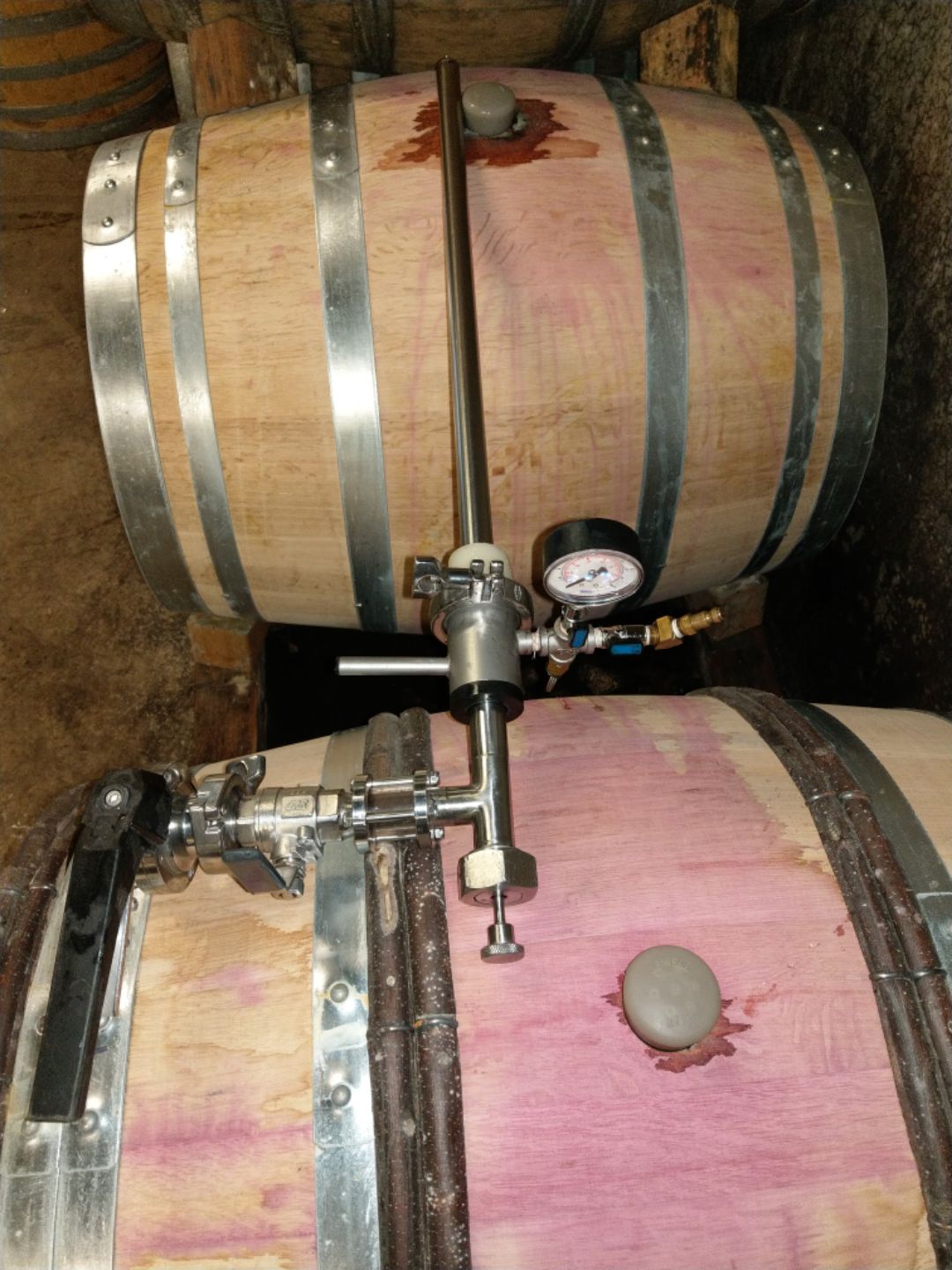
The barrel room at Amalie Robert Estate provides a similar challenge. There are about 200 barrels of wine each year, more or less depending on the vintage, that need to be blended and bottled. Our job is to find a blend for each barrel. How do we do that, you may be asking yourself. Gird your loins, for the answer is about to be revealed.


It all starts, as you are free to imagine, with the bung hole. The bung hole is typically stoppered with a 2 inch diameter, silicone bung. A little-known fact is that Peanut Butter is colloquially referred to as “Bung Solder” – from Old English. Of course, it doesn’t really fit with the whole PB&J TLA. BS&J anyone? NFW!


The next tool we employ is the wine thief, again from Old English. This is a somewhat slender, one inch diameter glass cylinder that is about 10-18 inches long. Some are curved, some have a bulbous end and some are straight, with a point. However, each are designed for one purpose and one purpose alone, to directly enter the bung hole and “thieve” the contents.


The CBO (Chief Bung Operator) removes the bung from the barrel in question, inserts the wine thief straight down allowing it to fill with wine, and then with the opposing thumb sealing the top end hole, extracts the wine from the barrel. Opposing thumbs are so useful, they keep the rest of the animal kingdom from thieving our wine. That and a security system.


The contents of the cylindrical glass thief are then deposited into a wine glass for a thorough evaluation. Another portion of said contents is reserved for the lab where we will perform analytical analysis to ascertain its chemical composition. All very technical and not unlike the lab report from your annual exam. Milligrams per liter and parts per million, oh my!


Sensory evaluation is what is performed with the contents in the glass. The color of the wine, for everyone captivated by such things, is noted to be particularly red in most cases. Vehemently red in the case of Syrah.

WTF (Waft The Fruit) is a TLA for deploying the olfactory senses to the contents of the glass. This is usually done after one volatizes the esters with a twist of the wrist that sets the wine in motion against the curvature of the glass releasing aroma compounds. That simple procedure will display the vibrant colors of the wine and simultaneously release the captivating bouquet. It’s a twofer at no additional cost, a concept missing from most insurance EOB’s (Explanation of Benefits).

WTF?! Sometimes that TLA means the contents of the glass must stand alone. The wine is just so compelling that it would be a severe injustice to blend the wine from this single barrel with any other wine from the cellar. We mark that barrel as The Reserve in the case of Pinot Noir, or Top Barrel in the case of our Syrah. It is at that point that the winegrower at Amalie Robert Estate is bestowed a special gesture of gratitude.

As we continue to probe each barrel’s bung and examine the contents, we discover that certain barrels appeal to us in different ways. Dena may become very excited about a specific barrel of wine and Ernie, while acknowledging his vinicultural prowess, may find the wine to be very good, but not as compelling. Rinse and repeat and the roles are reversed. This is how Dena chooses her barrels of wine for Amalie’s Cuvée and Ernie marks his territory for Estate Selection.

From the more than you really wanted to know section, we can tell you that each barrel has a purpose in the blend. Mind you that we like to keep our wine in barrel for around 18 to 20 months. Somewhat of a rarity in Oregon Pinot Noir.


Some barrels are first fills. The wine is absorbing the character of the barrel’s newly toasted oak. This can add a pretty aroma and a sense of richness in the wine’s texture, provided the wine itself is up to the task of supporting this concentration of oak aroma and flavor. The amount of oak influence you detect in a wine is often dependent upon the number of first fill barrels in the final blend. Unless you were born upside down*.

Wine from barrels that have been filled 2, 3 or even 4 times still have some oak influence. Their primary contribution to the blend is in the mid-palate and finish. Stem tannins are more present when not masked by first fill barrels and will contribute length and staying power in the blend. These barrels can provide the structure or “back-end” to our blends.

And lastly, we have the Deadwood barrels. These barrels are sourced from the town of Deadwood in the old west. They are coopered out of long ago dead trees and have been preserved for several years in damp cool cellars. The air channels in the staves have been plugged by several generations of indigenous yeast lees to prevent air from coming in contact with the wine as it ages. Deadwood barrels do not impart any new oak aroma or flavor. The outside of the barrel is colonized with a cornucopia of mycelia (aka cellar flora). You never want to touch a Deadwood barrel, and yet we are drawn to them.

The wine in a Deadwood barrel is truly something to behold. No interference from new oak aromas, flavors or textures. The Deadwood barrel bouquet is subtle, savory and sweet, calling forth enduring memories. You are harkened back to summertime and the horse drawn carriages up and down the dirt roads of Deadwood, where street cleaners had yet to be invented.

The palate is ethereal elegance – presence without weight as they say. The wine from Deadwood barrels is simply sublime. Deadwood barrels are used in the blend to soften rough edges and expand the core of richness in the mid-palate. They allow us to complete our blends without the use of modern chemical fining agents or old world additives such as fish bladders, egg whites or ox blood.

We use Deadwood barrels to help us blend for complexity without the use of modern, or medieval chemistry. They are truly the key to our house style.

* Do you ever notice that sometimes when you are tasting wine with a group of people, there is one person that never seems to get on board with the really great wines? Everyone is going off about the wonderful aromas, flavors and texture of the wine. The room is filled with evocative descriptors and high praise. And yet, this person is not engaged. Well, there is a simple explanation for all of this.

That person was born upside down. While a rare phenomenon, it does occur. And when it affects a wine drinker, the results are predictable and well documented. You see, for the person who is born upside down, they are the opposite of the rest of the population - their nose runs and their feet smell. When you come across this person in a wine tasting setting, or locker room, please, be kind.

Moving right along to the edge of the cellar, and what have we here? A single barrel, albeit a very big one, of Chardonnay. As big as that barrel is, it has the same size bung hole as all the other barrels. A deep probing of this barrel results in a sunburst yellow stream filling the glass. The BFC (Barrel Fermented Chardonnay) is a good thing. However, a little stainless steel fermented Chardonnay in the blend helps to rein in the fatness from a new French oak barrel that can arise in the azimuth of the wine. A fat azimuth is not what we are looking for in our BFC.


Now here is an easy one, a gimme. These four barrels, which look like they came over on the Mayflower but are actually from Deadwood, hold Pinot Meunier. The wine came out of a single fermenter from wine berries harvested from a single block. Block 1 for those of you who are tracking and posting such things on social media, or are being tracked and posted on social media without your knowledge or consent by one of an ever growing number of “apps”.


Our goal here is to verify the quality of each barrel. Often times with the Pinot Meunier it takes more than one session to ascertain the quality level in each barrel. This procedure is repeated until Ernie finally says, let’s get this in a tank and bottle it before it is all thieved away and there is nothing left to bottle!

At this point in the cellar discourse, you may be wondering when the ubiquitous quarter will appear. Well, truth be told, it landed on its side and rolled into the farmin’ drain before we could catch up to it. You can only imagine the contortions on Ernie’s face as his eyes tracked that coin and his mind raced back to the shame of losing his quarter during the CPA exam.

However, all is not lost. Excel has a random number generator function that can produce 1’s or 0’s. We know this because we see some of the reviews that come out of the Wine Spectator (not ours, of course). Actually, we just made all that up. We are pretty sure they have a quarter. Full Disclosure: We do not submit wine to the Wine Spectator.


Let’s leave the barrel room for a moment and visit the CGR (Case Goods Room). Here we find our Bellpine Pearl Rosé (Blanc de Noir) and Pinot in Pink Rosé. You may ask yourself how did these wines get here? Why are they bottled just a couple months after harvest? We ask ourselves the same question. Apparently here on planet Earth, the cognoscenti decree that these wines must be consumed within 6 months of harvest date. Horseradish! This is one of the wine world’s greatest disservices to the wine consumer. Great Rosé wines should really be given the opportunity to at least come out of bottle shock, if not allowed to develop somewhat, before they are foisted upon the unsuspecting wine consumer.


And while we are all about transparency, hence the clear glass bottles holding our Rosé’s, we do have another one of Ernie’s experiments to report on. That bucket perched on the lab table holds half of this years G’WZR harvest. Just about 5 gallons, or 2 cases of his latest love of labor. He thinks it is his best ever, pretty farmin’ good he will tell you. Come on by this spring and we will just see about that.

A successful failure is what happens when you do not succeed at your primary goal, however find yourself better off than when you started your endeavor. Put another way, experience is what you get when you don’t get what you want.

Well, 2017 gave Ernie a successful failure with his S. Rosie (Syrah Rosé). The good news is that the fermenter of Syrah was great, but the Rosé, well not so much. So he tried again this year deploying his prior year’s experience, and Voila! we have a S. Rosie from 2018. Just 7 bottles (minus 1), that Dena got to bottle by hand, but it is a damn righteous wine. After that bottling, Dena was bestowed a special gesture of gratitude by the winegrower at Amalie Robert Estate.

So, that is a little peek inside the bowels of the cellar at Amalie Robert Estate. They say every picture tells a story and certainly every barrel has a bung (hole). Look out for our upcoming Earth Day Open House E-mail and then come scope us out!


Kindest Regards,

Dena and the Winegrower at Amalie Robert Estate