Introduction

Winemaking: The Continuation of Terroir by Other Means.®

Welcome to the Amalie Robert Estate Farming Blog, aka FLOG. By subscribing, you will receive regular FLOGGINGS throughout the growing season. The FLOGGING will begin with the Spring Cellar Report in April. FLOGGINGS will continue each month and detail how the vintage is shaping up. You may also be FLOGGED directly after the big Cluster Pluck with the yearly Harvest After Action Report. Subscribe now and let the FLOGGINGS begin!

Rusty

"This is one of the Willamette Valley’s most distinguished wineries, but not one that is widely known."

- Rusty Gaffney, PinotFile - September 2016

Josh

"Dena Drews and Ernie Pink have been quietly producing some of Oregon's most elegant and perfumed Pinots since the 2004 vintage. Their 30-acre vineyard outside the town of Dallas, abutting the famed Freedom Hill vineyard where Drews and Pink live, is painstakingly farmed and yields are kept low so production of these wines is limited. Winemaking includes abundant use of whole clusters, which is no doubt responsible for the wines' exotic bouquets and sneaky structure…"

- Josh Raynolds, Vinous - October 2015

David

"...Dallas growers Dena Drews and Ernie Pink... showed me this July three of their reserve bottlings and thereby altered my perception of their endeavors. Since these are produced in only one- or two-barrel quantities, they offer an extreme instance of a phenomenon encountered at numerous Willamette addresses, whose really exciting releases are extremely limited. But they also testify, importantly, to what is possible; and what’s possible from this site in these hands revealed itself to be extraordinary!... And what a Syrah!"

- David Schildknecht, The Wine Advocate - October 2013

Wine & Spirits

"Finding that their whole-cluster tannins take some time to integrate, Pink and Drews hold their wines in barrel for up to 18 months - so Amalie Robert is just releasing its 2008s. And what a stellar group of wines: Bright and tart, they possess both transparency and substance, emphasizing notes of rosehips and sandalwood as much as red berries. The pinot noirs alone would likely have earned Amalie Robert a top 100 nod this year. But the winery also produces cool-climate syrah that rivals the best examples from the Sonoma Coast. And the 2009 Heirloom Cameo, their first attempt at a barrel-fermented chardonnay, turned out to be one of our favorite Oregon chardonnays of the year. Ten vintages in, Amalie Robert has hit its stride."

- Luke Sykora, Wine & Spirits Magazine – September 2011

Copyright

© 2005 – 2021 Amalie Robert Estate, LLC

Showing posts with label cellar report. Show all posts

Thursday, March 19, 2020

Amalie Robert Estate: Lip Sanitizer & 2020 Spring Cellar Report - Vegan Edition


Hello and Welcome, 
Before we get to the Spring Cellar Report - Vegan Edition, we have a Special FLOG Communication.  

As you are most certainly aware, the Coronavirus is rapidly spreading across the planet. Virtually all US and World health related agencies have issued safety precautions, travel warnings and, in some cases, quarantines to help contain the spread of the virus. These are important recommendations that should be followed. You can follow Johns Hopkins University tracking of the outbreak here.

The Pacific Northwest, and the Seattle area in particular, was one of the first areas in the United States to be exposed to the Coronavirus. As efforts to contain the spread of this virus have increased, many public events and gatherings have been cancelled. The downstream effects of these cancellations include a reduction in travel and tourism related economic activity. Specifically in the greater Seattle area, over 40 restaurants have closed, some permanently, in response to a lack of patrons.

Retailers are feeling the effects as well. If your local merchant is running “out of stock” on hand sanitizer or bath tissue, may we suggest looking to online sellers such as eBay. Not that we recommend that you should support these sellers, but it is interesting to see private label brands being re-sold this way. And maybe that is why your local merchant is running “out of stock”.

If you are looking for even more protections, may we suggest augmenting your facial mask protocol with a lip sanitizer. Lips are important and form a quite necessary aperture for the enjoyment of wine. To exclude lips from the first line of defense seems to leave open a pathway to potential infection. To help provide a first line of protection for your lips we suggest Pinot in Pink Rosé as a home remedy lip sanitizer. Note: The effectiveness of Pinot in Pink Rosé as a home remedy lip sanitizer has not been proven, studied or even contemplated.

We would also like to remind you that everyone gets a free cork included in each bottle. Our corks are firebranded (no ink) and are made from natural tree bark, as are most premium closures in use for fine wines today. They are also considered to be an approved vegan closure. We compress our corks to about 50% of their relaxed diameter and then insert them into our bottles. The cork will naturally expand to fill the neck of the bottle and seal the contents inside from virtually all outside contamination. While natural corks are not a substitute item for bath tissue, they may perform a necessary and vital function during an “out of stock” condition.

The winery at Amalie Robert Estate is closed to visitation for the duration of March. Even though we believe we are virus free, the challenge is for you to get here and return home safely via plane, train or automobile.


Please join us for the 2020 Spring Cellar Report – Vegan Edition.

~~~~~~~~~~~~~~~~~~~~~~~~~~~~~~~~~~~~~~~~~~~~~~~~~

2020 Spring Cellar Report – Vegan Edition

Hello and Welcome,

This is the 2020 Spring Cellar Report – Vegan Edition from @AmalieRobert. A FLOG Communication.

After a brief respite and a well-deserved nap, we are back in the cellar. The primary fermentations are complete, and the Malo-lactic conversions are in suspended animation. Too damn cold for the Malo-lactic bacteria to convert malic acid to lactic acid. But not to worry, when the cellar warms up the bacteria will complete their conversion and blow the barrel bungs. Then it is time to melt some sand and harvest some tree bark, it’s bottling season.

Meanwhile, we would like to guide you through the mystery of converting a vegan agricultural crop (wine berries) into an otherworldly adult recreational beverage (wine). Please be aware that what you are about to read and see may upset your cognitive processes and dislodge some preconceived notions about how we get from wine berries to wine. And the images will be graphic, especially the graphs. Like this one:


The “Jet” also known as the “Jet Stream” or more colloquially as the “Trade Winds” have a Yuge impact on the final days of the be-dangled wine berry, and consequently the resulting wine. In the above graphic, we see a trove of cold air coming to arrest the sugar development of any yet to be harvested wine berries, thus providing for lower alcohol potential and retention of scintillating acidity. Aroma, flavor and texture, however, continue to develop unabated, albeit somewhat more slowly. The harvest lesson to be learned is that if the Jet Stream is below you, prepare for a little arctic influence in your ripening curve.


This concept is known as hangtime and has been missing from the Willamette Valley for the past few vintages. As you will notice from about the 6th of September and throughout the end of the month, below average daytime temperatures keep sugars in check. Then toward the end of the month, the evening temperatures drop, helping to preserve our natural acidity.

Or, as Ernie would tell you, this is when the vintage took a turn for the best. We experienced slow and steady aroma, flavor and texture development without having to worry about excessive sugar accumulation and the resulting high alcohol potential.


What a welcome relief from the days of the Jet Stream to our north filling the Willamette Valley with all the misbegotten heat from the Central Valley. Note: Heat expands to fill the space available.

We think of a vineyard construct in terms of acreage cut into blocks comprised of rows of vines constrained by a trellis. All very well and good and serves our purpose of growing wine. But for today’s FLOG let’s just think of a vineyard as a big East Coast city. One that has been around awhile, maybe a century or so, harkening us back to the 20’s. Man what a time to be alive, Speakeasies and Alphonse Capone were alive and well. The unintended consequences of Prohibition were to be seen all around, including your prescription for medicinal wine.

Like most big cities, our vinous city has neighborhoods and boroughs. Boroughs because we also have gophers that burrow under the walkways and roads, always trying to undermine our good faith efforts by eating the roots off of our vines. Occasionally, we have the opportunity to confront these rival gangs and dispatch them forthwith. And yes, Ernie has a “grease gun” but not the kind you may be thinking about.

Welcome to the neighborhood. In our city there are several neighborhoods mostly defined by where they are located. Pockets of vines that face east or south, or southwest. We also have the east side, as any representative city would have. Some of these neighborhoods are very diverse, home to Pinot Noir and Pinot Meunier, or Pinot Noir and Chardonnay. Others are more isolated, such as the Gewurztraminer grafted onto the old rootstock block. And then there is the Syrah and Viognier quarter. They are transplants from Northern Rhônia. They keep to themselves and are rarely seen in other parts of our vinous city.


A year in the life. As these neighborhoods have matured, they have started to gift the city a bountiful harvest. Not of tax dollars or intellectual ingenuity, but of wine berries. Each neighborhood provides a unique contribution depending on their geographic location and indigenous population. Let’s have a look at one family in particular.

Introducing Gluc and Fruct Ose. Gluc and Fruct are closely related by genetics. Each wine berry that is harvested has a similar Ose family. The acid family is well represented within the wine berry collective by Tartaric and Malic. (Note, these families were gender neutral way before it was nouveau.) And then there are the Saccharomyces cerevisiae (aka Yeast). Growing up alongside the wine berry, but never welcomed inside the outer membrane. These are the main actors in our neighborhood. Then there is Cousin Como T. Ose, more on that one later on.


In a genetic experiment that went horribly wrong, High Fruct Ose corn syrup was invented. Much like GMO crops and their associated pollen, once released into our environment they are hard to control. Legalization of previously restricted compounds, processes and procedures can have unintended consequences. Fortunately, these products do have ingredient labels.

And some products do not have warning labels but should. Consider the vegan wine dilemma. Their thing is they would like to not consume animals, parts thereof or anything with animal residue. Fair enough, but why does this have anything to do with wine berries, Gluc and Fruct, or Saccharomyces cerevisiae? In our city it doesn’t, but every city has its underworld. More on that to follow, ya follah?

Right, so on harvest day Ernie rolls up with the tractors and harvest bins and we collect the bounty from each neighborhood. We try and get there before the other unregulated factions do, but those birds and deer are fairly cunning in their approach. Nonetheless, there is plenty for everyone.


All of the wine berries are sorted in case they have been turned against us by mildew or Botrytis. Those compromised wine berries are sent to compost collectives where they will be repurposed to nourish the land and positively contribute to a future vintage. Everyone must do their part, to do the best at what is expected from them.

As the sorting and processing function occurs, the wine berry families are deposited in sanitized 3,000 pound containers (fermenters) along with several of their neighbors. A small amount of sulfur dioxide is incorporated to keep any nefarious actors from corrupting the group. Slowly but surely the wine berries start to release Gluc and Fruct out of their wine berry skins and across the membrane. The Acid clan Malic and Tartaric go with them to provide some microbial protection, and that is when they meet Saccharomyces cerevisiae for the first time.

Gluc is the more gregarious of the Ose family and is first to undergo the transition to Ethanol with the help of Saccharomyces cerevisiae. This is a big day for the Ose family as they will become part of a new adult recreational beverage called wine. Sometimes a few grams per liter of the Fruct remain in the final product and accept the moniker of Residual Sugar, but for the most part in our city all of the Ose family will convert to Ethanol and become wine. The process can take up to 4 weeks, as we do not introduce any foreign Saccharomyces cerevisiae. We want the yeast that grows in our neighborhoods to transition the Ose family to Ethanol. Gotta support the home team.

Now the Acid clan takes a different path to wine. Tartaric and Malic will not be swayed by the charms or coercion of Saccharomyces cerevisiae. In fact, Tartaric does not transition at all, but moves from the wine berry family to the Ethanol based wine unchanged. Malic has less of a constitution than Tartaric and falls victim to the sweet and sultry calls of Malo-lactic bacteria.

Once the Ose family has been converted to Ethanol, the Malo-lactic bacteria start to convert Malic to Lactic acid. It is a gentle conversion and only occurs when the cellar temperature is around 60 degrees Fahrenheit. While the Malic acid is wholly consumed in this process, the resulting Lactic acid is a softer acid and more approachable in the wine. Consider that as humans develop, we lose our primary teeth to more permanent teeth. Or you could consider this process more of a pubescent experience. Wine being an adult recreational beverage, this may be a more apt analogy.

Except for Chardonnay. Sometimes Chardonnay likes to hold onto its Malic acid. Linus has his blanket, and that works for him. And despite our best cellar efforts to induce Malic to become Lactic, it’s just not going to happen. And so, from time to time our Chardonnay will have Malic present. Some kids refuse to grow up and they retain a little wild streak. So be it.

Experience is what you get when you don’t get what you want. Let’s focus in on our flamboyant friend Saccharomyces cerevisiae. Yes, quite a character to be sure, but like everyone else there are limits. Gluc and Fruct are willing participants in the transition to Ethanol, but only to a point. Once the Ethanol level reaches 15.6% our friend Saccharomyces cerevisiae dies. Everyone feels bad, especially the person who has to sell the resulting (sweet) wine. There is no further conversion to Ethanol and it is usually Fruct left on the outside looking in at the Ethanol party.

How can this be, you may ask. Well, in these past few West Coast vintages there has been some serious heat units resulting in an over concentration of Gluc and Fruct. When Saccharomyces cerevisiae hits the scene, there is a limit to the Ethanol conversion. This is the result of external forces interacting with our neighborhood. The dastardly villain Climate Change has been here!

And yes, we have made a Fruct filled wine. Actually, a pretty good one too. Viognier, that masochistic wine berry provided an opportunity in 2015. Ernie picks on flavor and that is how the way it is. No flavor, no harvest. And so, the Viognier was not giving it up in 2015. Ernie walked away and pressed his Pinot Noir to barrel, ignoring the Viognier.

Eventually the aroma, flavor and texture did come around and it was as beautiful a juice as we had ever seen, but at a cost. The Gluc and Fruct were so concentrated that they conquered Saccharomyces cerevisiae. But not until the Ethanol had reached a concentration of 15.6%. That is the outer limit for Saccharomyces cerevisiae and it was death by Ethanol poisoning. They went off to meet cousin Como T. Ose.

But the wine was something very special. All of the Viognier goodness you could handle. It was 5 by 5! Aromas, flavors, and textures permeated the frontal lobe, not to mention a few compromised sensory membranes along the way. And yes, Fruct was there to experience it all. It was a marvelous wine darling, just marvelous.

And that is a teachable moment. Do not let your neighborhood get out of control, especially those Pinots. Gluc and Fruct are necessary, but there is such a thing as too much of a good thing.

Maturation and the path to bottling or, in the brave new world we find ourselves in, getting canned. The final step of winemaking is packaging the said wine for distribution and sale. And this is where the vegan lifestyle meets the winemaking world head-on.

The vegan wine conundrum is really hard to conceptualize. Wine berries being naturally fermented with the yeast they rode in on, into an alcoholic beverage seems to be as vegan as you can get. How did wine come to be so controversial in the vegan home world?

At a wine dinner recently, Ernie was confronted with this question: “I bought a box of Chardonnay the other day, and it said, “May contain fish parts. What the Hell is that all about?” This question, while not specifically vegan, brings the issue front and center.

First of all, if we want to drink wine or any other fermented beverage, like beer, or enjoy certain fermented foods such as soy sauce or kimchi, we have to accept yeast as vegan. Until Star Trek becomes real and we have Synthehol, we need yeast to make fermented beverages. And typically, the yeast among us are quite happy, if not pre-programmed to perform this service for mankind.


We consider grapes to be vegan. If you walk through any of our neighborhoods at harvest time, from Chardonnay to Viognier, and eat wine berries, they are as vegan as the day is long. If you put a few pounds of wine berries in a bucket and they begin to ferment with wild yeast that are already on the grape skins, then that has to be vegan as well. The resulting wine that is produced? Gotta be considered vegan, and a natural wine as well.

The additives (fining agents) are the issue – egg whites, fish bladders, ox blood, horse hooves etc. Sometimes, these fining agents are added to improve the sensory experience of the wine, be it aroma, flavor or texture. And that process of adding fining agents is as old as wine itself.

Fining agents are mostly old world remedies that resolved issues from old world methods and techniques. As the human population has gained greater knowledge, we have in many cases moved from old word techniques and associated remedies to new world processes that require less intervention. The relatively recent discontinuation of leaches in the medical field is a case in point.

Wine is a luxury good and should offer a pleasurable experience. An adult recreational beverage to be enjoyed with a meal and friends, or with a trusted companion by the fire as the case may be. In the case of Champagne, when you are in love, or equally so, when you are not.

But for goodness sake, let’s leave the chemistry experiment to the energy drinks business, or the upcoming cannabis industry, or some other product where we expect manipulation.

But there is one old world fining agent we use that has stood the test of time and that is Bentonite clay. Bentonite is a (common) clay used for clarification and it is vegan. We use Bentonite to clarify our white and rosé wines, so they are considered vegan. Our reds fall clear in barrel and we add no fining agents whatsoever, so they are also vegan.

So at this point of the program, we have vegan wine to put into a container for distribution and sale. Fortunately, no one uses goat skins anymore - especially fortunate for the goats. Metallic closures such as cans and kegs contain no animal residue, so they are vegan. Glass, which is melted sand is also vegan, so far so good.

That brings us to the stopper that goes into the bottle. Traditional corks and the new glass stoppers with silicone O rings are vegan. We use natural cork for all of @AmalieRobert wines, so our entire portfolio of wines are vegan. The technical closures are next.


Technical closures are made from all manner of things. One in particular could be of issue with vegan wine and that is a closure made of cork bits and bound with some form of glue. As everyone knows glue can and has been made from several binding agents. One such binder could be honey, or milk based. And then there is our school days friend Elmer’s glue which was made from equestrian components.

While many wines could be considered vegan, the packaging could eliminate the vegan status by using a closure that contains animal parts or residue thereof. @AmalieRobert we use natural cork, for all of our wines and that is always a safe choice. Good to go!

So as you read this, admiring your natural @AmalieRobert (vegan) cork wine stopper, you can rest assured that in vintage 2019 Gluc and Fruct have left the building. Malic has been smitten and is becoming Lactic. The neighborhoods are all getting pruned back, in order to deliver a spectacular bounty for vintage 2020. In case you missed the first go around, enjoy the “Roaring 20’s”.

Kindest Regards,

Dena & Ernie

Free (vegan) natural cork in every (melted sand) glass bottle.

Sunday, April 14, 2019

Amalie Robert Estate: 2019 Spring Cellar Report


Hello and Welcome, 
  
This is the 2019 Spring Cellar Report from Amalie Robert Estate. A FLOG Communication


It’s pruning time in Oregon wine country and let’s all pay our respects to the field hands that are actually doing the work. It is a cold, rainy, windy, flat out miserable time of year for field work. But a necessary function in the lifecycle of the vine. It is a New Year’s resolution we must keep as winegrowers. But soon enough it will be done, and new growth will emerge signaling the start of our 19th growing season. Of course, your New Year’s resolutions may last longer than our winter pruning, but history and the human condition would not be on your side.


We would also like to open this Spring Cellar Report with a “Thank You” to everyone we have had the pleasure to FLOG this past year. Some of you have enjoyed it more than others and some of you more than you should. So, it should come as no surprise that Ernie has taken stock of all of your feedback and channeled that energy into his new book. You have no one to blame but yourselves.

My First Colonoscopy is a tender, probing, coming of age exposé of a young man relinquishing control to the invasive medical field for the first time. Set inside the healthcare labyrinth of today’s current state of affairs, Ernie relates his journey in excruciating detail from the posterior, first person point of view. As you might expect from Ernie, the appendices include a full and complete compendium of the Supreme Court oral arguments of each healthcare lawsuit adjudicated to date. Until a publisher is found, this will remain an “E-book”. E-book for Ernie, get it?

Right. While we do not have the traditional numbers of a growing season FLOG communication, we do have a single number to share. Standing alone, and unafraid is the number 94. Well actually there are three of them, but each presented individually.


“Amalie Robert, whose vineyard is in the western part of the Willamette Valley, makes a very strong case for Syrah, but production of their two graceful wines is painfully small, as in just a few barrels of wine per vintage.”                           - Josh Raynolds, Vinous, February 2018

And this is the segue we were looking for to cover the main topic of this Spring Cellar Report FLOG. Going it alone or blending for complexity – how to decide? When Ernie took the CPA* exam at the University of Montana, seemingly a lifetime ago, it was a 3 day exam. East Coast and West Coast all started at the same physical time, so no one could call to the other coast and reveal the mental horrors that await. Back in the day, the University of Montana did not offer PTSD counseling. But there was the Foresters Ball.

* CPA is a TLA that means Certified Public Accountant, which allows you to guide others out upon the great accountant-sea. FYI - TLA means Three Letter Acronym. Now you know.

The 3 day CPA exam was comprised of the standard multiple choice questions, compare and contrast scenarios, explain this (if you can) in the limited space provided and the ubiquitous true or false. Ah, the binary choice of yes or no, go or no go. Ernie knew of these things as he had already earned a degree in the Byzantine new world of Computer Science. He had been a bit-twiddler for 4 years. They were 1’s and 0’s in the newfangled computer world but still, a binary choice would apply to the second oldest profession. Derivatives be damned!


While we make no secret that the 5 gallon bucket may in fact be the most useful piece of winery equipment we own (just don’t bucket-up), the unadorned quarter is the tool of choice for conquering the true false scenario. The quarter is ideally designed to help you cope with this challenge. It is unambiguous, it leaves no doubt in the course of action to take. Heads it’s true and tails it’s false. Next question, proctor.

These matters are usually handled in a very discreet manner. Typically, the quarter is flipped in such a way that it lands on the back of one’s hand, quietly revealing the correct answer to the flipper. However, at 8:00 am on the third morning after a hard day’s night, the physical dexterity of the college student can falter. It is at this moment you discover, along with the entire population of the exam room, that the hardwood floor, while it is there for you, is not your friend.

Now it is theoretically possible that the quarter may land on its edge and quietly roll away before turning on its side to reveal the correct answer, but that is simply a mathematical construct. Much the same way that the square root of negative 4 includes an imaginary number – how convenient for mathematicians. In other words, it never happens in the real world and certainly not when you would desperately need it to. The proctors usually recover enough quarters over the 3 days to keep them each heavily caffeinated for a week or so.

The barrel room at Amalie Robert Estate provides a similar challenge. There are about 200 barrels of wine each year, more or less depending on the vintage, that need to be blended and bottled. Our job is to find a blend for each barrel. How do we do that, you may be asking yourself. Gird your loins, for the answer is about to be revealed.


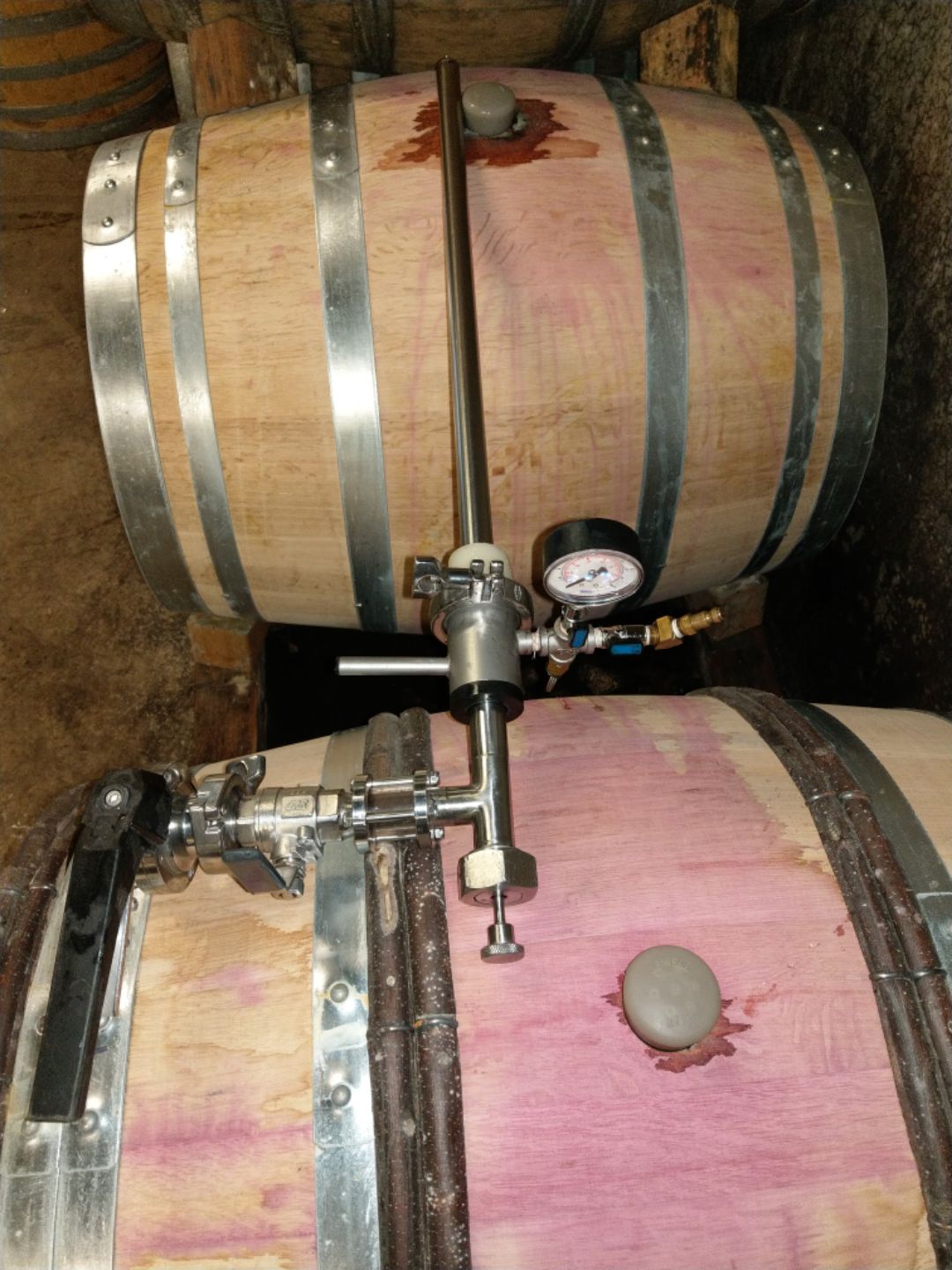
It all starts, as you are free to imagine, with the bung hole. The bung hole is typically stoppered with a 2 inch diameter, silicone bung. A little-known fact is that Peanut Butter is colloquially referred to as “Bung Solder” – from Old English. Of course, it doesn’t really fit with the whole PB&J TLA. BS&J anyone? NFW!


The next tool we employ is the wine thief, again from Old English. This is a somewhat slender, one inch diameter glass cylinder that is about 10-18 inches long. Some are curved, some have a bulbous end and some are straight, with a point. However, each are designed for one purpose and one purpose alone, to directly enter the bung hole and “thieve” the contents.


The CBO (Chief Bung Operator) removes the bung from the barrel in question, inserts the wine thief straight down allowing it to fill with wine, and then with the opposing thumb sealing the top end hole, extracts the wine from the barrel. Opposing thumbs are so useful, they keep the rest of the animal kingdom from thieving our wine. That and a security system.


The contents of the cylindrical glass thief are then deposited into a wine glass for a thorough evaluation. Another portion of said contents is reserved for the lab where we will perform analytical analysis to ascertain its chemical composition. All very technical and not unlike the lab report from your annual exam. Milligrams per liter and parts per million, oh my!


Sensory evaluation is what is performed with the contents in the glass. The color of the wine, for everyone captivated by such things, is noted to be particularly red in most cases. Vehemently red in the case of Syrah.

WTF (Waft The Fruit) is a TLA for deploying the olfactory senses to the contents of the glass. This is usually done after one volatizes the esters with a twist of the wrist that sets the wine in motion against the curvature of the glass releasing aroma compounds. That simple procedure will display the vibrant colors of the wine and simultaneously release the captivating bouquet. It’s a twofer at no additional cost, a concept missing from most insurance EOB’s (Explanation of Benefits).

WTF?! Sometimes that TLA means the contents of the glass must stand alone. The wine is just so compelling that it would be a severe injustice to blend the wine from this single barrel with any other wine from the cellar. We mark that barrel as The Reserve in the case of Pinot Noir, or Top Barrel in the case of our Syrah. It is at that point that the winegrower at Amalie Robert Estate is bestowed a special gesture of gratitude.

As we continue to probe each barrel’s bung and examine the contents, we discover that certain barrels appeal to us in different ways. Dena may become very excited about a specific barrel of wine and Ernie, while acknowledging his vinicultural prowess, may find the wine to be very good, but not as compelling. Rinse and repeat and the roles are reversed. This is how Dena chooses her barrels of wine for Amalie’s Cuvée and Ernie marks his territory for Estate Selection.

From the more than you really wanted to know section, we can tell you that each barrel has a purpose in the blend. Mind you that we like to keep our wine in barrel for around 18 to 20 months. Somewhat of a rarity in Oregon Pinot Noir.


Some barrels are first fills. The wine is absorbing the character of the barrel’s newly toasted oak. This can add a pretty aroma and a sense of richness in the wine’s texture, provided the wine itself is up to the task of supporting this concentration of oak aroma and flavor. The amount of oak influence you detect in a wine is often dependent upon the number of first fill barrels in the final blend. Unless you were born upside down*.

Wine from barrels that have been filled 2, 3 or even 4 times still have some oak influence. Their primary contribution to the blend is in the mid-palate and finish. Stem tannins are more present when not masked by first fill barrels and will contribute length and staying power in the blend. These barrels can provide the structure or “back-end” to our blends.

And lastly, we have the Deadwood barrels. These barrels are sourced from the town of Deadwood in the old west. They are coopered out of long ago dead trees and have been preserved for several years in damp cool cellars. The air channels in the staves have been plugged by several generations of indigenous yeast lees to prevent air from coming in contact with the wine as it ages. Deadwood barrels do not impart any new oak aroma or flavor. The outside of the barrel is colonized with a cornucopia of mycelia (aka cellar flora). You never want to touch a Deadwood barrel, and yet we are drawn to them.

The wine in a Deadwood barrel is truly something to behold. No interference from new oak aromas, flavors or textures. The Deadwood barrel bouquet is subtle, savory and sweet, calling forth enduring memories. You are harkened back to summertime and the horse drawn carriages up and down the dirt roads of Deadwood, where street cleaners had yet to be invented.

The palate is ethereal elegance – presence without weight as they say. The wine from Deadwood barrels is simply sublime. Deadwood barrels are used in the blend to soften rough edges and expand the core of richness in the mid-palate. They allow us to complete our blends without the use of modern chemical fining agents or old world additives such as fish bladders, egg whites or ox blood.

We use Deadwood barrels to help us blend for complexity without the use of modern, or medieval chemistry. They are truly the key to our house style.

* Do you ever notice that sometimes when you are tasting wine with a group of people, there is one person that never seems to get on board with the really great wines? Everyone is going off about the wonderful aromas, flavors and texture of the wine. The room is filled with evocative descriptors and high praise. And yet, this person is not engaged. Well, there is a simple explanation for all of this.

That person was born upside down. While a rare phenomenon, it does occur. And when it affects a wine drinker, the results are predictable and well documented. You see, for the person who is born upside down, they are the opposite of the rest of the population - their nose runs and their feet smell. When you come across this person in a wine tasting setting, or locker room, please, be kind.

Moving right along to the edge of the cellar, and what have we here? A single barrel, albeit a very big one, of Chardonnay. As big as that barrel is, it has the same size bung hole as all the other barrels. A deep probing of this barrel results in a sunburst yellow stream filling the glass. The BFC (Barrel Fermented Chardonnay) is a good thing. However, a little stainless steel fermented Chardonnay in the blend helps to rein in the fatness from a new French oak barrel that can arise in the azimuth of the wine. A fat azimuth is not what we are looking for in our BFC.


Now here is an easy one, a gimme. These four barrels, which look like they came over on the Mayflower but are actually from Deadwood, hold Pinot Meunier. The wine came out of a single fermenter from wine berries harvested from a single block. Block 1 for those of you who are tracking and posting such things on social media, or are being tracked and posted on social media without your knowledge or consent by one of an ever growing number of “apps”.


Our goal here is to verify the quality of each barrel. Often times with the Pinot Meunier it takes more than one session to ascertain the quality level in each barrel. This procedure is repeated until Ernie finally says, let’s get this in a tank and bottle it before it is all thieved away and there is nothing left to bottle!

At this point in the cellar discourse, you may be wondering when the ubiquitous quarter will appear. Well, truth be told, it landed on its side and rolled into the farmin’ drain before we could catch up to it. You can only imagine the contortions on Ernie’s face as his eyes tracked that coin and his mind raced back to the shame of losing his quarter during the CPA exam.

However, all is not lost. Excel has a random number generator function that can produce 1’s or 0’s. We know this because we see some of the reviews that come out of the Wine Spectator (not ours, of course). Actually, we just made all that up. We are pretty sure they have a quarter. Full Disclosure: We do not submit wine to the Wine Spectator.


Let’s leave the barrel room for a moment and visit the CGR (Case Goods Room). Here we find our Bellpine Pearl Rosé (Blanc de Noir) and Pinot in Pink Rosé. You may ask yourself how did these wines get here? Why are they bottled just a couple months after harvest? We ask ourselves the same question. Apparently here on planet Earth, the cognoscenti decree that these wines must be consumed within 6 months of harvest date. Horseradish! This is one of the wine world’s greatest disservices to the wine consumer. Great Rosé wines should really be given the opportunity to at least come out of bottle shock, if not allowed to develop somewhat, before they are foisted upon the unsuspecting wine consumer.


And while we are all about transparency, hence the clear glass bottles holding our Rosé’s, we do have another one of Ernie’s experiments to report on. That bucket perched on the lab table holds half of this years G’WZR harvest. Just about 5 gallons, or 2 cases of his latest love of labor. He thinks it is his best ever, pretty farmin’ good he will tell you. Come on by this spring and we will just see about that.

A successful failure is what happens when you do not succeed at your primary goal, however find yourself better off than when you started your endeavor. Put another way, experience is what you get when you don’t get what you want.

Well, 2017 gave Ernie a successful failure with his S. Rosie (Syrah Rosé). The good news is that the fermenter of Syrah was great, but the Rosé, well not so much. So he tried again this year deploying his prior year’s experience, and Voila! we have a S. Rosie from 2018. Just 7 bottles (minus 1), that Dena got to bottle by hand, but it is a damn righteous wine. After that bottling, Dena was bestowed a special gesture of gratitude by the winegrower at Amalie Robert Estate.

So, that is a little peek inside the bowels of the cellar at Amalie Robert Estate. They say every picture tells a story and certainly every barrel has a bung (hole). Look out for our upcoming Earth Day Open House E-mail and then come scope us out!


Kindest Regards,

Dena and the Winegrower at Amalie Robert Estate


Friday, March 16, 2018

Amalie Robert Estate: 2018 Spring Cellar Report


Hello and Welcome,

This is the 2018 Spring Cellar Report from Amalie Robert Estate. A FLOG communication.


There are all sorts of clichés, but in the wine industry we are always looking for our niche. In fact, a niche cliché is what we are looking for today.

At the end of harvesting 100 tons of wine berries over the course of 7 weeks, we were “As delighted as the dog that actually caught the car.” And since we farm on hillsides, we would remind everyone that “..it doesn’t run uphill.” But after turning 100 tons of wine berries into about 16,500 gallons of wine, we are leaning-in “Like trying to get a drink out of a fire hose.”


But now that Spring is beginning to emerge, we are onto the next big thing – Blending for Complexity.

We turn back a vintage and begin our quest for the Hers and His reserves. You see we “barrel over”. That is in fact different from “being over a barrel” which seems to be a Hollywood thing.

To “barrel over” means to hold your wine in barrel over the next vintage. At Amalie Robert Estate our Pinot Noir and Syrah are in barrel while the next vintage is coming into the winery. At the end of the day, we are looking to have our Pinot Noir in barrel for around 18 months and our Syrah for closer to 26 months. And yes that requires us to have twice as many barrels, and a place to age them, than wineries that empty their barrels after 11 months so they can refill them with the next vintage.


And there is more than one way around the barn, or through the cellar. There is always a fast way, a wrong way, and the Ernie way. Other than increasing costs, the Ernie way has the added benefit of extended barrel maturation. This allows our whole cluster tannin to soften naturally over time. There is no need to add fining agents that modify the aroma, flavor, taste or texture of our wines. You are getting the real deal from Amalie Robert - time in a bottle. Or think if it as a message in a bottle.
The other way to do it is to add something that will soften the whole cluster astringency and advance the wine’s maturity window. Historically, egg whites and ox blood were used. This continued until winemakers realized that chicken eggs were a lot more economical than other additives. However, fish bladders are still in use for white wines to this day. Hey Google, “What is isinglass?”

By the time we get to blending, our Amalie’s Cuvée (Hers) and Estate Selection (His) Pinot Noir wines have been in the same barrel they were filled into for about a year. No racking from barrel to barrel allowed. The yeast lees that came down from the press with the wine are now settled in the bottom of the barrel. And since our barrels are on their side, the bottom of the barrel is called the bilge. Directly opposite the bilge is the bung. This is how you know the barrel is in the correct wine maturation position.


Our job is to select about 20 or so barrels of wine that contain our favorite wine from the vintage. Since we harvest, ferment and then fill barrels from each of our 42 blocks separately, we have the ability to taste the wines grown from each and every one of our vineyard blocks. This allows us the ultimate flexibility in creating our Hers and His reserve blends. But be careful what you ask for, as that adds up to about 200 and some barrels per year. You can’t boil the ocean.

What we can do is critically evaluate about 10 barrels of wine per session. This is usually an afternoon thing. And we seem to be predisposed to Friday afternoons. It’s just our thing. Oh sure, we can taste wine from more than 10 barrels in an afternoon – no problem there! However, the problem comes the next day when you are trying to decipher the notes of barrel number 16 - what language is that? That is why 10 is the magic number, at 4 pm, on a Friday afternoon.

Some people will take a more technical approach and begin evaluations in the late morning or early afternoon. And that is all well and good. But we blend our wines with an eye toward enjoying them with a meal and with friends. We start to get a little wine craving in the afternoon and feel this is the better time for us to critically evaluate wines. Of course, your mileage may vary.

Once we make the first pass through the cellar, we can usually get our favorites list down to about 20 or so barrels and that is a good place to start. The magic number for the Hers and His Reserves is 12 barrels each, about 300 cases worth. Logistically, this is three of our blending tanks, so even though the 13 barrel blend is good, there is nowhere to put it.

Now comes the hard part, finding which of those 20 barrels of wine are going to make the final cut to get us down to 12. There are plenty of algorithms to use to sort them. From our Computer Science days, we could use a bubble sort, a merge sort or a quick sort. Or we could actually taste them and rank the aroma, flavor, texture and finish. Hopefully this illustrates one of the reasons we left the hi-tech world for wine.

Once all of our barrel samples are ranked on their criteria, we begin blending a few samples together. The joy is when the barrels combine to build enhanced aroma, flavor, texture and finish. We can adjust the blend naturally by including a sample that is more high toned, or contributes more structure. If the finish is too astringent, we can swap out a barrel for something softer. We call this blending for complexity. It does take discipline, attention to detail and several iterations. Another benefit of our approach, is that we do not have to add aforementioned fining agents to modify our wines. We just look to swap a barrel that helps to temper the blend.

And that is how we get from 20 individually stunning barrels of wine, to a blend of 12 that combine into a wine that is as sublime as the day is long. Of course, Dena has veto power. If the blend doesn’t feel just right, then it’s back to the blending bench. Often times this is in the kitchen, which is handy when we are evaluating the blend for its culinary suitability.


And let’s spend a minute on the Farmer barrel. As each vineyard block is harvested, fermented and sent to barrel separately, we can get a read on how Ernie managed the vineyard. And that is where the Farmer barrel comes into focus. We are not giving away any trade secrets here by telling you that each fermenter fills about 4 barrels. The first barrel is brand new each year. The next two barrels have been filled two or three times. And then there is the fourth barrel, the Farmer barrel.

The Farmer barrel is always dead neutral. That means that if it did not come over to the New World on the Mayflower, then it has been filled (and by definition emptied) several times. The result is that there is no oak influence left in the barrel. This barrel, the Farmer barrel, is where we can evaluate how the fruit from the vineyard is showing without any oak influence whatsoever.

This feedback is quite useful to the Ernie who farms our field. He can dial in his vineyard management program of leaf pull, cover crops, hedging, vineyard floor management, thinning and harvest strategy to modify the aroma, flavor, texture and finish of our wines.

Spoiler Alert: All of those aroma, flavor, texture and finish characteristics in the finished wine are a natural evolution from not only the terroir, but also the human factor of what was or was not done as a response to the vintage. And all of our vineyard management techniques and viticultural practices are site specific to Amalie Robert Estate as we farm our own field, and no one else’s. Good to know.

The feedback loop is YUUGE when it comes to our stainless steel fermented whites such as Her Silhouette Chardonnay and Our Muse Viognier. Stainless steel fermented white wines are the most transparent exemplars of terroir you will find. And the GWZ’R Gewürztraminer is coming, so please be patient. It takes a while to build up to critical mass with just 24 vines.

The making of iPinot. So, after the Hers and His, we have a few barrels that are quite pleasurable, but “didn’t make the team” Hers or His. What to do? Ah yes, these reserve level barrels, when blended among themselves make quite a compelling wine from the vintage.

iPinot and the three halves of Pinot Noir. People will tell you there are only two halves to Pinot Noir. It doesn’t have to be that way. Let us explain. The first half of Pinot Noir is the brilliantly elegant color refracting with a simple twist of the wrist releasing a heady bouquet – Very nice indeed.

The second half of Pinot Noir is when it colonizes your palate. Lively, delineated, lithe and tart, supple and sweet - all the things that stunning Pinot Noirs are made from. And then comes the third half of Pinot Noir – the scintillating and enduring finish of refined whole cluster stem tannin.

Fermenting with whole clusters extracts a little tannin from the stems. If you want to experience this for yourself, purchase some table grapes, remove the fruit and chew on the stems. Do it in front of the mirror for the full effect. Wowza!

However, over time, oxygen makes its way to the wine and gently softens this astringency into refined tannins. These refined tannins manifest themselves as a silky mouthfeel contributing length and a more than just subtle grip to the finish. That is the third half of Pinot Noir.

For all of you analytical types out there, try this exercise. Everyone knows that 50 is half of 100. And most people will tell you there are only two halves to a whole. But are there not three 50's in 100? Sure there are: 0 – 50 is a 50; 25 – 75 is a 50; and then there is 50 – 100, the third half! That makes three halves to a whole. Who’s got change for a $100?

iPinot is sold direct from the winery. If some day Apple is looking to acquire a winery, well let’s just say we trademarked iPinot with an eye toward the future.

Now it would not be a FLOG communication from Amalie Robert Estate if we didn’t do the numbers. Let’s see here, how about 94? That’s as good a number as any. It also just happens to be the review Ernie’s 2012 Top Barrel Syrah earned from Vinous in early February 2018. Not only is this the highest score ever for an estate grown Willamette Valley Syrah, it is the first 94. And that is the thing about being the first one, no matter who follows, you are always the first one!

Let's review, shall we:

The stainless steel fermented white wines are a window into our terroir. 2016 Her Silhouette Chardonnay is our Chablis style, stainless steel fermented Chardonnay where we block the malo-lactic conversion.

“Brilliant straw-yellow. High-pitched Meyer lemon and green apple aromas are complemented by suave jasmine and zesty mineral notes. Tangy and focused on the palate, offering bitter citrus zest and pear skin flavors that pick up a gingery accent with air. Shows a hint of fennel on the finish, which lingers with strong, subtly sweet tenacity. 91.” - Vinous, February 8, 2018

2016 Our Muse Viognier is stainless steel fermented Viognier. This is part of Ernie’s Northern Rhône program. The 2016 vintage earns a 93 point review and an “Editors’ Choice” from Wine Enthusiast on April 1, 2018. (Tomorrow’s news today!)

“Pale green-tinged yellow. Bright and precise on the nose, displaying fresh white peach, tangerine and pungent floral qualities along with delicate honey and white pepper flourishes. Juicy, focused on light on its feet, offering juicy orchard and pit fruit flavors that are given tangy cut by an orange zest nuance. Finishes silky and long, featuring lingering florality and a hint of candied citrus fruits. 91.” - Vinous, February 8, 2018


The 2014 Heirloom Cameo Chardonnay is our BFC (Barrel Fermented Chardonnay.) Fermented in a new 500-liter puncheon each year, this is our answer to White Burgundy, Chassagne-Montrachet in particular.

“Limpid yellow. Ripe pear, Meyer lemon, vanilla and smoky minerals on the deeply perfumed nose, along with hints of jasmine and candied ginger that build in the background. Supple and well-concentrated, offering expansive citrus and orchard fruit flavors complemented by brioche and toasty lees nuances. The floral note repeats emphatically on the very long, supple finish, which is energized by a jolt of zesty acidity. 92.” - Vinous, February 8, 2018


Rosé is the newest category in the Amalie Robert Estate portfolio and we have doubled down. Our original Rosé of Pinot Noir is called Pinot in Pink Rosé. Fermented in stainless steel with vivacious acidity to “crush it” on the lanai, or veranda, or even the back patio. Yes, it’s really that versatile.

“Lurid orange-pink. Mineral-accented red berries, citrus fruits and rose pastille on the expressive, sharply focused nose. Juicy and precise on the palate, offering concentrated raspberry and tangerine flavors that show excellent clarity and spicy lift. Powerful yet lithe, delivering strong closing thrust and a lingering suggestion of candied flowers. 91.” - Vinous, February 8, 2018

Our latest effort, 2016 Bellpine Pearl Rosé is where you end up if you are thinking about making a base wine for sparkling wine. This wine is made from the wings of Pinot Meunier and Pinot Noir. In the weeks leading up to harvest, Ernie has the crew thin the wings from the main clusters. After a gentle pass through the press the juice picks up a little color and then is fermented in stainless steel.

“Full orange. Dried red berries, orange pith and pungent flowers on the mineral-accented nose. Concentrated red berry and citrus fruit flavors are accompanied by a spicy element that adds back-end lift and cut. Rich yet lively, delivering solid closing thrust on a long, supple finish that echoes the berry note. 90.” - Vinous, February 8, 2018


The ALT-Reds:

And there is good news for all of you Pinot Meunier fans out there! The 2015 vintage earns another 91 point review from Vinous. The pinnacle for us was the 2014 vintage. Last year the 2014 Pinot Meunier earned the highest rating of any Pinot Meunier from Oregon with a 92. They say it is a fine line between genius and insanity. What a difference a point makes. While the 2015 vintage has “left the building,” the 2016 Pinot Meunier is released and ready to go!

2015 vintage: “Brilliant red. Spice- and herb-tinged cherry and red currant scents, slowly joined by subtle woodsmoke and cola notes. Chewy and focused on entry, offering bitter cherry and rose pastille flavors that flesh out and become sweeter with air. Nicely concentrated but lively as well, showing strong closing thrust, dusty tannins and a lingering cherry note. 91.” - Vinous, February 8, 2018


And that brings us to the Syrah program at Amalie Robert Estate, aka Côte Rôtie from Oregon. Lucky Block 13 has 4 clones of Syrah all sourced from the cool Northern Rhône growing region called Côte Rôtie. Côte Rôtie is often referred to as the “Burgundy of the Rhone.” Hmm, sounds intriguing.

Due to a lack of focus and attention to detail during the grafting process, we have a few Viognier plants interspersed in Lucky Block 13. Sauce for the goose, as they say. Ernie said something quite different the first year he saw the Viognier grapes in his Syrah block. Nonetheless, he took it all in stride and chose not to dig them out. Besides, after three years, they had put down some serious roots. Farmer first, winemaker second, aka Winegrower.

While we harvest, ferment and barrel all of our 30 plus acres of Pinot Noir by block, Ernie drills down to the next level with Syrah. He harvests each row of Syrah separately. This is the only way he can maintain the clonal integrity of the block. Dena just smiles and remembers when they first met. “Yeah, Ernie is wired a little differently.”

About half of all the Syrah berries go in the fermenter on the stem as whole clusters. That’s a lot of astringency in a young wine, and it is going to take a while to unwind, but Ernie loves the tactile structure you can only get from whole cluster fermentation. No matter, these wines are built to slowly unwind over time. And that process starts with about 26 months of barrel maturation encased within 1,200 tons of concrete below grade in the cellar at Amalie Robert Estate.

After that amount of time things have mellowed out, a bit. Then it is time to see just what has evolved over the past couple of years. This is when we find out if we have a “Top Barrel” candidate from the vintage. If so, that single barrel is bottled separately as the Top Barrel Syrah and the remaining barrels are blended to create our Satisfaction Syrah.

2011 vintage Top Barrel Syrah: “In a thrilling cool-climate experiment, the team at Amalie Robert planted syrah and viognier on a single acre in a cool vineyard west of Salem, drawing from the four clones that Marcel Guigal recommended on a visit to Oregon. This wine barely crosses the threshold of 12 per cent alcohol, and in most respects would be thought of as backward. But the aromas - carob, smoke and olive - are resolved and mature, the flavors composed and quiet, dark red fruits marked by charry, mature tannins. Decant it to serve with lamb. 91.” - Year's Best US Syrahs, Patrick J. Comiskey, Wine & Spirits Magazine, February 2018


Included in the recent “Oregon’s Expanding Palette of Wines” from Vinous, February 8, 2018, is a little note about our Syrah program.

“Amalie Robert, whose vineyard is in the western part of the Willamette Valley, makes a very strong case for Syrah, but production of their two graceful wines is painfully small, as in just a few barrels of wine per vintage.”

2012 vintage Top Barrel Syrah: “Brilliant violet. A complex, expansive bouquet evokes ripe black and blue fruits, smoky Indian spices and potpourri, backed by subtle olive and cola nuances. Sweet, sappy and penetrating on the palate, offering intense blueberry, cassis, bitter chocolate and spicecake flavors and a strong suggestion of candied violet. Strongly channels the savory qualities of the northern Rhône and finishes extremely long, smooth and spicy, with subtle tannins building slowly. 94.” - Vinous, February 8, 2018

Please note, the 2012 Top Barrel is the highest rated Syrah from the Willamette Valley and the first to earn a 94 point review from Vinous. So for now, the Top Barrel reigns supreme.

2013 vintage Top Barrel Syrah: “Lurid ruby. Pungent, spice-tinged boysenberry, cherry pit and licorice scents are complemented by suggestions of cracked pepper, violet and woodsmoke. Juicy and focused on the palate, offering bitter cherry and dark berry flavors that unfold slowly on the back half. Decidedly lithe, even Pinot-esque compared to its 2012 sibling, featuring good tension and spicy cut on the very long, gently tannic finish. 92.” - Vinous, February 8, 2018

Ah yes, a Syrah with a Pinot-esque finish. That's how you know your Syrah was made by a Pinot guy. Not to be confused with Pinot made by a Syrah guy. For those of you who demand Satisfaction, here it is!

2011 vintage Satisfaction Syrah: “The 2011 Syrah Satisfaction includes 50% whole-cluster fruit of four Rhône clones (plus a touch of co-planté Viognier vines). Not picked until November 14, it has an attractive bouquet with macerated red cherries, Provençal herbs, juniper berries and a touch of melted wax. The palate is medium bodied with ripe red berry fruit mixed with blueberry, Seville orange marmalade and a healthy pinch of white pepper lending the finish that Rhône “vibe.” Very linear at the moment, the finish is quite tight. I would actually cellar this for one or two years as it should replay handsomely. 91.” - The Wine Advocate, March 2015

2012 vintage Satisfaction Syrah: “Vivid ruby. Heady spice- and mineral-accented raspberry and cherry scents show excellent clarity and pick up subtle woodsmoke and cola nuances as the wine opens up. Alluringly sweet and precise on the palate offering intense red fruit liqueur blood orange spicecake and violet pastille flavors that show a suave blend of richness of vivacity and no rough edges that I can detect. Finishes very long sappy and smooth with fine-grained tannins lending gentle grip. 92.” - Vinous, January 2017

2013 vintage Satisfaction Syrah: “Bright ruby. Fresh cherry and dark berries on the nose, along with hints of incense, olive paste and candied flowers. Energetic and focused in style, offering bitter cherry and cassis flavors and spicy touch of cracked pepper that appears on the back half. Finishes very long and precise, displaying repeating spiciness and dusty tannins that lend gentle grip. 90.” - Vinous, February 8, 2018


And that about wraps it up for the Spring Cellar Report. The Monthly FLOGs will start up again with the April update where we expect an early bud break, despite the late snow fall. That’s Mother Nature's sense of humor for you, what a kick in the pants! As farmers, we have learned it makes a difference which way you stand.

We realize that our communications are a tad bit longer than most that come across your inbox. Kind of like shoving 10 pounds of it in a 5 pound bag. Or as Ernie would tell you, that’s how we get three halves into our Pinot Noirs.


Kindest Regards,

Dena & Ernie