Introduction

Winemaking: The Continuation of Terroir by Other Means.®

Welcome to the Amalie Robert Estate Farming Blog, aka FLOG. By subscribing, you will receive regular FLOGGINGS throughout the growing season. The FLOGGING will begin with the Spring Cellar Report in April. FLOGGINGS will continue each month and detail how the vintage is shaping up. You may also be FLOGGED directly after the big Cluster Pluck with the yearly Harvest After Action Report. Subscribe now and let the FLOGGINGS begin!

Rusty

"This is one of the Willamette Valley’s most distinguished wineries, but not one that is widely known."

- Rusty Gaffney, PinotFile - September 2016

Josh

"Dena Drews and Ernie Pink have been quietly producing some of Oregon's most elegant and perfumed Pinots since the 2004 vintage. Their 30-acre vineyard outside the town of Dallas, abutting the famed Freedom Hill vineyard where Drews and Pink live, is painstakingly farmed and yields are kept low so production of these wines is limited. Winemaking includes abundant use of whole clusters, which is no doubt responsible for the wines' exotic bouquets and sneaky structure…"

- Josh Raynolds, Vinous - October 2015

David

"...Dallas growers Dena Drews and Ernie Pink... showed me this July three of their reserve bottlings and thereby altered my perception of their endeavors. Since these are produced in only one- or two-barrel quantities, they offer an extreme instance of a phenomenon encountered at numerous Willamette addresses, whose really exciting releases are extremely limited. But they also testify, importantly, to what is possible; and what’s possible from this site in these hands revealed itself to be extraordinary!... And what a Syrah!"

- David Schildknecht, The Wine Advocate - October 2013

Wine & Spirits

"Finding that their whole-cluster tannins take some time to integrate, Pink and Drews hold their wines in barrel for up to 18 months - so Amalie Robert is just releasing its 2008s. And what a stellar group of wines: Bright and tart, they possess both transparency and substance, emphasizing notes of rosehips and sandalwood as much as red berries. The pinot noirs alone would likely have earned Amalie Robert a top 100 nod this year. But the winery also produces cool-climate syrah that rivals the best examples from the Sonoma Coast. And the 2009 Heirloom Cameo, their first attempt at a barrel-fermented chardonnay, turned out to be one of our favorite Oregon chardonnays of the year. Ten vintages in, Amalie Robert has hit its stride."

- Luke Sykora, Wine & Spirits Magazine – September 2011

Copyright

© 2005 – 2021 Amalie Robert Estate, LLC

Tuesday, August 31, 2010

Amalie Robert Estate Climate Update: 2010 August

Hello,

This is the climate update for August 2010.

Due to the tardiness of this communiqué, I can tell you September is shaping up to be quite fine. September 11 brought with it a beautiful day that Ernie took full advantage of by sewing in his fall cover crop. This was a day the quail had been waiting for since the Spring cover crop was drilled in April. It was also a day of remembrance at Amalie Robert Estate.

So, we find ourselves right where Mother Nature wants us. Despite the "noise" from the peanut gallery we are right where we should be, turning the corner from veraison into a slow and steady ripening phase. Not too hot, not too cold, but just like the proverbial porridge - just right. Maybe it's true, the ends do justify the means.

Sure harvest will start about the same time we finished last year, but hey if it were easy, everyone would be doing it. Bear in mind, that the old timers around here will tell you (and have told me, repeatedly) that own rooted vines on wide spacings typically were harvested in the second to third week of October. Their view on a "late" harvest? No big deal. The Syrah and Viognier however, are going to be a November pick.

My extended forecast calls for cooler days and nights, with some fits and starts of rain. There will be sunny days (like today!), and some cloudy days. Oh, and the wind will blow. I haven't quite worked out the timing or duration yet, but you will know it when you see it. The vines however, are a determined bunch. They are focused on ripening their seeds and calling it a vintage. As my architect likes to say, they are "dedicated to a purpose", as are we.

It is said that 80% of life is just showing up and we continue to do our part each and every day. The vineyard received a third hedge again this year. The purpose of this last hedge is to remove as many actively growing shoot tips as possible. These shoot tips are in competition with the grapes for the energy of the vine. By removing these energy "sinks" we are directing more of the vine's energy to the fruit. Also, it just looks nicer. Maybe Ernie was a shrubber in a previous movie.

We have dialed in our crop load and are finishing up our thinning. The wings on Pinot Noir this year are big and green - they are the first to go. From there we start thinning the remaining fruit to hedge our bets toward full flavor development. Based on Mr. Erath's wisdom and experience, backed up with actual vineyard trials, we thin our vines so that if we need to leave a little extra fruit, we do so at the end of the cane. He thinks it's better quality fruit, and I trust him.

Now we wait just as quickly as we can. Not so easy for the "A" type, but Dena helps provide balance this time of year. So, let's overanalyze the numbers. We have recorded about 466 degree days for the month of August, providing a total of 1,265 degree days since the beginning of the growing season on April 1st. This compares with 534 degree days last August and a comparative total of 1,634 degree days for 2009.

Let me say that another way, we are about 370 degree days short of last year at this time. Now the astute reader will know that 370 degree days equals a typical June. It seems we have this global warming thing back to front.

Note the cool growing season may benefit the wines in a way we all have been waiting for, lower alcohols. With reduced degree days, we may see harvest conditions that show ripe seeds and fully developed flavors at lower sugar levels. This converts directly to lower alcohols. You will be interested in following this vintage if you are enjoying how pretty the 2007 Pinots are becoming. As we like to say: PFNA - Pretty Fruit, Nice Acid ®.

During August, our highest high was 97.9 and our lowest high was 94.8; we missed the century mark this year. Our lowest low was 43.2 and our highest low was 46.1 degrees Fahrenheit. The rainfall for August came in a single 48 hour period and 0.75 inches and was 0.40 inches above last August's rain of 0.35. Rainfall since April 1st through August 30th was 13.78 inches, and is 5.50 inches greater than last year's growing season to date rainfall of 8.28 inches.

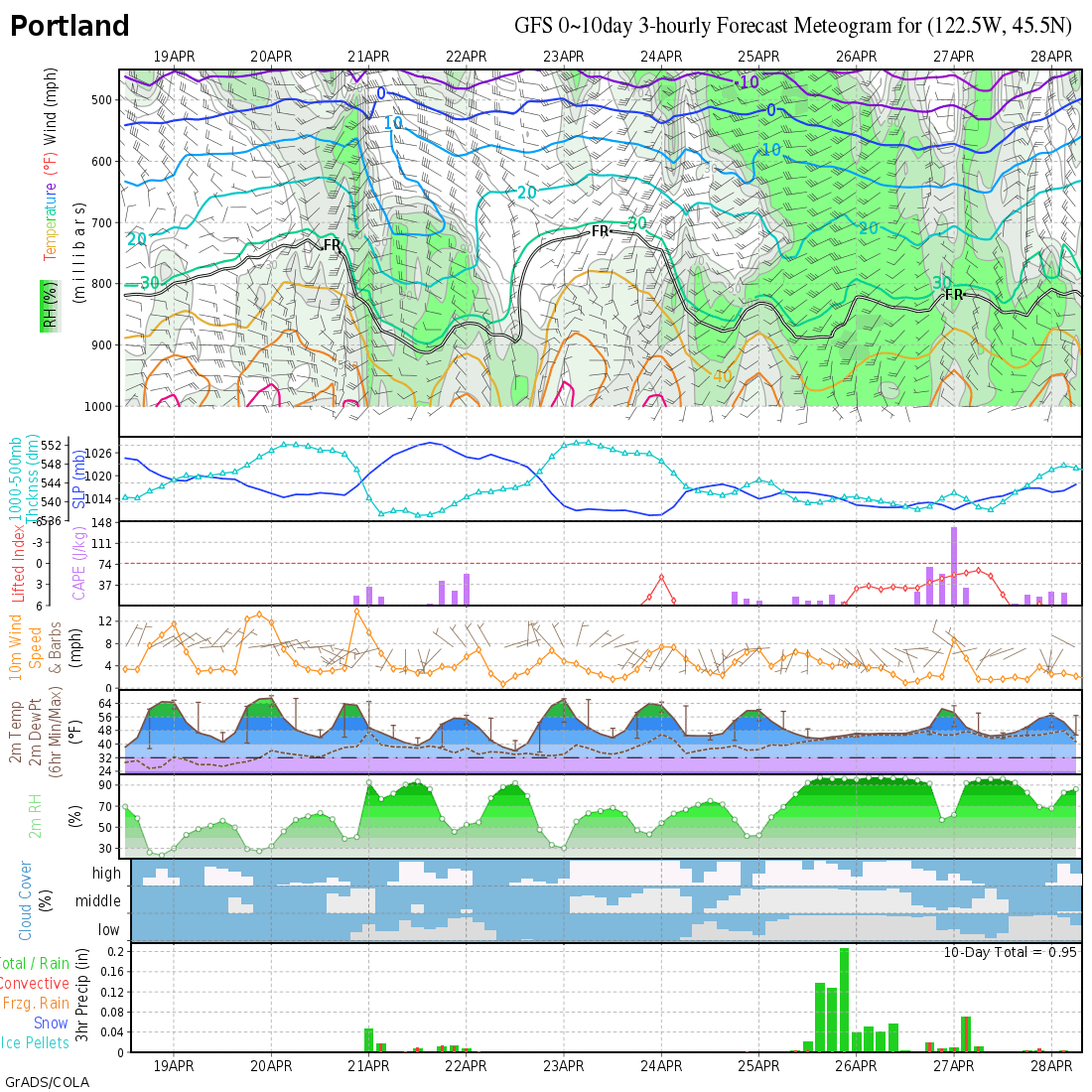
Here is a weather website that gets a lot of traffic in September and October. Ernie checks it about as often as E-mail. http://wxmaps.org/pix/pdxgfs.png

Kindest Regards,

Ernie

Tuesday, August 24, 2010

Amalie Robert Estate Vintage Update: 2010 August Veraison

Hello,

It seems the Pinot Noir just needed a nice weekend in the sun. Sure enough, we spied the first "Pink" berries of the season on Monday morning, August 23rd. Yeah, Ernie likes that. Typically, we see the first color change or “Veraison” by the 15th of August. In the grand scheme of things we appear to still be behind the "average" (a mediocre word at best), but are making up a little lost time.  

Even though we see the encouraging signs of harvest coming our way, there is No Financial Way (NFW) that these vines can ripen this much fruit. So we thin them down to a reasonable crop load, and for us that is about one bottle of wine per vine. It is tough love.

Here we are looking at Syrah, and we are leaving just about 6 clusters per vine. That means we are cutting off the other 18 clusters, and the wings from the hearty souls that remain. That's a pretty tough selection process.

The Pinot Noir harvest is still on track to begin in mid-October, day 285 to be exact. Regarding the Syrah and Viognier, well they might make nice Christmas gifts this year.

Kindest Regards,

Ernie

Saturday, July 31, 2010

Amalie Robert Estate Climate Update: 2010 July

Hello,

After 12 years years of doing this, I have come to the conclusion that Pinot Noir vines are diurnal and Mother Nature is bipolar. And as a Pinot Noir grower, I am fairly confident she is a redhead. Yeah, she's that kinda girl. http://en.wikipedia.org/wiki/Red_hair


But it's all good, and we will take what we have been offered until we run out of growing season. The canopy is finally up and the third wires are clipped into place. I have been able to make a single hedging/mowing pass in July and now await for the newfound shoot tips to stick their heads out for a second pass. The suckers are all gone and so are some of the leaves. We will finish leaf pull promptly and await lag phase.

Contrary to the name, lag phase is a very busy time. This is the point of the berry development where the seed "hardens off." We know this is happening when we try and push through the berry with a thumbnail, and find the seed will not easily split. When we find this condition in the vineyard, Ernie gets out the scale, green eyeshade and a calculator. He is dialing in the crop load, block by block, for 34 blocks. It's working so far. Please follow this link for our latest reviews from Stephen Tanzer's International Wine Cellar: Amalie Robert Estate Earns Top Score for 2007 Pinot Noir!

Lag phase provides an early warning mechanism to determine the final cluster weights and tons available for harvest. Not that we get to harvest it all. The birds, deer and other nefarious creatures all take their cut. We know that most blocks in the vineyard will see the cluster weight double in weight from lag phase to harvest. This is a multiplier of 2.0. Some blocks, due to clone, rootstock or available soil moisture, have a multiplier closer to 2.2, and others as low as 1.8. Note: this is not to be confused with the current experiment going on in Washington DC regarding the Keynesian multiplier.

Ernie takes a representative sample from each and every block. He counts the number of clusters on the vine, and then takes one cluster for a sample. He cuts the wings off and weighs the de-winged clusters to determine our current "tons per acre." His goal is to make one bottle of wine per vine. When the dust settles, Ernie has a plan by block for the number of clusters to cut off each vine. It is a bittersweet moment.

The idea is that each cluster that is left will be better able to survive the winter and reproduce in the Spring. No wait, that is survival of the fittest - sorry. What we are really doing is concentrating our Pinot flavors in the vineyard. The removal of wings is also a standard practice that keeps the green/unripe flavors out of our wines.

That is just about enough drivel. Where are the numbers?! Paint me a picture, give me the data!


We have recorded about 464 degree days for the month of July, providing a total of 798 degree days since the beginning of the growing season on April 1st. This compares with 532 degree days last July and a comparative total of 1,100 degree days for 2009 (a bit light in the loafers we are this year), 993 degree days in 2008, and 1,054 degree days for 2007. In 2006 we had accumulated 1,246 degree days through the end of July.

Hmmm, that is 798 this year, 1,100, 993, 1,054 and 1,246 degree days for July the last 4 years. That can only mean one thing. As Mother Nature winds down the growing season we will see a very warm August, temperate September, and a long, dry, cool October. Yeah, that's my kinda girl. http://www.amalierobert.com/winery_soil_profile.htm

During July, our highest high was 99.4 and our lowest high was 93.2. Our lowest low was 42.5 and our highest low was 44.7 degrees Fahrenheit. The rainfall for July was a meager 0.10 inches and was 0.83 inches below last July's rain of 0.93. Rainfall since April 1st through July 31st was 13.03, and is 5.10 inches more than last year's growing season to date rainfall of 7.93 inches.

So, there it is. We are older, colder, and gonna be late. I think I will start looking for a new hat.

Kindest Regards,

Ernie


Wednesday, June 30, 2010

Amalie Robert Estate Climate Update: 2010 June

Hello,


The big news is that we welcome the 4th of July weekend with Pinot Noir flowers!! Providing Mother Nature gives us a bit of sun and warm weather, these little flowers will turn into grapes. We are hopefully optimistic.


Yes, the Redtail hawks are back and we do have another pair of juvenile raptors to report. However, the overabundance of ground squirrels seems to be too much for them to control. Enter the Bobcats. Yes, we seem to have attracted the attention of a pair of Bobcats. From a distance, and with binoculars, their facial markings remind us of Bengal tigers. So we sit on the deck of the winery and observe these "cats" do their best to help control an out of control population of ground squirrels. A biological control that seeks balance.


Here are the numbers. The month of June continued in May's footsteps providing us with cool temperatures and more rain. We have recorded about 249 degree days for the month of June, providing a total of 334 degree days since the beginning of the growing season on April 1st. This compares with 369 degree days last June and a comparative total of 568 degree days. During June, our highest high was 88.7 and our lowest high was 83.0. Our lowest low was 40.2 and our highest low was 41.0 degrees Fahrenheit. From a heat summation point of view, we are nearly a month short from last year.

The rainfall for June was 4.97 inches and was about 3.52 inches more than last June's rain of 1.45. Rainfall since April 1st through June 30th was 12.93 inches, and is 5.93 inches more than last year's Q2 accumulation of 7.00 inches. Every inch of rain is about 27,000 gallons of water per acre, or about 18.6 gallons per vine.

The vineyard work is progressing nicely as we wait for our shoot growth to reach the second wire position, block by block. The usual suspects are ready to go, but the cooler sections of the vineyard, and those on 44-53 rootstock seem to be holding out for better weather. I can't say I blame them.

In light of the Independence Day weekend, I would like to recognize our founding fathers who have created a concept that has survived the test of time - 234 years to be precise. Imagine their surprise if they were to learn that some of our best allies are the Brits!

For those of you interested, here is a link to the Declaration of Independence. You can see the original document and read the transcript.
http://www.archives.gov/exhibits/charters/declaration_zoom_2.html

Kindest Regards,


Ernie

Tuesday, June 29, 2010

Amalie Robert Estate Vintage Update: 2010 June Flowers

Hello,


Well, it looks like they are back for more, finally...


We detected the first vineyard flowers on the 180th day of the growing season. This corresponds to June 29th. The first block of Pinot Noir to show flowers this year was a neat little block of 113 clone on 5C rootstock. And what a wonderful 3 days of weather it was, before a nice wet cooling off period retuned us to early Spring like weather.


We are behind the historical curve folks. Typically the average date of flowering is the 15th of June. Not that any year has recorded flowers on that date, it is just the average. Flowering is a significant event in the vineyard because it gives us an idea of our potential harvest dates.


The harvest window for Pinot Noir generally opens 105 days after flowering. Again, it is not a "hard coded" date, but an average. For 2009, we will be looking at about the 285th day of the year to commence harvest. The 285th day of the year is a Tuesday, October 13th.


The reason it is 105 days after flowering is that we are looking for the grapes to develop flavors. Sugars are less important, in fact a cooler growing season may mean less sugars resulting in lower alcohol. But we need the day count for the flavors to develop. Hence the grower's plight - "hurry up and wait."

Not that this is bad, or good for that matter, it just is. However, in the world of probability theory we have just discovered a fact that replaces an assumption. This newfound fact tells us that we will be harvesting late this year. The later the harvest, the greater chance of deteriorating weather patterns and conflicting with the schedule of marauding flocks of starlings. These conditions also favor the gift of botrytis (aka bunch rot) for the unprepared.

It is good to bear in mind that in 2008 we did not flower until the 171st day, and look how well that vintage is regarded. Follow this link to view our 2010 Vineyard Flowers Photo Gallery.

Kindest Regards,

Ernie

Monday, May 31, 2010

Amalie Robert Estate Climate Update: 2010 May

Hello and Welcome,

This is the climate update for the month of May 2010. "What a long, cool Spring it's been..." Or something like that.


Despite having an earlier bud break on April 16, as compared to April 22nd in 2009, we have had a cold and wet month of May. The result is "Cabin Fever" and a late bloom period. Bloom is also known as fruit set (hopefully), and that is when the clock to harvest starts ticking. Typically, we need about 105 days from fruit set until we are getting busy in the winery. The longer we wait for bloom, the later the harvest will be. From a farmer's point of view this translates into higher risk of fall rains, bird damage and bunch rot. But it is still early, and June looks to be quite nice. Hope springs eternal.

Here are the numbers. We have recorded about 85 degree days from April 1 through May 31. This is significantly less than the 200+/- degree days for the same period in 2007 thru 2009. During May, our highest high was 82.3 and our lowest high was 77.4 Our lowest low was 31.7 (brrrr) and our highest low was 32.5 degrees Fahrenheit. The rainfall for May was 2.64 inches and was about 1.60 inches less than last May's rainfall of 4.24 inches. Year to date rainfall is 25.51 inches compared with last year's 18.96 inches.

It's what makes the grass grow - rain that is, and we have had plenty of that. As luck would have it, Ernie was able to recycle last year's cover crop including the pruning's and drill in the new summer cover crop blend of Buckwheat and hairy vetch before most of the late May rains arrived. The result is a pretty nice stand of cover crop that will provide cover for beneficial insects over the summer.

Our next key event is bloom, aka fruit set, and that is typically around the 15th of June. Based on the weather so far, it seems that bloom is about as far away as the next global warming summit. But just in case it sneaks up on us, we are raising our first set of catch wires and clipping the shoots in place. When the heat wave hits, the vines will explode with growth. It is not uncommon to see nearly an inch of growth a day under hot conditions with adequate soil moisture.

If anyone needs a few minutes of "office vacation" time why not tour the erma? http://www.ermunch.com/projects/winery.html Outstanding content and a hip new design await your visit. A mouse click away will LEED you there, and NO carbon footprints left behind for the Green Police to track you down!

Kindest Regards,

Ernie

Friday, April 30, 2010

Amalie Robert Estate Climate Update: 2010 April

Hello and Welcome back!!

After a long, seemingly endless winter’s respite, we are back in the vineyard business. We know this because we saw bud break in the vineyard on April 16th! This is about 6 days earlier than last year. The key point about bud break is to check the tender new growth for winter freeze injury or mite damage. Fortunately, we are free of both of these blights. The real key vineyard date is flowering, usually in mid-June. Stay tuned.

The vineyard has wintered over well. The fall cover crop of Oats and Peas took nicely. This combination helps us in many ways including holding the soil on the hill in spite of the 35.87 inches of rain we received from October 2009 through March 2010. For those of you new to this report, each inch of rain represents about 27,500 gallons of water per acre.

This fall we received about 986,425 gallons of rainfall per acre and a stunning 29.35 million gallons of water for the entire vineyard. This turns out to be about 680 gallons of water per vine. These winter rains also leach the nitrogen from the soil. Read on to learn how we replenish this vital nutrient.

The Oats and Peas cover crop combination also helps us feed the vines by fixing nitrogen in the soil. Peas are a legume and are the primary source of nitrogen. They "fix" nitrogen right out of the air and it is seen as small nodules on the roots. However, Peas will only fix nitrogen in the soil where there is a deficiency. Here is where the Oats come into play. The Oats take up nitrogen from the soil as they grow, creating a deficit for the Peas to replenish. This cycle is similar to a solar panel and a battery. The solar panel can create energy, but needs a battery to store it. And of course, nicely drilled vineyard cover crop looks nice. Who knew agronomy could be so exciting?!

But alas, all good things must come to an end. The winter cover crop has been turned into the soil. Now the real work begins. All of the nitrogen rich plant material and fibrous roots will be composted "in situ" between the vine rows. As many of you know, Ernie thinks of the soil as the plant’s stomach, and this is his way of feeding our vines.

But wait, there's more! If you take a closer look, you will see a new Spring cover crop beginning to emerge. It is the summer special of Buckwheat and Vetch. This combination is also a helpful blend to help the vines uptake of phosphorus (a macronutrient along with nitrogen and potassium), as well as nitrogen from the Vetch. Check for new photos in the May report.

Now, onto the details of the first period of the growing season. April 1st is the start of the growing season and this is day 91 for the Julian calendar year 2010. We have accumulated 5.32 inches of rain since the 1st of April and that is 4.01 inches more than the 1.31 inches during the same period in 2009. Q1 2010 rainfall was 17.55 inches and was 4.14 inches more than the 13.41 inches of rain for Q1 2009. The historical 30 year average for Q1 is 19.72 inches of rain, or 536,384 gallons per acre.

We have recorded 2.72 degree days for April 2010. Our highest high was 73.9 and our lowest high was 70.4. Our lowest low was 29.3 and our highest low was 30.9 degrees Fahrenheit. For comparison, we did record 10 degree days in 2009, but no degree days for April 2008 or April 2007; about 25 degree days for April 2006 and 49 degree days for April 2005.

Well, that pretty much puts a wrap around April, 2010. In what is seeming to be a year of change and uncertainty, (this describes every year if you farm the land), we are reminded of the immortal words (and illustrations by Norman Mingo) of Alfred E. Neuwman: "What, me worry?"

You may not know, Mr. Neuwman has also run for the office of the President several times under write-in candidate status (with his name misspelled) with the slogan "You could do worse... and you always have!" http://madcoversite.com/mad218.html

For more inspiration, and a tip on how to remove gum from a shag carpet, you can follow this link: http://www.dccomics.com/mad/?action=faq

Kindest Regards,

Ernie

Wednesday, September 30, 2009

Amalie Robert Estate Climate Update: 2009 September

Hello and Welcome,

This is the September 2009 Climate update. Despite all the hoopla regarding the 2008 vintage, I am still a firm believer that 2009 is the vintage of the year.

Let's start with the numbers. We have recorded about 405 degree days for the month of September (260 through the 15th and an additional 145 through the end of the month), providing a total of 2,040 degree days since the beginning of the growing season on April 1st. This compares with 414 degree days last September and a comparative total of 1,896 degree days for 2008. 

During September, our highest high was 98.6 and our lowest high was 92.5. Our lowest low was 41.0 and our highest low was 42.5 degrees Fahrenheit. The rainfall for September was 1.13 inches and was 0.46 inches above last September's rain of 0.67. Rainfall since April 1st through September 30th was 9.41 inches, and is 4.31 inches greater than last year's growing season to date rainfall of 5.10 inches. 

Through the looking glass I see another 32 degree days for October and ideal harvest conditions. 

Ernie

Monday, August 31, 2009

Amalie Robert Estate Climate Update: 2009 August

Hello and Welcome,

This is the climate update for August 2009.

All in all, I must say 2009 has been a pretty nice year. The vineyard still looks very green and healthy, the summer cover crops have contributed their all and are now resting below an inch or so of tilled soil, and the weather has been fairly moderate. I will drill in some Oats and Field Peas between the rows and that should put the vineyard floor in good stead for a well deserved winter rest.

Here is what I know for sure, as much as you can know anything for sure in agriculture. We have recorded about 534 degree days for the month of August, providing a total of 1,634 degree days since the beginning of the growing season on April 1st. This compares with 448 degree days last August and a comparative total of 1,481 degree days for 2008. Tack on another 300 for September, and we are in striking distance.

During August, our highest high was 103.4 and our lowest high was 100.2. Our lowest low was 45.4 and our highest low was 47.6 degrees Fahrenheit. The rainfall for August was 0.35 inches and was 1.35 inches below last August's rain of 1.70. Rainfall since April 1st through August 30th was 8.28 inches, and is 3.85 inches greater than last year's growing season to date rainfall of 4.43 inches.

Regarding last month's question: Do the clusters at the end of the vine make better wine than the clusters toward the head? The answer is the best wine is made from the clusters that make it to the winery! Since we can never really know for sure, here are some thoughts on the subject:

  • As long as the vine is healthy, the cane is not too long and not overburdened, then the fruit should be relatively uniform along the cane. If any of these conditions are degraded, the fruit in the center of the cane may have lower quality.

  • The fruit at the end of the cane is typically better quality due to the vine's natural growth habit. The end shoots typically are more vigorous as they are looking to climb - they are vines after all. This means the end shoots are drawing greater energy from the vine in hopes for growing into an ideal location to produce fruit (aka ripen seeds.) The clusters on these end shoots are the beneficiaries of the increased vascular tissue activity.

  • Another view is that we want to space the fruit out along the cane. Early in the year this can be done by cutting large clusters in half. The result is the top half of the cluster remains on the vine and the clusters are evenly spread across the cane. I think this is easier to do with large clustered varieties such as Dolcetto or Syrah.

Also, whatever clusters remain, removal of the wings or "fruiting tendrils" may improve wine quality. This is due to the notion that wings flower about a week after the main cluster. The wing is Mother Nature's back-up plan in case of bad weather during the critical bloom stage. This means the wing needs an extra week or so to ripen. However, the cluster will be harvested long before the grapes on the wing fully develop flavor and aroma.

So, there we have it.

As I sit at my desk writing, I can see that the nearly inch of rain we just received is followed by a strong breeze and partly sunny skies. The forecast is for warm dry days and cool nights. Perhaps the wind is at our backs and the sun is warming our faces - it could be worse. Here is a link to a weather page that is no worse than any I have found: http://wxmaps.org/pix/pdxgfs.png
September is the time of reflection on the year's events that have shaped this vintage. We look forward to September's sunny days and cool nights when Mother Nature puts her finishing touches on the vintage. Of course, we are doing our part by thinning off excess crop and late ripening wings.

Ernie

Thursday, August 6, 2009

Amalie Robert Estate Vintage Update: 2009 August Veraison

Hello,

We will have the little pink berries again this year. They will emerge alone and unafraid in Block 14 (Pommard on Schwarzmann rootstock), which is now being expertly manicured for Mr. Etzel, on August 6, 2009. Congratulations Mike!

Some have suggested the harvest of the year will come early, and for some I am sure this is true. However, every time I am tempted by these "false choices", I remember that Charlie Brown Thanksgiving special where he is falsely coerced into kicking the football. I think this is also called "marketing."

He knows it is the wrong choice, however he is pressured into thinking about the glory to be his when he kicks that football. Not to plagiarize here, but he seems to have the audacity of hope. Alas, it is not to be. Fortunately, he is not seriously injured and returns in a few weeks time with a Christmas Tree, but that is indeed another story.

Personally, I know that I will be harvesting Syrah and Viognier at the last possible moment - in NOVEMBER - with the birds. So if anyone is ready to go early, I will be happy to accommodate.

In the mean time we will build sugars, ripen seeds and begin respiring malic acid.

Ernie