Hello and Welcome,
This is the 2013 Spring Cellar Report aka “Vit
Lit.”
Introduction:
This fall and winter have been a tough
slog here at Rancho Deluge. Why just the other day the sun came out and everyone
thought it was just another exploding meteorite. Alas, when we finally did
locate the sunscreen it was all for not, not even a rainbow to mark the
occasion. We were, however, thankful when our eyesight returned.
 ...
... ...
...
Springtime
is when the vines wake up and we get back to work in the cellar. The Pinot Noirs
and Syrah from that great 2012 vintage are just completing their Malo-lactic
conversion, and the stainless steel fermented Chardonnay and Viognier are queued
up for bottling. Meanwhile, the 2011 vintage Pinot Noirs are ready for blending
trials. This really is the most rewarding part of winemaking for us, blending
our single vineyard wines for
complexity.
Marketing:
Throughout the growing season we are
doing our best
to grow our wines on the vine. We think of those grape skins as tannin packed
flavor and aroma packets. Our job as winegrowers is to understand the style of
wines we want to produce and take specific actions in the vineyard to shape the
development of those flavors, aromas and tannins. “Human Terroir” if you
will.
This means we pay attention to how much sun exposure the grapes
receive by removing just a few leaves for air circulation, but leave enough that
provide partial shade. We also thin off the wings that ripen later than the main
cluster and can impart green or unripe flavors. The last, most important
decision is always harvest. Once the sugars and acids are within acceptable
ranges, we start to taste the berries. Specifically, we are tasting for skin
development and monitoring the ripeness of the seeds.
The Back
Story:
Once in the winery, we ferment some of the grapes on the stems. We
also use the yeast they brought with them from the vineyard. This is known as
whole cluster fermentation with indigenous yeast. We know that this fermentation
style protects the character of the vineyard and will add stem tannin to the
finished wine. This tannin is “alive” and will continue to develop character
with bottle age. In the cellar we fill the wine into a combination of new and
previously filled French oak barrels. We are also experimenting with Hungarian
and Russian oak, but don’t tell anybody – it’s a secret!

Think of the barrels as our spice rack. Each cooper has a style, and in fact
each individual barrel will impart a unique aroma, flavor and texture profile to
the wine. Add the variable of time, and the wines will mature from the
aggressive tannins of freshly fermented juice into nuanced and interleaved
aroma, flavors, textures and a lengthy finish. That is how we put the “F” in
fermentation - it is in the finish.
So, do we engineer our wines? Maybe.
But our point is we actually thought about the styles of wine we want to enjoy,
and learned the farming and winery practices to create them. Of course, this
winegrowing structure is superimposed over Mother Nature’s prerogatives. We know
she is never going to be reliable, but she is predicable. Our job is to be ready
in a moments notice to snatch our grapes from the jaws of defeat, or 3 inches of
rain in week, ceteris paribus.
As we taste the wine in barrel, we review
not only the vintage, but how we grew, fermented and barrel aged our wines. We
evaluate the aroma, texture and weight on the palate. When we make our blends we
seek to present our entire vineyard terroir as well as the human terroir that we
have contributed to the wine. A point of clarification here: Don’t ever agree to
go barrel tasting in anyone’s cellar. Barrels do not taste good. You want to
taste the wine in the barrel. That’s where the action is.
What
does this mean and why should I care?

What this means, is we thought about creating our Amalie Robert Estate wines in
our own particular idiom – yes, it is the year of the snake, a Python if you
will. You should care because in the world of wine, very few wines are offered
that represent this level of care, stewardship and dedication by the founders
and owners who still are able to do the work.
It was our first piece of
intellectual property in the wine business, and we stand by it today: “Wines
true to the soil, Wines true to the vintage.” We invite you to experience Amalie
Robert Estate wines with friends, food and in moderation.
Current
Events:
While we try very hard to be politically tone deaf, it is really
difficult to ignore the shenanigans in our great nation’s capital. These “self
inflicted wounds” remind us that the fewer facts you have, the more general your
knowledge, until you reach the pinnacle of politics whereby you know nothing
about everything. This is, in fact, a late life bi-polar response to adolescence
where you know everything about nothing.
It was
Benjamin
Disraeli who said “It is much easier to be critical than correct.” Perhaps
true, however it would leave us all significantly less entertained, wine writing
included. So in this year of the snake, we take to heart some of the more
interesting, and potentially irreverent, concepts of the British comedy troupe
Monty Python. To wit: “Message for you sir!” - “Strange women lying in ponds
distributing swords is no basis for a system of government!”
For those
unfamiliar with this artform, you may view the unofficial script

of
“
Monty Python
and the Holy Grail” at this link. You will, of course, have to improvise the
audio and video. Note: A fine glass of Pinot Noir may help you in your
quest.
Today’s Feature Presentation: Fluid Transfer
While
laughter may be the best medicine, wine it is said, is the essence of life. And
that brings us to the concept of “Fluid Transfer” which in fact is the essence
of life. And as we all know, life is a sexually transmitted condition which may
be the result, in certain cases, of consuming wine – perhaps in excess. We will
now set about to prove wine is the essence of fluid transfer.
The grail
of wine you savor most likely came from a 4,200 degree F. heat formed molten
silica sand package - aka a glass bottle. The fluid contents of which were
sequestered in said package by a curious piece of tree bark known as a cork, or
natural stopper for those into the “natural wine” movement. Clearly there is no
fluid here and not the point of today’s commentary. The wine however is fluid,
and that is where we begin our journey. (Note: Until man learned how to heat
sand to 4,200 F., goat skins were used to package wine – perhaps this is the
origin of the natural wine movement. Even today in your local wine purveyor,
some wines are sold in a box containing an unnatural plastic bladder that holds
“wine.”)
Our 30 acre vineyard is a southern leaning coalition of
wine grape vines that strive to transfer water, and with it the essence of the
soil, into roughly 750,000 clusters of wine grapes. This is no small task that
they are preprogrammed to achieve, however they have from April through October
to get the job done. Mother Nature does her part by providing roughly 45 inches
of rainfall per year. This fluid transfer from the Heavens to the earth is
really the seminal event of the growing season. And there is more than enough to
go around.
At an average rainfall of 45 inches per year, we receive
about 45 inches x 27,154 gallons/inch per acre = 1,221,930 gallons of water per
acre of land. Now on that typical acre of land, we plant about 1,452 vines. That
means each vine, in theory, has access to about 845 gallons of water per year.
Our typical crop yield results in about a single 750 ml bottle of wine per vine,
or about 0.198 gallons. The remainder of the 845 gallons is either leached
through the soil, taking our hard earned Nitrogen with it, or transpired through
the canopy to cool the leaves during the growing season. However, during the
winter months we are slogging through the soil and depend on high quality
footwear, aka “work boot style rubber overshoes” or “Wellies”
As the
growing season progresses, the vines are ripening up the year’s vintage without
too much drama, however we all know “closing time” is on the way. Late September
is when all manner of things can happen. We could get a little sprinkle on the
fruit that may cause wine reviewers to panic. We could get warm dry days with a
little breeze that will desiccate our fruit, aka reverse fluid transfer. Or,
things could be just hunky dory – a condition not seen in our
lifetime.
We could get a bad “pre-harvest review” from an otherwise
intelligent person on the periphery of the wine “business.” This seems to happen
more often than not and can clearly point to a very lucrative political career
(see above.) Not so much fluid transfer there, but we would recommend keeping
your wallet in your front pocket. Please see the
harvest review
from 1957.
Then before you can say Waft The Fruit, there you are in
the biggest cluster pluck you can imagine! Plant by plant is harvested by hand
into 5 gallon buckets weighing about 20 pounds – more if the soil is wet and the
buckets get muddy. This hand job goes on from sunrise until just after midday.
When it is all said and done we will have transferred about 15 tons of skins,
seeds, pulp, stems, bugs, mud and grape juice from the vineyard to the winery.
It is, in a word, rapture.
What started as an innocent, if not carefree,
shower in the spring has produced a beautiful bounty of fruit. While we are
basking in the afterglow of a fine performance, there is much work to be done.
We begin at the beginning with our first step: “Get the fermentation out of the
way!”
Once our grapes have made it to the winery, we believe our job is
stewardship. If you have seen our stained hands and bleary eyes in November and
December, you can easily understand this is not a hands-off affair. We are to
take the fluid from the grapes, ferment the sugars into alcohol, infuse tannins,
textures and aromas from the skins, stems and barrels over a period of 18-24
months and then transfer the essence of our vineyard into 750 milliliter
bottles, each individually sealed with a cork and capsule (SWACC.)

If
wine is the essence of fluid transfer, then variety is the spice. Not only do we
grow our own Pinot Noir, we also dabble in Chardonnay, Pinot Meunier and
Viognier. If these wines seem to leave you unfulfilled, we encourage you to seek
a glass of Satisfaction, Syrah that is.
We are almost there. All that is
left now is to put the stem on the apple, or more accurately, pull the cork from
the bottle. Here is where you can get hands-on with wine. If you have read this
far, you understand they are all a little bit different. It is not only the
shape and size of the bottle but whether or not it has been fitted with a
natural cork or a synthetic closure. Some bottles are fitted with a “roll on
tamper evident” closure known affectionately as a screwcap or, again for the
natural wine movement, a screwoff. Call it what you will, but it costs the
winery about 15 cents.
And then there is the capsule. It used to be the
case that corks were protected with lead foils or “capsules” during ocean going
transport. The idea was to keep shipboard pests from nibbling out the corks and
releasing the wine prematurely. Well (a hole in the ground with water in it,)
lead is no longer used for this purpose because wine is shipped in sealed,
temperature controlled ocean going containers and, more importantly, seamen are
afforded shore leave on a more regular basis.
But still to this day, not
everyone uses a protective capsule. If you are sure of the brand, and have been
enjoying it for some time, the capsule may not be all that important to you.
However, if you are trying a new brand for the first time, we encourage you to
select a package that has a nice looking, form fitting and functionally
protective capsule. Note: Some capsules have little holes in the end that
facilitate automated, high throughput installation via electrical appliance.
Choose wisely.
Perhaps you are new to the joys of wine, and are not all
that familiar with the equipment. With the excitement of trying a new brand, you
may well pull the cork right through the capsule. Over time, and with more
practice, you will be able to master control. Also, you can avoid significant
embarrassment and social stigma by not using a corkscrew on a “roll on tamper
evident” screwoff closure before your guests arrive. It will be obvious to
everyone right away.
While it has never happened at Amalie Robert
Estate, we have heard of wineries sometimes forgetting to put the cork in and
just applying the capsule over the top of the bottle - faking it. While there is
no way to know this at the time of sale, it is an unfortunate and hopefully
uncommon occurrence that can significantly change your perception of that
brand.
Fetchez la Vache! This is supposed to mean “Bring me a wine
glass.” Instead, it means “Fetch me the cow.” Occasionally Pinot Noir grown in
the Burgundy region of France has what is know as “the cows arse” in the aroma,
so maybe that is how this got lost in translation.
Much like the
differing shapes and sizes of wine bottles, there is vi

rtually
an endless array of elegant, sophisticated shapes and styles of glasses designed
specifically to receive wine. Most of these glasses are referred to as stemware
due to the elongated stem that separates the foot of the glass from the
voluptuous bowl. While we often evaluate the complete package, we pay keen
attention to length of the stem and specifically the shape of the
bowl.
It is a widely accepted fact that sophisticated wine “stems” are
high maintenance. To compensate for the extra effort of maintaining the
integrity of these delicate stems, a new style of wineglass has been introduced.
It is called a “stemless” glass and has all of the virtues of a voluptuous bowl.
It is however, lacking the elongated stem and herein lies the issue – there is
no place to touch this glass that will preserve its inherent beauty. By the end
of the evening, the glass has clearly been well groped and only a forensic lab
may be able to determine the interloper.
We are rounding third base and
heading for home. While it has been a subliminal exercise for the reader, you
should by now have in front of you the following items: a fine bottle of wine
from a brand you respect and trust, the proper tool (or in the case of a vintage
port, tools,) that can be used to release the wine in a controlled manner
(especially important for the disgorgement of sparkling wine,) clean stemware
commensurate for the anticipated experience, soothing background music and the
swoon worthy embers of a warm fire.
After the potentially awkward moment
of pulling the cork, or disgorging as the case may be, the wine gently flows
into the elegant and voluptuous stemware. A quick twist of the wrist and the
wine swirls and rises to its zenith and gently recedes. The heady aroma fills
the air, nostrils flare.
The sophisticated stemware directs the wine to
the most sensitive part of your aroused palate. The rush of the aromas, flavors
and textures triggers a pulse quickening, primal reaction. You swallow, then
slowly a tingling sensation begins to come to the fore of your consciousness. It
is your brain reminding you it is time to breathe!
The svelte tannins
and lingering acidity continue the full frontal lobe assault. It is at this
moment your heightened senses are alerted to the first drops of rain from a
spring shower gently pattering against your window. Significant meteorological
phenomena are about to be released.
This simply cannot be just any wine;
it is the essential wine - Pinot Noir. Ergo, our work here is complete: There
can be no doubt that Pinot Noir is the essence of “Fluid Transfer.” Join us next
time as we cleverly explain why Chardonnay is the catalyst to “Spontaneous
Combustion.” Think Blanc de Blanc.
Kindest Regards,
Dena &
Ernie


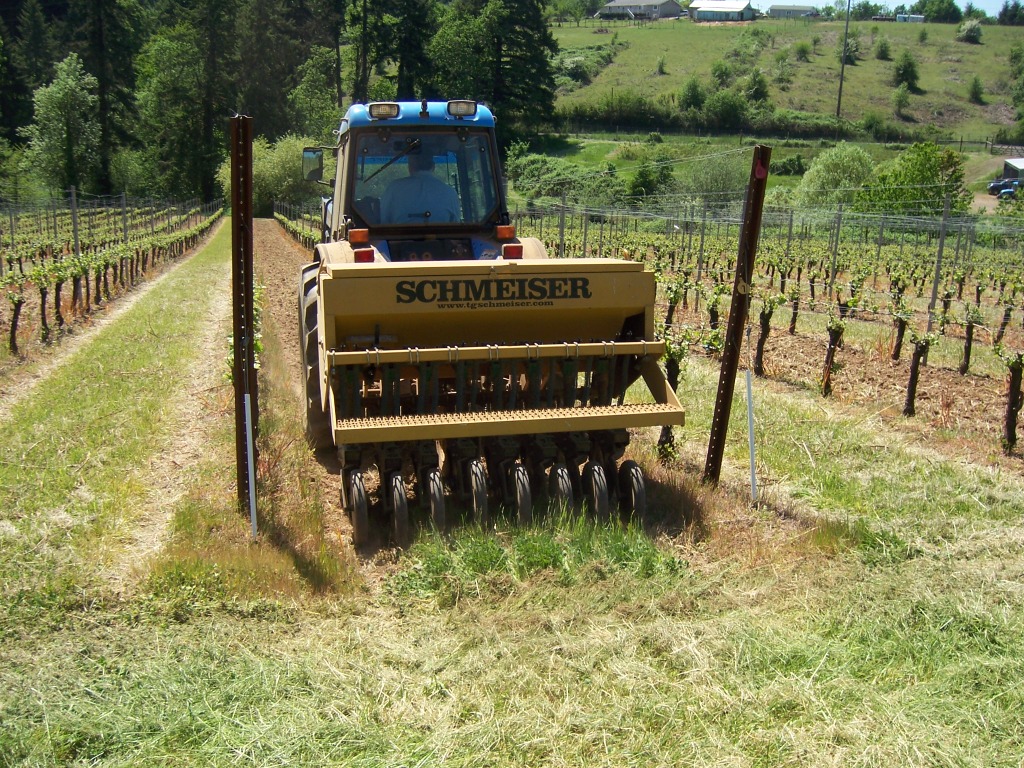
 Looking at the growing season to
date, this was a pretty fortuitous event. We have had a very dry spring and
that does not bode well for the dry farmed vineyard at Amalie Robert Estate. The
warm stretch in April and early May invigorated the grass as well as the vines.
Grass, while it doesn’t seem to be doing much, is a voracious consumer of
water. The taller it grows, the more rapidly it depletes the available soil
moisture. In some parts of the vineyard, grass is a tool we use to eliminate
excess soil moisture. In some parts of the country, grass is grown for other
purposes.
Looking at the growing season to
date, this was a pretty fortuitous event. We have had a very dry spring and
that does not bode well for the dry farmed vineyard at Amalie Robert Estate. The
warm stretch in April and early May invigorated the grass as well as the vines.
Grass, while it doesn’t seem to be doing much, is a voracious consumer of
water. The taller it grows, the more rapidly it depletes the available soil
moisture. In some parts of the vineyard, grass is a tool we use to eliminate
excess soil moisture. In some parts of the country, grass is grown for other
purposes.