Introduction

Winemaking: The Continuation of Terroir by Other Means.®

Welcome to the Amalie Robert Estate Farming Blog, aka FLOG. By subscribing, you will receive regular FLOGGINGS throughout the growing season. The FLOGGING will begin with the Spring Cellar Report in April. FLOGGINGS will continue each month and detail how the vintage is shaping up. You may also be FLOGGED directly after the big Cluster Pluck with the yearly Harvest After Action Report. Subscribe now and let the FLOGGINGS begin!

Rusty

"This is one of the Willamette Valley’s most distinguished wineries, but not one that is widely known."

- Rusty Gaffney, PinotFile - September 2016

Josh

"Dena Drews and Ernie Pink have been quietly producing some of Oregon's most elegant and perfumed Pinots since the 2004 vintage. Their 30-acre vineyard outside the town of Dallas, abutting the famed Freedom Hill vineyard where Drews and Pink live, is painstakingly farmed and yields are kept low so production of these wines is limited. Winemaking includes abundant use of whole clusters, which is no doubt responsible for the wines' exotic bouquets and sneaky structure…"

- Josh Raynolds, Vinous - October 2015

David

"...Dallas growers Dena Drews and Ernie Pink... showed me this July three of their reserve bottlings and thereby altered my perception of their endeavors. Since these are produced in only one- or two-barrel quantities, they offer an extreme instance of a phenomenon encountered at numerous Willamette addresses, whose really exciting releases are extremely limited. But they also testify, importantly, to what is possible; and what’s possible from this site in these hands revealed itself to be extraordinary!... And what a Syrah!"

- David Schildknecht, The Wine Advocate - October 2013

Wine & Spirits

"Finding that their whole-cluster tannins take some time to integrate, Pink and Drews hold their wines in barrel for up to 18 months - so Amalie Robert is just releasing its 2008s. And what a stellar group of wines: Bright and tart, they possess both transparency and substance, emphasizing notes of rosehips and sandalwood as much as red berries. The pinot noirs alone would likely have earned Amalie Robert a top 100 nod this year. But the winery also produces cool-climate syrah that rivals the best examples from the Sonoma Coast. And the 2009 Heirloom Cameo, their first attempt at a barrel-fermented chardonnay, turned out to be one of our favorite Oregon chardonnays of the year. Ten vintages in, Amalie Robert has hit its stride."

- Luke Sykora, Wine & Spirits Magazine – September 2011

Copyright

© 2005 – 2021 Amalie Robert Estate, LLC

Friday, March 16, 2018

Amalie Robert Estate: 2018 Spring Cellar Report


Hello and Welcome,

This is the 2018 Spring Cellar Report from Amalie Robert Estate. A FLOG communication.


There are all sorts of clichés, but in the wine industry we are always looking for our niche. In fact, a niche cliché is what we are looking for today.

At the end of harvesting 100 tons of wine berries over the course of 7 weeks, we were “As delighted as the dog that actually caught the car.” And since we farm on hillsides, we would remind everyone that “..it doesn’t run uphill.” But after turning 100 tons of wine berries into about 16,500 gallons of wine, we are leaning-in “Like trying to get a drink out of a fire hose.”


But now that Spring is beginning to emerge, we are onto the next big thing – Blending for Complexity.

We turn back a vintage and begin our quest for the Hers and His reserves. You see we “barrel over”. That is in fact different from “being over a barrel” which seems to be a Hollywood thing.

To “barrel over” means to hold your wine in barrel over the next vintage. At Amalie Robert Estate our Pinot Noir and Syrah are in barrel while the next vintage is coming into the winery. At the end of the day, we are looking to have our Pinot Noir in barrel for around 18 months and our Syrah for closer to 26 months. And yes that requires us to have twice as many barrels, and a place to age them, than wineries that empty their barrels after 11 months so they can refill them with the next vintage.


And there is more than one way around the barn, or through the cellar. There is always a fast way, a wrong way, and the Ernie way. Other than increasing costs, the Ernie way has the added benefit of extended barrel maturation. This allows our whole cluster tannin to soften naturally over time. There is no need to add fining agents that modify the aroma, flavor, taste or texture of our wines. You are getting the real deal from Amalie Robert - time in a bottle. Or think if it as a message in a bottle.

The other way to do it is to add something that will soften the whole cluster astringency and advance the wine’s maturity window. Historically, egg whites and ox blood were used. This continued until winemakers realized that chicken eggs were a lot more economical than other additives. However, fish bladders are still in use for white wines to this day. Hey Google, “What is isinglass?”

By the time we get to blending, our Amalie’s Cuvée (Hers) and Estate Selection (His) Pinot Noir wines have been in the same barrel they were filled into for about a year. No racking from barrel to barrel allowed. The yeast lees that came down from the press with the wine are now settled in the bottom of the barrel. And since our barrels are on their side, the bottom of the barrel is called the bilge. Directly opposite the bilge is the bung. This is how you know the barrel is in the correct wine maturation position.


Our job is to select about 20 or so barrels of wine that contain our favorite wine from the vintage. Since we harvest, ferment and then fill barrels from each of our 42 blocks separately, we have the ability to taste the wines grown from each and every one of our vineyard blocks. This allows us the ultimate flexibility in creating our Hers and His reserve blends. But be careful what you ask for, as that adds up to about 200 and some barrels per year. You can’t boil the ocean.

What we can do is critically evaluate about 10 barrels of wine per session. This is usually an afternoon thing. And we seem to be predisposed to Friday afternoons. It’s just our thing. Oh sure, we can taste wine from more than 10 barrels in an afternoon – no problem there! However, the problem comes the next day when you are trying to decipher the notes of barrel number 16 - what language is that? That is why 10 is the magic number, at 4 pm, on a Friday afternoon.

Some people will take a more technical approach and begin evaluations in the late morning or early afternoon. And that is all well and good. But we blend our wines with an eye toward enjoying them with a meal and with friends. We start to get a little wine craving in the afternoon and feel this is the better time for us to critically evaluate wines. Of course, your mileage may vary.

Once we make the first pass through the cellar, we can usually get our favorites list down to about 20 or so barrels and that is a good place to start. The magic number for the Hers and His Reserves is 12 barrels each, about 300 cases worth. Logistically, this is three of our blending tanks, so even though the 13 barrel blend is good, there is nowhere to put it.

Now comes the hard part, finding which of those 20 barrels of wine are going to make the final cut to get us down to 12. There are plenty of algorithms to use to sort them. From our Computer Science days, we could use a bubble sort, a merge sort or a quick sort. Or we could actually taste them and rank the aroma, flavor, texture and finish. Hopefully this illustrates one of the reasons we left the hi-tech world for wine.

Once all of our barrel samples are ranked on their criteria, we begin blending a few samples together. The joy is when the barrels combine to build enhanced aroma, flavor, texture and finish. We can adjust the blend naturally by including a sample that is more high toned, or contributes more structure. If the finish is too astringent, we can swap out a barrel for something softer. We call this blending for complexity. It does take discipline, attention to detail and several iterations. Another benefit of our approach, is that we do not have to add aforementioned fining agents to modify our wines. We just look to swap a barrel that helps to temper the blend.

And that is how we get from 20 individually stunning barrels of wine, to a blend of 12 that combine into a wine that is as sublime as the day is long. Of course, Dena has veto power. If the blend doesn’t feel just right, then it’s back to the blending bench. Often times this is in the kitchen, which is handy when we are evaluating the blend for its culinary suitability.


And let’s spend a minute on the Farmer barrel. As each vineyard block is harvested, fermented and sent to barrel separately, we can get a read on how Ernie managed the vineyard. And that is where the Farmer barrel comes into focus. We are not giving away any trade secrets here by telling you that each fermenter fills about 4 barrels. The first barrel is brand new each year. The next two barrels have been filled two or three times. And then there is the fourth barrel, the Farmer barrel.

The Farmer barrel is always dead neutral. That means that if it did not come over to the New World on the Mayflower, then it has been filled (and by definition emptied) several times. The result is that there is no oak influence left in the barrel. This barrel, the Farmer barrel, is where we can evaluate how the fruit from the vineyard is showing without any oak influence whatsoever.

This feedback is quite useful to the Ernie who farms our field. He can dial in his vineyard management program of leaf pull, cover crops, hedging, vineyard floor management, thinning and harvest strategy to modify the aroma, flavor, texture and finish of our wines.

Spoiler Alert: All of those aroma, flavor, texture and finish characteristics in the finished wine are a natural evolution from not only the terroir, but also the human factor of what was or was not done as a response to the vintage. And all of our vineyard management techniques and viticultural practices are site specific to Amalie Robert Estate as we farm our own field, and no one else’s. Good to know.

The feedback loop is YUUGE when it comes to our stainless steel fermented whites such as Her Silhouette Chardonnay and Our Muse Viognier. Stainless steel fermented white wines are the most transparent exemplars of terroir you will find. And the GWZ’R Gewürztraminer is coming, so please be patient. It takes a while to build up to critical mass with just 24 vines.

The making of iPinot. So, after the Hers and His, we have a few barrels that are quite pleasurable, but “didn’t make the team” Hers or His. What to do? Ah yes, these reserve level barrels, when blended among themselves make quite a compelling wine from the vintage.

iPinot and the three halves of Pinot Noir. People will tell you there are only two halves to Pinot Noir. It doesn’t have to be that way. Let us explain. The first half of Pinot Noir is the brilliantly elegant color refracting with a simple twist of the wrist releasing a heady bouquet – Very nice indeed.

The second half of Pinot Noir is when it colonizes your palate. Lively, delineated, lithe and tart, supple and sweet - all the things that stunning Pinot Noirs are made from. And then comes the third half of Pinot Noir – the scintillating and enduring finish of refined whole cluster stem tannin.

Fermenting with whole clusters extracts a little tannin from the stems. If you want to experience this for yourself, purchase some table grapes, remove the fruit and chew on the stems. Do it in front of the mirror for the full effect. Wowza!

However, over time, oxygen makes its way to the wine and gently softens this astringency into refined tannins. These refined tannins manifest themselves as a silky mouthfeel contributing length and a more than just subtle grip to the finish. That is the third half of Pinot Noir.

For all of you analytical types out there, try this exercise. Everyone knows that 50 is half of 100. And most people will tell you there are only two halves to a whole. But are there not three 50's in 100? Sure there are: 0 – 50 is a 50; 25 – 75 is a 50; and then there is 50 – 100, the third half! That makes three halves to a whole. Who’s got change for a $100?

iPinot is sold direct from the winery. If some day Apple is looking to acquire a winery, well let’s just say we trademarked iPinot with an eye toward the future.

Now it would not be a FLOG communication from Amalie Robert Estate if we didn’t do the numbers. Let’s see here, how about 94? That’s as good a number as any. It also just happens to be the review Ernie’s 2012 Top Barrel Syrah earned from Vinous in early February 2018. Not only is this the highest score ever for an estate grown Willamette Valley Syrah, it is the first 94. And that is the thing about being the first one, no matter who follows, you are always the first one!

Let's review, shall we:
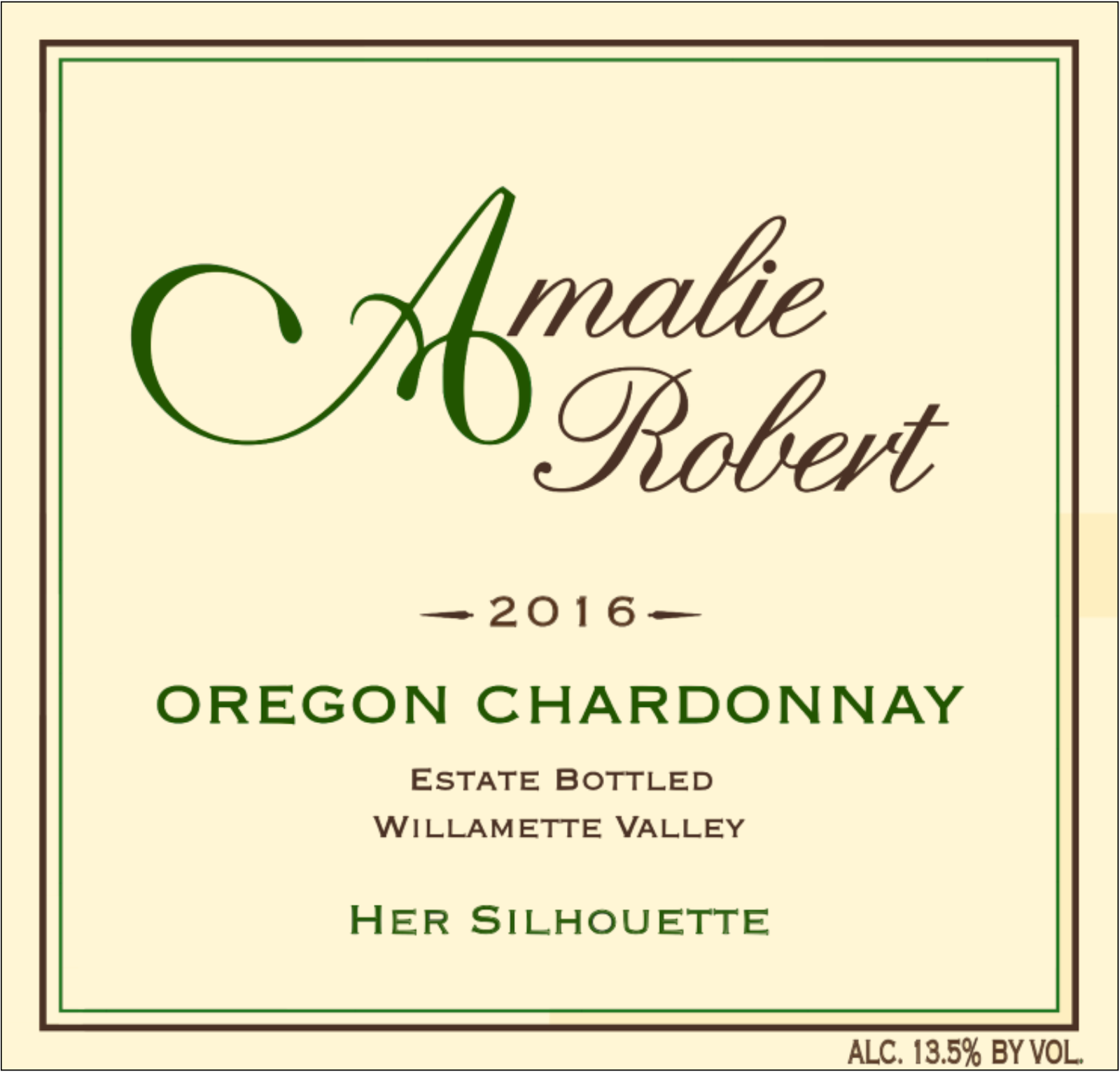
The stainless steel fermented white wines are a window into our terroir. 2016 Her Silhouette Chardonnay is our Chablis style, stainless steel fermented Chardonnay where we block the malo-lactic conversion.

“Brilliant straw-yellow. High-pitched Meyer lemon and green apple aromas are complemented by suave jasmine and zesty mineral notes. Tangy and focused on the palate, offering bitter citrus zest and pear skin flavors that pick up a gingery accent with air. Shows a hint of fennel on the finish, which lingers with strong, subtly sweet tenacity. 91.” - Vinous, February 8, 2018

2016 Our Muse Viognier is stainless steel fermented Viognier. This is part of Ernie’s Northern Rhône program. The 2016 vintage earns a 93 point review and an “Editors’ Choice” from Wine Enthusiast on April 1, 2018. (Tomorrow’s news today!)

“Pale green-tinged yellow. Bright and precise on the nose, displaying fresh white peach, tangerine and pungent floral qualities along with delicate honey and white pepper flourishes. Juicy, focused on light on its feet, offering juicy orchard and pit fruit flavors that are given tangy cut by an orange zest nuance. Finishes silky and long, featuring lingering florality and a hint of candied citrus fruits. 91.” - Vinous, February 8, 2018


The 2014 Heirloom Cameo Chardonnay is our BFC (Barrel Fermented Chardonnay.) Fermented in a new 500-liter puncheon each year, this is our answer to White Burgundy, Chassagne-Montrachet in particular.

“Limpid yellow. Ripe pear, Meyer lemon, vanilla and smoky minerals on the deeply perfumed nose, along with hints of jasmine and candied ginger that build in the background. Supple and well-concentrated, offering expansive citrus and orchard fruit flavors complemented by brioche and toasty lees nuances. The floral note repeats emphatically on the very long, supple finish, which is energized by a jolt of zesty acidity. 92.” - Vinous, February 8, 2018


Rosé is the newest category in the Amalie Robert Estate portfolio and we have doubled down. Our original Rosé of Pinot Noir is called Pinot in Pink Rosé. Fermented in stainless steel with vivacious acidity to “crush it” on the lanai, or veranda, or even the back patio. Yes, it’s really that versatile.

“Lurid orange-pink. Mineral-accented red berries, citrus fruits and rose pastille on the expressive, sharply focused nose. Juicy and precise on the palate, offering concentrated raspberry and tangerine flavors that show excellent clarity and spicy lift. Powerful yet lithe, delivering strong closing thrust and a lingering suggestion of candied flowers. 91.” - Vinous, February 8, 2018

Our latest effort, 2016 Bellpine Pearl Rosé is where you end up if you are thinking about making a base wine for sparkling wine. This wine is made from the wings of Pinot Meunier and Pinot Noir. In the weeks leading up to harvest, Ernie has the crew thin the wings from the main clusters. After a gentle pass through the press the juice picks up a little color and then is fermented in stainless steel.

“Full orange. Dried red berries, orange pith and pungent flowers on the mineral-accented nose. Concentrated red berry and citrus fruit flavors are accompanied by a spicy element that adds back-end lift and cut. Rich yet lively, delivering solid closing thrust on a long, supple finish that echoes the berry note. 90.” - Vinous, February 8, 2018


The ALT-Reds:

And there is good news for all of you Pinot Meunier fans out there! The 2015 vintage earns another 91 point review from Vinous. The pinnacle for us was the 2014 vintage. Last year the 2014 Pinot Meunier earned the highest rating of any Pinot Meunier from Oregon with a 92. They say it is a fine line between genius and insanity. What a difference a point makes. While the 2015 vintage has “left the building,” the 2016 Pinot Meunier is released and ready to go!

2015 vintage: “Brilliant red. Spice- and herb-tinged cherry and red currant scents, slowly joined by subtle woodsmoke and cola notes. Chewy and focused on entry, offering bitter cherry and rose pastille flavors that flesh out and become sweeter with air. Nicely concentrated but lively as well, showing strong closing thrust, dusty tannins and a lingering cherry note. 91.” - Vinous, February 8, 2018


And that brings us to the Syrah program at Amalie Robert Estate, aka Côte Rôtie from Oregon. Lucky Block 13 has 4 clones of Syrah all sourced from the cool Northern Rhône growing region called Côte Rôtie. Côte Rôtie is often referred to as the “Burgundy of the Rhone.” Hmm, sounds intriguing.

Due to a lack of focus and attention to detail during the grafting process, we have a few Viognier plants interspersed in Lucky Block 13. Sauce for the goose, as they say. Ernie said something quite different the first year he saw the Viognier grapes in his Syrah block. Nonetheless, he took it all in stride and chose not to dig them out. Besides, after three years, they had put down some serious roots. Farmer first, winemaker second, aka Winegrower.

While we harvest, ferment and barrel all of our 30 plus acres of Pinot Noir by block, Ernie drills down to the next level with Syrah. He harvests each row of Syrah separately. This is the only way he can maintain the clonal integrity of the block. Dena just smiles and remembers when they first met. “Yeah, Ernie is wired a little differently.”

About half of all the Syrah berries go in the fermenter on the stem as whole clusters. That’s a lot of astringency in a young wine, and it is going to take a while to unwind, but Ernie loves the tactile structure you can only get from whole cluster fermentation. No matter, these wines are built to slowly unwind over time. And that process starts with about 26 months of barrel maturation encased within 1,200 tons of concrete below grade in the cellar at Amalie Robert Estate.

After that amount of time things have mellowed out, a bit. Then it is time to see just what has evolved over the past couple of years. This is when we find out if we have a “Top Barrel” candidate from the vintage. If so, that single barrel is bottled separately as the Top Barrel Syrah and the remaining barrels are blended to create our Satisfaction Syrah.

2011 vintage Top Barrel Syrah: “In a thrilling cool-climate experiment, the team at Amalie Robert planted syrah and viognier on a single acre in a cool vineyard west of Salem, drawing from the four clones that Marcel Guigal recommended on a visit to Oregon. This wine barely crosses the threshold of 12 per cent alcohol, and in most respects would be thought of as backward. But the aromas - carob, smoke and olive - are resolved and mature, the flavors composed and quiet, dark red fruits marked by charry, mature tannins. Decant it to serve with lamb. 91.” - Year's Best US Syrahs, Patrick J. Comiskey, Wine & Spirits Magazine, February 2018


Included in the recent “Oregon’s Expanding Palette of Wines” from Vinous, February 8, 2018, is a little note about our Syrah program.

“Amalie Robert, whose vineyard is in the western part of the Willamette Valley, makes a very strong case for Syrah, but production of their two graceful wines is painfully small, as in just a few barrels of wine per vintage.”

2012 vintage Top Barrel Syrah: “Brilliant violet. A complex, expansive bouquet evokes ripe black and blue fruits, smoky Indian spices and potpourri, backed by subtle olive and cola nuances. Sweet, sappy and penetrating on the palate, offering intense blueberry, cassis, bitter chocolate and spicecake flavors and a strong suggestion of candied violet. Strongly channels the savory qualities of the northern Rhône and finishes extremely long, smooth and spicy, with subtle tannins building slowly. 94.” - Vinous, February 8, 2018

Please note, the 2012 Top Barrel is the highest rated Syrah from the Willamette Valley and the first to earn a 94 point review from Vinous. So for now, the Top Barrel reigns supreme.

2013 vintage Top Barrel Syrah: “Lurid ruby. Pungent, spice-tinged boysenberry, cherry pit and licorice scents are complemented by suggestions of cracked pepper, violet and woodsmoke. Juicy and focused on the palate, offering bitter cherry and dark berry flavors that unfold slowly on the back half. Decidedly lithe, even Pinot-esque compared to its 2012 sibling, featuring good tension and spicy cut on the very long, gently tannic finish. 92.” - Vinous, February 8, 2018

Ah yes, a Syrah with a Pinot-esque finish. That's how you know your Syrah was made by a Pinot guy. Not to be confused with Pinot made by a Syrah guy. For those of you who demand Satisfaction, here it is!

2011 vintage Satisfaction Syrah: “The 2011 Syrah Satisfaction includes 50% whole-cluster fruit of four Rhône clones (plus a touch of co-planté Viognier vines). Not picked until November 14, it has an attractive bouquet with macerated red cherries, Provençal herbs, juniper berries and a touch of melted wax. The palate is medium bodied with ripe red berry fruit mixed with blueberry, Seville orange marmalade and a healthy pinch of white pepper lending the finish that Rhône “vibe.” Very linear at the moment, the finish is quite tight. I would actually cellar this for one or two years as it should replay handsomely. 91.” - The Wine Advocate, March 2015

2012 vintage Satisfaction Syrah: “Vivid ruby. Heady spice- and mineral-accented raspberry and cherry scents show excellent clarity and pick up subtle woodsmoke and cola nuances as the wine opens up. Alluringly sweet and precise on the palate offering intense red fruit liqueur blood orange spicecake and violet pastille flavors that show a suave blend of richness of vivacity and no rough edges that I can detect. Finishes very long sappy and smooth with fine-grained tannins lending gentle grip. 92.” - Vinous, January 2017

2013 vintage Satisfaction Syrah: “Bright ruby. Fresh cherry and dark berries on the nose, along with hints of incense, olive paste and candied flowers. Energetic and focused in style, offering bitter cherry and cassis flavors and spicy touch of cracked pepper that appears on the back half. Finishes very long and precise, displaying repeating spiciness and dusty tannins that lend gentle grip. 90.” - Vinous, February 8, 2018


And that about wraps it up for the Spring Cellar Report. The Monthly FLOGs will start up again with the April update where we expect an early bud break, despite the late snow fall. That’s Mother Nature's sense of humor for you, what a kick in the pants! As farmers, we have learned it makes a difference which way you stand.

We realize that our communications are a tad bit longer than most that come across your inbox. Kind of like shoving 10 pounds of it in a 5 pound bag. Or as Ernie would tell you, that’s how we get three halves into our Pinot Noirs.


Kindest Regards,

Dena & Ernie


Monday, January 15, 2018

Amalie Robert Estate Vintage Update: 2017 Harvest After Action Report (HAAR)

Hello and Welcome, 

This is the 2017 Harvest After Action Report (AAR) from Amalie Robert Estate. A FLOG communication. 


The Great Cluster Pluck of 2017 began at Amalie Robert Estate in September by harvesting the wings of Pinot Noir for our Bellpine Pearl Rosé, and after much ado with our well pump, motor and wiring, we resumed with the Gewürztraminer, Chardonnay, Pinot Meunier and Pinot Noir. The Great Cluster Pluck of 2017 concluded in November with our cool climate, Côte Rôtie style Syrah and Viognier. 

And along the way to the New Year, there was the vintage extending two and a half months of fermentations, punch downs and ultimately pressing the red wine from the depleted skins and stems. This was about the time the tractor with the front forks that moves this material lost the ability to travel in reverse under its own power. This is why it is nice to have a sturdy chain and a Dodge Diesel Dually available. And a replacement tractor. Thanks Tom!


And a note about the well. By definition, a well is a hole in the ground that has water in it. This is a very nice thing to have. However, without the means to extract the water from 180 feet below the surface, a well is, well, not that useful. And that is why it is nice to have a competent plumber available. Like Forbes Plumbing. Thanks guys!

Meanwhile, the temperature dropped for a natural cold stabilization of our Chardonnay, Gewürztraminer and Bellpine Pearl Rosé, so we had to make time to steward those finished wines to bottle and top them off with a wee bit of natural tree bark, aka cork.

So from the start of September through nearly all of December, this was Ernie having his way with about 100 tons worth of wine berries. Looking back on this four month protracted ordeal, it could also be reasonably stated that the wine berries, the well and the tractor all had their way with him.


How to tell if you are out of water. After a successful day of gently pressing the wings of Wadenswil, 667 and Pommard clone Pinot Noir it was time to wash down the equipment. But first, let’s review what it takes to make the Bellpine Pearl Rosé. You need the following items and the time to execute the production and clean up plan:

Freshly plucked wings of Pinot Meunier and Pinot Noir (we go back and pluck the main clusters when they are fully mature).

A press to gently extract the clear juice from the be-winged wine berries and just a hint of color from the skins.

A pan to collect this sublime “Pinot in Pink” juice, with a valve that is attached in such a way that it can be fully opened and closed. The first processing day of the vintage always provides a great opportunity to refresh oneself on how (and why) all the bits and pieces fit together.

A pump to transfer the freshly extracted juice to a clean 1,000 liter stainless steel tank – about 250 gallons is all it will hold. This is nice to know in advance, during the planning portion of the day, before the production portion of the day ensues forthwith. A functioning drain, while effective in its own duties, is the receptacle of last resort.

Add in all of the obligatory hoses and various sundry bits and pieces and you too can make Rosé.

Note: While electrical power is also required to operate the equipment, it is not the focus of this section. We lost power after all of the wine berries were harvested. Once again, the Dodge Diesel Dually with a power inverter and 100’ extension cord saved the day. Punch down, we would like you to know, is a fully manual and hands on affair that does not require electrical power and continued unabated.


And then comes the wash down, with water. It all starts off so easily. Rinse everything down with cold water first to wash away the sugary juice and then move to ever hotter water to clean and eventually sanitize the equipment. So simple, even a winemaker can do it!

When you come to the point in the process where you are fully activating the hose nozzle while looking straight down it’s barrel, you are out of water. Instinctively we all know you can pull a vacuum but you cannot pull a hose, so we look to see if there is a kink in the hose. Nope, clear all the way back to the hose bib (still) mounted on the wall. And a second look confirms both the hot and cold valves are at least partially open.

Right. Down to the pumphouse we go. Here we find the hole in the ground that presumably has water in it. A circuit breaker box that controls the flow of electricity to various pumps and controllers that sense low water pressure and activate said pumps. And a 2,500 gallon above ground tank that Ernie had installed when we built the winery. Clever indeed.

But the circuits were all fine and the breakers were not tripped. Then we discovered a giant clue – the 2,500 gallon above ground tank was empty. Worse yet, it was not being refilled. It’s as if all the circuits were asleep or on break. But they were not asleep or on break. At this point, the notion that you cannot restore your own water crystalizes in your frontal lobe providing a sense of urgency and immediate focus on the plumber’s phone number that you have programmed on speed dial.

And that is how you know you are out of water.

But things designed by humans can usually be repaired by humans, albeit usually by bringing to bear a more intelligent design (and financial resources) than the original implementation. And that was the set of circumstances that restored our water supply. And harvest began, in earnest, the following morning.


As far as the wine berries are concerned they had quite a vintage. Just consider their itinerary of events leading up to the Great Cluster Pluck of 2017:

November 2016 through April 2017: Let’s have a nice relaxing winter rest while the humans scurry about pruning and tying down a fruiting cane. Hmm, looks nice. Maybe take up some nutrients from the fall cover crop and sluff off a layer of bark. Nothing too demanding and certainly not in any hurry. We have 6 months off!

March 53rd Budbreak: Whoa! Is it spring time already? What is that guy on the tractor up to? What a rude awakening! Time to push out the new buds and get some leaves going on.


June 11th Flowering: And here they are! This year’s bouquet of flowers. That sure makes the property smell fine! Meanwhile Ernie is figuring to add 105 days of ripening and looking at a harvest window in late September. Little does he know about the impending well issue.


August 6th Pinot Noir In Flagrante! Blushing wine berries start to emerge throughout the 55,000 vines. Just a few at first, but given time they all join in.


August 21st In the Path of Totality: The vines were treated to their first total solar eclipse. A Double Diurnal Day!

Photo by Vincent Cantwell

September 22nd Winging It: The first wings make it to the winery for the Bellpine Pearl Rosé.


October 5th OOW (Out Of Water): It’s a well thing.

October 12th: The Great Cluster Pluck begins!


From a climate point of view, 2017 continues the de-escalation of the last few overly hot vintages providing us a degree day total of 2,279. See below for a 15 year retrospective.


And once again we held out for rain and were handsomely rewarded. Most everything we plucked came in with very moderate sugars and nice hang time. The Chardonnay, however, was letting us know, that pretty soon it would be time to go.

You see Chardonnay does not really like rain. It can handle a little, but much more than just a passing conversation and Botrytis starts to take hold. The odd mauve colored wine berry tells us that they have developed pretty much all of the aroma and flavor we are going to get. If we let it hang through another shower or two and the temperature rises, the Botrytis will take over. So, we take it at first light when the buckets are clean.


Rainfall for October was 4.70 inches. Total rainfall for the vintage was 14.10 inches and distributed throughout the growing season as follows:


And then it got cold. While most everyone, if not in-fact everyone, was finished with harvest, Ernie was holding out for his cool climate, Côte Rôtie inspired Syrah and Viognier. We took the Viognier first and it went straight to the press and then stainless steel. The resulting juice was a very cool 40 degrees. Not a lot happening at 40 degrees, microbially speaking, so Ernie deployed his tried and true 300-watt fish tank heater. That pretty much did the trick and the following day the juice was fermenting and flocculating with great abandon. The dazzling aroma of white peaches and honeysuckle and tamarind filled the fermentation deck.

Now, what do you call a hole in the ground with ash coming out of it? No, that would be our neighboring grape growers lighting burn piles while we are still hanging fruit. The more correct answer is a volcano.

Lucky block 13 is the Syrah block. That is 4 Northern Rhône Syrah clones represented by 1,188 vines covering just short of one acre and is Cluster Plucked by clone. The oddly interplanted Viognier is treated as a light skinned Syrah clone and co-harvested and co-fermented with its dark skinned cousins. In the winery, we use about 50% whole cluster and ferment in the same 1.5 ton fermenters as we use for Pinot Noir. This is Syrah made by a Pinot guy. Which is quite a different thing than Pinot made by a Syrah guy. Maybe.


The fermenters started out that morning at 42 degrees. Hmm. Ernie thought to himself. I wonder if the indigenous yeast that came in on those wine berry skins will take off at 42 degrees. Not only did those two fermenters take off, it was so cold that all of the fruit flies died off before they could get in the fermenters. It was a Cluster Pluck miracle! And we just happened to end up with about 10 gallons of Syrah Rosé. So many wines, so little time.

But then it got real cold and Ernie was concerned, that maybe just perhaps, the fermenters would get too cold to finish fermenting. So he lined up the press and a nice new barrel, and he pressed the wine down to our below ground cellar.

“It will finish in barrel,” he proclaimed with a grin. “It will finish fermenting with the yeast from within!”

And with the Syrah safely tucked into barrel, we conclude the 2017 Harvest After Action Report (AAR).


Kindest Regards,


Dena & Ernie

Tuesday, December 5, 2017

Amalie Robert Estate: 2017 Happy Holidays!

As the season turns to friends and family, we would like to extend to you our warmest wishes for a very Merry Christmas and a fruitful New Year. We would also like to take this opportunity to welcome new friends to the Amalie Robert Estate FLOG. 


 The 5th of the month and the repeal of Prohibition! 

The 5th of the month has more significance than Ernie was previously aware. A thirst for knowledge and a little research has greatly expanded his appreciation for the 5th of the month.


January through March is a write-off. We are just too busy working to be bothered. However for some, the 5th of the month is payday.

April 5th is a day we wake up and realize the government is about to get more of our money than ever before. However, we owe ourselves about $20.6 trillion (up from about $19.9 trillion last year), that's just about $63,048 (up from about $61,315 last year) per person living in the United States, and $170,291 per taxpayer. Hmmm, back to work. You can check our progress from time to time right here.

As you well know, the holiday Cinco De Mayo is a celebration on the 5th day of the 5th month. The purpose of which is to celebrate the victory by the Mexican Army over the French Army in the Battle of Puebla on May 5, 1862. Of course, and as always, there is more to the story. Here is a link with more details.

We transition right to June 5th. This date is very significant to Ernie, as it is Dena’s birthday! As many of you know, Dena’s middle name is Amalie and is the palate defining Amalie’s Cuvée.


July 5th is the day we would have declared our Independence, however as Americans, we just couldn’t wait. Somewhat like opening a gift, or maybe two, on Christmas Eve.

August 4th, 2011, again we couldn’t wait, is the first time the US debt exceeded 100% of our Gross Domestic Product - GDP (Gosh Darn Politicians.)

However, August 5th brings little pink berries to our Pinot Noir vines. Ernie likes this, a lot!


September 5th is significant to all children and especially their parents. It usually is about the time the children are going back to school.

October 5th usually finds us in the middle of harvest. Due to the protracted nature of harvesting and fermenting Chardonnay, Pinot Meunier, Pinot Noir, Syrah, Viognier and now that little rascal Gewürztraminer, Ernie has dubbed the 10th and 11th months to be “Octo-vem-BIER.”


On December 5th we find ourselves at the end of the calendar. 2017 marks the 84th year of the repeal of the social experiment known as Prohibition.

On January 16th, 1919, the United States Congress passed the Volstead Act. The Volstead Act led to the 18th amendment to the Constitution of the United States. This marked the beginning of Prohibition. We wonder what Congress’s approval rating was that year.

This is an excerpt of section 1 of the 18th amendment:

“…the manufacture, sale, or transportation of intoxicating liquors within, the importation thereof into, or the exportation thereof from the United States and all territory subject to the jurisdiction thereof for beverage purposes is hereby prohibited.”

During the following 13 years, the people of the United States bore witness to the effects of Prohibition. Further, they were able to compare the politicians’ promises and pontifications to the experiences in their own daily lives - aka reality. This phenomenon has persisted in each and every congress since and can lead to the malady known as cognitive dissonance. Ernie calls it “Negotiated Reality.”

It was in 1929 that a curious little product was invented and granted trademark protection. Ernie may be deviating from his factual discourse here, but perhaps this product was used in reference to the politicians of the day who could not tell the difference between a good idea and Prohibition. Sometimes it is hard to tell fact from fiction, sometimes not. The product was a shoe wax called Shinola.


Winegrowers of the time were a hearty breed, they had to be. The manufacture, distribution and sale (including export offshore) of alcohol was illegal. If your livelihood depended on growing some 100 tons of grapes and selling the fermented juice, you were out of business (and so was your labor force), or so the politicians thought.

Now, let us introduce the law of Supply and Demand (Note: Much like gravity this is a law not subject to political pressure.) Despite a small minority trying to legislate morality on the entire citizenry, the American public sought to exercise their rights as citizens living in a free country. After all, that’s why they were here.

It turns out that many people had unexplained illnesses during those 13 years. In visiting their family physicians, it seemed the most cost effective treatment was the prescription of alcohol, wine in most cases, for medicinal purposes. Thankfully, there was not a government run healthcare system at the time to prevent such a low cost and effective treatment. It would have been illegal and besides, that’s what the bootleggers were for!


Even today, the debate continues over the health benefits of alcohol, red wine in particular and Pinot Noir specifically, for the high content of Resveratrol. If only the perennial healthcare debates and litigation were this simple. You can learn more about Resveratrol here.

We now come to the presidential election of 1932. FDR, as he was known, achieved many things. The most wide sweeping change affected nearly everyone in the United States and for generations to come, including several of our foreign trading partners. Recall, the importation of Canadian, Irish and Scotch whisky was also illegal. As an aside, Ernie’s time in Ireland taught him that the Scot’s never acknowledged Prohibition and kept the pipeline open.

On December 5th, 1933, the 21st amendment was ratified by the United States Congress. In what may be the most effective and efficient legislation known to this great country, here is Section 1 in its entirety:

“Section 1. The eighteenth article of amendment to the Constitution of the United States is hereby repealed.”


We see here that sweeping changes in legislation, or repeal of them, may be difficult, but certainty not impossible.

As you enjoy the holiday season, please take a moment to reflect on your constitutional right to grow, produce, blend, bottle, sell/purchase and consume wine, especially Pinot Noir! And if you find yourself in need of a little good cheer to celebrate this momentous occasion, then please visit yourself upon the Amalie Robert Company store. UPS drivers are standing by.

When the time is right, please enjoy our wines with friends, food and in moderation.

Kindest Regards,

Dena & Ernie


Saturday, September 30, 2017

Amalie Robert Estate Climate Update: 2017 September

This is the September 2017 Climate Update from Amalie Robert Estate. A FLOG communication.

And since the holidays are just up ahead of us, we would like to share an early Christmas gift with everyone.


Once again, Amalie Robert Estate finds itself on a Top 100 list. This year we have earned the top Pinot Noir spot with 93 points for the 2012 The Uncarved Block from Wine & Spirits “Top 100 Best Buys of the Year!”


The Master Farmer (MF) exam is scheduled to begin in October, and Ernie has been preparing for it since he drilled in the winter cover crop last fall.


Every year about this time, winegrowers in Oregon’s Willamette Valley take this exam. Unlike other wine accreditations such as MW, MS, WSET et al, the MF must achieve a passing grade each year. It’s really quite a Cluster Pluck when you get right down to it.


A MF must deliver healthy, mature wine berries that have stunning aromas and flavors regardless of the degree day accumulations, expected or unexpected rainfall, and be pristine exemplars of the variety with balanced acids (malic and tartaric) and sugars (glucose and fructose.) This is a pretty tall order to fill each year at Amalie Robert Estate that includes 6 varieties of wine berries covering 35 acres represented by about 55,000 vines. That’s roughly 800,000 clusters to be plucked, all by hand. Yeah, it’s a long way to the top if you got some grapes to haul.


At first light of the first morning of The Great Cluster Pluck, the MF’s plan is revealed for all to see. Well maintained tractors sporting fully inflated tires and full tanks of diesel are hitched to harvest trailers containing clean harvest bins with lids (to keep the rain and yellow jackets out) and buckets and extra buckets. Humans from all walks of life descend upon the vineyard with harvest shears at the ready. Clipboards with color coded control sheets and extra pens are clearly evident. The First Aid and water stations are mobile and always very close by. We are about to get it on, or get them off. Either is acceptable nomenclature.


The MF knows each block’s clone and rootstock combination and he is familiar with the soils they are planted into. He knows which blocks mature early. He knows if given the opportunity, which blocks to let hang a little longer. He knows a mug of steaming morning accelerant with dark chocolate is the best way to quietly watch the sunrise.


And so it goes, each day the MF has a new harvest target package identifying the blocks to be Cluster Plucked and in what order. When it is time to take the Chardonnay, the MF knows to start with the white wine berries while the buckets are clean before moving to the red wine berries. However, the interplanted Viognier is co-plucked with the Syrah. He knows that too and he knows why.

After the wine berries are delivered for the day, the MF collects the harvest buckets and does not let them be stacked. The juice will dry and permanently adhere the buckets into a 20 foot column of useless plastic. Tires are checked with more than just a swift kick, fuel tanks are filled and walk around inspections detect any loss of vital fluids, such as brake fluid. The MF likes a Dog Nose Beer (cold and wet) to celebrate the bounty of the harvest and skating past the pitfalls Mother Nature has set for him.

The MF is more than just connected with the land – it owns him. He is the steward of the mental construct that he has implemented to the best of his ability. The MF does not understand irrigation; he leaves that duty to Mother Nature. He does his best to preserve available soil moisture to keep the vine canopy functioning with the goal of achieving optimal aroma and flavor development for each variety of wine he grows. However, the MF understands erosion and erosion control with nutrient fixing cover crops. The MF performs tractor maintenance, knows when something should be fixed and when it should be replaced. Everything he drives runs on diesel.

The Master Farmer exam is administered over approximately 6 weeks (24x7) and concludes with the Syrah planted in lucky block 13. Then preparations begin for the 2018 Master Farmer exam with pruning.


The MF understands numbers. The MF knows they can be a guide, rules of the road that in some cases must be adhered to and in other cases, such as the speed limit, are more subject to interpretation. The MF knows to never pass on the opportunity to utilize the facilities.

We accumulated 426.4 degree days for September, which is “just fine.” The high temperature was 98.6 and the low temperature was 41.0. This brings the 2017 growing season to date degree days to 2,209.1. And that is right in the Master Farmer’s wheel house.


However, the big news is the lashing rain we received around midmonth. This was a variable rain event in that the rain received varied by the location. We were fortunate to receive about 2.7 inches over the course of 5 days. This rain event allowed the vines to rehydrate and lower the sugar concentration in the wine berries. The net effect was to allow more hang time to fully develop aromas and flavors without excess alcohol potential. Total rain for the month of September was 3.13 inches and the growing season to date total is 9.40 inches.


Then, as if pre-ordained, sunny, breezy and dry conditions prevailed as we began the Master Farmer exam aka The Great Cluster Pluck of 2017. Drama ensued forthwith in the form of a terminal well pump, loss of power at the winery and a broken clutch return spring on the tractor. All par for the course and fair game for the Master Farmer exam.

Kindest Regards,

Dena & Ernie