Introduction

Winemaking: The Continuation of Terroir by Other Means.®

Welcome to the Amalie Robert Estate Farming Blog, aka FLOG. By subscribing, you will receive regular FLOGGINGS throughout the growing season. The FLOGGING will begin with the Spring Cellar Report in April. FLOGGINGS will continue each month and detail how the vintage is shaping up. You may also be FLOGGED directly after the big Cluster Pluck with the yearly Harvest After Action Report. Subscribe now and let the FLOGGINGS begin!

Rusty

"This is one of the Willamette Valley’s most distinguished wineries, but not one that is widely known."

- Rusty Gaffney, PinotFile - September 2016

Josh

"Dena Drews and Ernie Pink have been quietly producing some of Oregon's most elegant and perfumed Pinots since the 2004 vintage. Their 30-acre vineyard outside the town of Dallas, abutting the famed Freedom Hill vineyard where Drews and Pink live, is painstakingly farmed and yields are kept low so production of these wines is limited. Winemaking includes abundant use of whole clusters, which is no doubt responsible for the wines' exotic bouquets and sneaky structure…"

- Josh Raynolds, Vinous - October 2015

David

"...Dallas growers Dena Drews and Ernie Pink... showed me this July three of their reserve bottlings and thereby altered my perception of their endeavors. Since these are produced in only one- or two-barrel quantities, they offer an extreme instance of a phenomenon encountered at numerous Willamette addresses, whose really exciting releases are extremely limited. But they also testify, importantly, to what is possible; and what’s possible from this site in these hands revealed itself to be extraordinary!... And what a Syrah!"

- David Schildknecht, The Wine Advocate - October 2013

Wine & Spirits

"Finding that their whole-cluster tannins take some time to integrate, Pink and Drews hold their wines in barrel for up to 18 months - so Amalie Robert is just releasing its 2008s. And what a stellar group of wines: Bright and tart, they possess both transparency and substance, emphasizing notes of rosehips and sandalwood as much as red berries. The pinot noirs alone would likely have earned Amalie Robert a top 100 nod this year. But the winery also produces cool-climate syrah that rivals the best examples from the Sonoma Coast. And the 2009 Heirloom Cameo, their first attempt at a barrel-fermented chardonnay, turned out to be one of our favorite Oregon chardonnays of the year. Ten vintages in, Amalie Robert has hit its stride."

- Luke Sykora, Wine & Spirits Magazine – September 2011

Copyright

© 2005 – 2021 Amalie Robert Estate, LLC

Wednesday, October 31, 2018

Amalie Robert Estate Vintage Update: 2018 Harvest After Action Report (AAR)


Hello and Welcome,  
The is the 2018 Harvest After Action Report (AAR) from Amalie Robert Estate. A FLOG Communication.  
Bringing in the harvest is the last act of farming. It is the culmination of all that has happened since the last time you harvested. And harvest equipment is kind of like winemaking equipment. You own it all year long, but you only get to use it once a year. You will look pretty silly running the harvest trailers around the vineyard in mid-April, unless you are from down under. Farm equipment, on the other hand is used most every day during the growing season, but not so much during the dormant season. The dormant season is when you perform the sacred “equipment maintenance” ritual along with a few “Hail Marys” and prayers to the patron saint of all things mechanical – Rube Goldberg.


But it is the vertically integrated wine growers and winemakers (the “ers”) that keep busy year-round. And let’s not forget the marketers. Without whom, you would not be able to enjoy a fine and pleasant FLOGing on a semi-irregular and somewhat irreverent basis.

Enough about us, let’s explore the tons and tons of sublime wine berries that were brought in this year by the human harvesters. We will leave the winged and hooved harvesters (aka blighters) for another FLOG.

Of course, there is math, just no avoiding it as a farmer. So, pull a cork and sip-along. First off you will need a piece of scratch paper, unless you want a permanent record, then go ahead and write it on the table with a Sharpie. In the upper left-hand corner, draw a 5 gallon plastic bucket with a handle.

Now go ahead and write the number “20” inside the bucket that you just drew. This represents how many pounds of wine berries are harvested in any given bucket. Now to be sure this is just an average. There may in fact be one or maybe two buckets that actually do weigh 20 pounds, the law of large numbers will see to that. By far and away, most buckets will not contain exactly 20 pounds of wine berries. (How many months have 28 days? – All of them…)

Most will contain at least 20 pounds, so we have a little wiggle room when a bucket gets spilled or contains a compromised cluster that needs to be “sorted out”. Yeah we do that right there in the field for the rest of the clusters see. They feel shame.

The harvest bucket is the keystone to making harvest work. So much is riding on this little piece of molded plastic with a half moon metal hoop precariously attached to the top. For Pinot Noir in particular, it takes about 4 clusters to make up a pound. You could say 4 ounces each, or if you are metrically oriented, that would be 454 grams divided by 4. Note: This is an exercise left to the metrically oriented reader.

Clearly, you can see which way we are oriented. (Note: Oreintated is not a real word. The same holds true for substainable, even here on the farm.). It‘s not that we are metrically challenged, it is just one more conversion to do when your synapses are already firing as fast as humanly possible. Even Einstein would tell you to write these conversions down for quick reference, so you could occupy your brain with more important matters. Like clusters per bucket, then buckets per harvest tote bin and followed-up with Ernie’s favorite measure: furlongs per fortnight.


And if we have done a good job in the field, any given vine will have about 12 clusters representing 3 pounds of wine berries. Now, you see where we are going. If a harvest bucket weighs in at around 20 pounds, this means there are going to be somewhere around 80 clusters in there. This is true for the metrically oriented reader as well, no conversion required - yet.


Here is where the math gets a bit more intense. If we harvest 80 clusters per bucket and any given vine has 12 clusters, how many vines are harvested for each two bucket human harvester trip to the harvest trailer? The old story problem brought back from the far, far away elementary school days. Well, the answer is “it depends”, which is mostly what they teach you to say in MBA school. If only we knew that as kids, we would have aced math class!

Assuming all the clusters on the vine are actually harvested, and you know some of them won’t make “the cut”, we can get between six and seven vines harvested per bucket, or let’s just say 13 vines for every pair of buckets coming up to the harvest trailer. But sometimes the winged harvester and the hooved harvester have visited the vine before the human harvester. This adds systemic variability and skews the entire multivariable equation in context of the time space continuum.

The long-range implication of that revelation is that we have about 55,000 vines to harvest. So that is roughly 4,250 two bucket trips to the harvest trailer. And to consider the human factor, we would say that is one human making 4,250 trips to the harvest trailer, or 10 humans making 425 trips to the harvest trailer, or maybe 20 humans each making 210 trips to the harvest trailer.


We go with the 20 human option, spread over a few weeks in the time space continuum. To give credit where credit is due, the human harvesters work very, very hard. It is physically demanding work and not well suited for the chronologically advanced. As most of you know, premium Oregon vineyards are situated on hillsides which makes running up and back down the rows more challenging. This adds a dimension of complexity that is clearly present in all of our wines.

A full day for any human harvesting wine berries is 100 buckets (50 two bucket trips) to the harvest trailer. That comes in as 20 pounds by 100 buckets for 2,00 pounds, or one ton. A metric ton is 2,205 pounds, and, well quite franc-ly, what do you do with that?

Now go ahead and draw a harvest tote bin just under the bucket. A harvest tote bin is 4 feet square by about 30 inches tall. Ours are white, so we know when we get them clean, but you can make yours whatever color you like.( Maybe a rainbow with a unicorn would be nice – parenthetically speaking). A harvest tote bin at Amalie Robert Estate should contain 36 harvest buckets and then a lid is snapped on to indicate to the yellow jackets that these wine berries are ours. Then we say the UK abbreviation for post office, which happens to be “P. Off”. Trust on this, Dena lived there and Ernie has never let it go. They speak English and we speak American. Good to know if you are planning a trip and need to ask someone where to “post” something. They will most likely tell you “P. Off!”


The key to the winery operating as smoothly as it was expertly designed by Mr. Munch, is getting 36 buckets (20 pounds each) of wine berries into each of these harvest tote bins. Now, go ahead and draw 36 buckets worth of wine berries in your harvest tote bin and then draw a lid on it. You can add a few angry yellow jackets (V. germanica most likely) buzzing about trying to sting people, or actually stinging people, or stinging you, depending on how you are oriented. Quickly draw an Epi-Pen if you are feeling like you may be going into anaphylactic shock. Whew, that was close.

Legal Disclaimer: If you publish your drawing and become rich and famous, we want a cut of the action.

There are three harvest bins on a harvest trailer that is hooked up to the tractor that Ernie drives to the winery to drop off full harvest tote bins and return with empty harvest tote bins. Ernie is inside a cab, so don’t draw any yellow jackets in there. But he does have his genuine USPS 1989 Montana Statehood commemorative stamp coffee mug full of morning accelerant if you want to draw that. A postage stamp in 1989 was 2 bits. Even in Two Dot, which is located in Wheatland County, Montana.

And now, the magic of 36 will be revealed for all to see. Just to the right of your harvest tote bin, go ahead and draw a fermenter. A fermenter has the same footprint as a harvest tote bin, but it is about 4.5 feet tall. Again, ours are white HDPE plastic, which makes it easy to see the wine berries and resulting wine. But to each his own.


Now, you don’t really need to know any of that, it’s called a red herring. Doodle one of those on your desk blotter, because you won’t have any space here. But what you do need to know is that our fermenters can only hold 1.4 tons (2,800 pounds when you ferment with whole clusters as we do, and you would too). Herein lies the lesson: 36 buckets by 20 pounds by 4 harvest bins fills a fermenter properly. And by properly we mean it is so full that we can get a warm (but not hot) fermentation to extract all the great aroma, flavor and texture, but not so full that the wine overflows and makes its way to the drain. You know, a proper fermentation – not too hot, not too cold and certainly not overfull. On the other side of the coin, an overfull fermenter is a sad, but self-correcting situation.

But wait, there is more math. We have 36 harvest bins. And that just so happens to be 12 trailer loads of 3 harvest tote bins. And those 36 harvest tote bins, at 4 per fermenter, will exactly fill 9 fermenters. How do you suppose that happened? Recheck your math on that furlong to fortnight conversion.

On the remaining open space of your paper, or the rest of the table, draw as many fermenters as you have room for. Now, fill them until all of the grapes are harvested or all of the fermenters are full, whichever comes first. Your mileage may vary.

The weather coming into harvest this year reminded us of the World Series. Those boys from Beantown won one, lost one and then they would simply not be denied. Even if it took 7 hours and 20 minutes to do so. It became a World Serious! Congratulations and ring up those folks at Gillette and get yourselves some razors.

We started The Great Cluster Pluck of 2018 with a warm, late September pluck for Ernie’s pre-sparkling wine project called the Bellpine Pearl. This wine is made from the wings of Pinot Meunier and Pinot Noir. The first vintage was 2015 and it was a white wine, and with 2018 we return to that style. Maybe, someday, it will actually be a proper sparkling wine, or Ernie will mess something up and it will be fizzy in the bottle. Until then, you will need a tall narrow glass, a straw and some form of eye protection (OSHA approved) to make your own bubbles.

Then, it rained. It was amazing and just what we were all hopping around the vineyard for - aka the rain dance. The first week of Okto-vember was cool and damp. Not enough to encourage the Botrytis, but enough to slow down sugar accumulation by rehydrating the wine berries. The best gift of all was to allow a little more hang time for aroma and flavor development. It was a gift from Mother Nature and all was right with the world.

The next week we were right back up in the 90 degree range. So much for a repeat of the wonderfully expressive 2007 vintage. The rest of October, just like those Red Sox, kept the heat on. It was GO, GO, GO and then GO some more! And so we did, 36 buckets per each. Vintage 2018.


The terms “indigenous fermentation” or “wild fermentation” refer to those select few individuals who choose not to add commercial yeast from a bag to their fermenters. We are included among those individuals. Instead, we rely on the yeast from the vineyard to start and complete our fermentation.

It is true, that the wine berries not only have indigenous yeast on them when the arrive at the winery, 36 buckets per harvest tote bin, they also have some other nefarious yeasts and bacteria. All of that gets mixed together, 36 buckets as whole clusters and 108 buckets as whole berries, into a fermenter and off they go! It’s a “Party in our Pinot”, microbially speaking.


All of this pre-supposes that you have successfully chosen days to process said wine berries when the power company has not chosen those very same days for “infrastructure maintenance" resulting in a loss of electricity. Fortunately, punchdown is done by hand, so no worries there. The other environmental concern to be aware of is when the State of Oregon lifts the backyard burn restrictions. That is usually at the end of October, and it becomes quite obvious who the closet pyromaniacs are in your neighborhood. They are all out in full regalia for opening day!

So, while all of this is very interesting and quite esoteric, you may be wondering how we know the indigenous yeast from the vineyard is going to ferment the wine berries. For an illustrative answer to that question we turn our attention to that horrible little insect, the fruit fly (Horribilis minimus).

Fruit flies, as annoying as they are, can teach us all a great deal about indigenous fermentation. Much like the yeast that ferments our wine, fruit flies seem to appear out of thin air. Two of the right fruit flies, or maybe just one of the wrong ones if you are (un)lucky can spawn an entire army that will colonize the winery in an exponentially reproductive fashion. We all know that 2 plus 2 is 4 and that 2 squared is 4, but 4 plus 4 is 8 and 4 squared is 16. Even Einstein’s theory of relativity informs us that time flies like an arrow, but fruit flies like a banana. Or was that Groucho Marx?

Yeast rely on cell division to reproduce, so none of that egg laying business. However, it would seem that the exponential population growth of both indigenous yeast and fruit flies are quite similar. It is a sad day when the first couple of fruit flies are spotted. From that point on, Ernie is somewhat militant, in an “A type” manner, about cleaning everything that has, or has had, contact with a wine berry.


Conversely, when you see the first carbon dioxide bubbles of fermentation, you are elated! Fermentation has begun! It actually worked! We were not so sure in 2006, with our first vintage in a brand new building. Two weeks is a long time to wait to see any sign of fermentation. We had fruit flies the first day for sure, but we had to wait for the indigenous yeast. Now that the building is inoculated with our own Amalie Robert Estate indigenous yeast, it just takes a couple of days or so and we behold the magic of fermentation. Often times through the purview of the fruit fly.

What gets measured is what gets done. That is a bit of wisdom Ernie picked up early in his career and it has served him well. Fully integrated and somewhat autonomous self-calculating spreadsheets track every vineyard activity and operation. A nickel is not a big deal, but multiply that little nickel by 55,000 vines and suddenly you have a meaningful number.

Ernie doesn’t start tracking the fruit fly population until it gets to about 1 million. Once it gets to 5 million, all of the fermenters should be full of indigenous yeast and actively producing carbon dioxide. Note: The vines are going to need that carbon dioxide next Spring, but in the meantime, Ernie has a plan.

Refer back to your diagram and notice the section with all of the fermenters. You probably drew them from a side view, and that is fine as you can now speckle your drawing with 5 million fruit flies. And don’t forget to put yourself in the picture. Maybe you are doing punchdown or washing the floor. Or maybe you just got stung, again… Kinda looks like a Jackson Pollock sort of thing. Well done, well done indeed!

And soon enough the fruit fly is interacting with your environment. From their point of view, you are interacting with their environment. Hard to say who is right or wrong, but a fruit fly in your ear or up the nose is clearly right out. And when they show up at your house, because they are in your hair and your clothes, you have performed cross inoculation - whether you knew it or not. And the whole cycle starts all over again, in your environment.

Ernie takes a more top down view. His view is looking down from directly above the fermenter. And he sees a piece of 4x4 HDPE plastic that sits on top of the fermenter and covers the wine berries.

He had these tops custom cut and they sit just inside the lip of the fermenter. At each corner there is just a wee little bit of a gap where they don’t fit snug. The fruit fly is predisposed to find this opening, and this is where they try to gain unauthorized access to the fermenting wine berries inside.

But they are greeted with the by product of indigenous yeast – carbon dioxide. A fermenter will produce about 14 times its volume worth of carbon dioxide. Ask anybody, that’s a whole lotta gas. With the tops in place, all of that gas has to escape from the 4 corners where the tops are not snug. And that is where the fruit flies mass for attack. But there will be no attack because they have all been asphyxiated. That’s a twofer for carbon dioxide. It’s not such a bad gas after all.

The other alternative is a Venus flytrap plant. Ernie first saw one of these in a winery setting while chatting with Steve Doerner at Cristom. We were delivering Pinot Noir wine berries to Cristom before we built our winery, and the significance that that plant represented was lost on us, at the time. The Venus flytrap plant is a poignant reminder of the sheer magnitude of the situation.

Eventually, about 4 to 6 weeks after harvest, the indigenous yeast complete their task and transform Fructose and Glucose into alcohol. They have produced a boatload of carbon dioxide responsible for killing most of the fruit flies and now lie dormant at the bottom of the fermenter, and on virtually every surface of the fermentation deck. They lie in wait, ready for the next harvest and the onslaught from a new battalion of fruit fly.


Then it was done. The end of October saw the Syrah and Viognier harvest, just before a nice shot of rain the next day. After the rain, the soil was perfect to drill in the fall cover crop. This gave Ernie a chance to get a jump on vintage 2019. The best laid plans…


If it has wheels or balls it will cause you trouble sooner or later. Today, this is in refence to tractors, Italian tractors in particular, to which Ernie owns three. One has steel tracks, and two have wheels. Out of the two with wheels, one has balls. The tractor in question has both wheels and balls.


Dena holding a pair of “Tractor Balls”

Off he goes, drilling away on a beautiful November day. It was simply perfect, the week of the ¡Salud!Pinot Noir auction planting our cover crop that will hold our soil through the winter rains and provide nutrients for our vines next Spring when it is tilled under. What could possibly go wrong?


Well, once Ernie got the tractor out of the 7.5-foot-wide row, he could clearly see what went wrong. The tractor balls were in place holding the seed drill to the three-point hitch, but he was missing a few lug nuts and a wheel stud or two.


Based on his 20 years of farming experience, and a few years of street racing, he knew what he needed to do. He also knew he had to get that tractor out of the field before the rains would most certainly arrive. Or, like back in Montana, wait until next spring to drive it out. It was a situation to focus the mind and provide a sense of urgency. What a time to be out of beer.

The decision tree went something like this. Order a new wheel, wheel studs and lug nuts, swap the tire onto the new wheel and remount on the tractor. Then finish drilling cover crop and drive the tractor out of the field before the rains made it a permanent fixture. As Ernie set this plan in motion, he remembered the words from his old boss at Microsoft - the Army guy. He said, “A plan never survives first contact with the enemy intact.”

It turns out that agricultural tractor wheel technology had changed over the past 20 years, and his style of wheel was no longer being produced. A glimmer of panic ensued. A call to the local dealer turned up a very small wheel that could be used to move the tractor, but not a permanent solution. The glimmer began to glow. The local Ag store had never seen anything like this wheel before. But they offered to build one out of scratch… Burning brightly now.

So, a call to the importer was the next step. The parts man was Clarence and while he was reluctant to deal with an “end user”, he finally relented to Ernie’s subtle “A-Type” ways. Any parts man worth his salt will ask for the serial number of the tractor as a defense mechanism. No serial number, no parts and goodbye. Ernie had his newly renewed insurance policy on the counter, thumbed through some pages and there it was. The serial number was the key to taking the next step.

Clarence was not impressed. He said the tractor came with 20-inch front wheels. Ernie confirmed his wheels were only 18-inch. “Well, then I can’t help you.” Ernie’s mind flashed back to the day he was standing at the Guigal winery talking with Marcel Guigal about Syrah clones. Think of something to say, and do it now!

“Well, the tire size is 280x70x18. Do you have any wheel that would fit that tire and my tractor?” Ernie’s question was met with a “Harumph.” But that happened to be the magic question that returned a part number! HA! This is going to work! But the next question foreshadowed things to come.

“Do you have one in stock?” Ernie asked, oh so gingerly. “Nope. The last one we sold was in 2006.” It turns out that no one in the United States had one in stock. And that if Ernie were to get one, it would have to come from the supplier, if they still had any. Being an Italian tractor, with both wheels and balls, the supplier was located in Europe, mostly likely Italy and that was a 2 week lead time, at best. If they had one. Cost approaching $1,000 all in, converted from metric.

Plan B arose like a Phoenix out of the smoldering ashes of the decision tree. It turns out, Ernie had a spare wheel from his other wheel tractor, that does not have balls. It is 100 horsepower, just no balls. The wheel leaked air, so he replaced it. The replacement wheel also leaked air, so he put a tube in it. But the wheel fit a 20-inch tire, not an 18-inch tire. However, the center mounting spokes were identical.

The local tractor dealer said that he knew a guy that could help Ernie with his problem. And would he be interested in checking out a new tractor while he was here? Off to King’s Industries to meet the key to this whole sordid affair. Ray King has a relatively small, but very well-kept machine shop not very conveniently located to the vineyard.

Friday afternoon, on the way to the ¡Salud! Pinot Noir auction, we met Ray King. Ray looked at Ernie’s handiwork on the 18-inch wheel and the nearly new 20-inch wheel and gave a quick nod. “I am not sure I can have it done today, but I am leaving town on Sunday, so I have to get to it before then unless you want to wait until next week.” “I can pick it up anytime tomorrow, if you can get to it,” Ernie heard himself say.

Saturday morning, he got the call. “Your wheel is done. You can come by and pick it up anytime.” Ernie thought to himself, either this Ray King guy is really good, or he has no idea what he is doing. Ernie was betting on the former. He wasn’t asking for a miracle, he was depending on one.

Sure enough, the wheel looked like it was just shipped from the factory. Ray explained how he tack welded a ring onto the good spokes, cut them off the wheel as one piece and then welded them into the 18-inch wheel. Ernie smiled and said, “I see you have done this before.” $175 dollars and 4 days later, Ernie was back drilling cover crop. Almost.


It turns out those wheel studs and nuts were as scarce as the wheel. So, it was another call back to Clarence. No serial number required this time, so it was a much shorter call. Add $150 for a set of 5 wheel studs, nuts and washers - Next Day air.

Back to Les Schwab to get the tire mounted onto the newly repaired wheel. Ray insisted the tire be taken off the wheel as he did not want the tire catching on fire while he was welding the wheel. Ray is the kind of guy that doesn’t run with scissors. Add $75 for a new tube, dismount and remount.

Now, Ernie had all the pieces to complete the repair. The glimmer of despair was replaced with the boldly burning fire of conquest! Pull out the floor jack, turn on the air compressor and get the impact wrench! We are going to mount this wheel! And so he did.


Every time Ernie goes to get in a tractor now, his precheck sequence has added responsibility. He must check not only their wheels and balls, now he has to torque their Italian studs and nuts.


Finally, the numbers. Let’s start with some serial numbers. While you are not likely to run across these unique sets of numbers, they are the real deal. If you happen upon them or they upon you, please let us know. Or your local law enforcement officials as they will know what to do.

260-75754
117-33556
B6258927
18401PZ163
3.141592653 (Actually this is not a serial number. It is Pi and goes on forever!)

And we have a NEW video to share! You can check out the Facebook page for the Dallas Oregon Sheriff’s department here. Recognize anyone? See something, say something.

And the farming numbers. “Hotter than the hubs of Hell” was the expression Ernie’s grandmother, Bert, used to say. Ernie just says, “Twenty-five hundred. You are a smart guy, you figure it out.” Way too farming hot to grow elegant Pinot Noir. Syrah, yes of course. A manly wine in touch with its feminine side. But Pinot Noir, not so farming much. But there it is. 2,502 degree days. Not since the horrific 2003 vintage (2,699 degree days) and the also ran 2014 vintage (2,499 degree days) have we been subject to such intolerable growing conditions.

Right. The last set of growing season Degree Day numbers we shared were April through August. The degree day accumulation through August was 1,954 Degree Days. Not so bad, pretty good overall. But what we thought would be a more moderate fall, morphed into a warm and exceedingly dry end of the growing season.

September added 342 Degree Days and October added 205 Degree Days for a 2018 vintage total of 2,502 Degree Days. You can check out the 16 year growing season Degree Day chart below to see how vintage 2018 stacks up. Channeling vintage 2007, 2010 and 2011: “Miss me yet?”


And it was dry, dry, dry as a popcorn flatulent. The first 2 weeks of September gifted us 0.51 inches of precipitation. However, the 90 day period preceding that September shower was one of the most beautiful summers to be had in Oregon, and all of those days were without precipitation. So that rainfall really didn’t get down to the roots. The opportunistic grass, gentle fall breezes and Photosynthetically Active Radiation (Farmer speak is PAR, you know it as sunshine) took care of that moisture in short order. Harvest began nonetheless on September 17th as we were sure (praying) more moisture was in store for us.

October delivered on that promise. The 6th of October registered 0.44 inches of rainfall. That was 3 weeks after the last 0.51 inches of rain, and as they say, too little too late. But we are farmers, and we just take it. Here is the second kick from our friend the mule. The high temperature in October was 82.4 degrees. That’s not bad, you think out loud. That temperature was recorded on the 16th of October. A little late in the game for that kind of heat. Hey Frank, can you get us some more beer and sunscreen?


So, climatically speaking, we have just about an inch of rain from June 11th through October 28th. Heat accumulation from the same period, June through October, was 1,717 Degree Days. Simply unprecedented. And let us remind you that when we planted the Pinot Noir, Ernie was keen on the deep rooting proclivities of 5C rootstock as we were going the dry farmed route. We will talk more about 5C, but we are not there yet.

At this juncture, we know what you are thinking. Ernie is just whining about over extraction, the demise of elegant, lower alcohol Pinot Noir and you would be right. But he is also waiting out Mother Nature for his Syrah and Viognier.

Everyone thought Ernie was daft for planting Syrah in the first place. He took the first class, one-way, nonrefundable ticket all the way to crazy town by grafting those vines onto the deepest rooting, latest ripening rootstock available to him – 5C.

Everyone said 5C will never ripen Syrah. You will be lucky to get Pinot Noir to ripen on 5C. That rootstock sends the roots too deep looking for water and they will not experience the drought condition needed to stop growing leaves and start ripening fruit. The vines will be stuck in a vegetative cycle and direct all their energy to growing more leaves, not ripening the fruit. Everyone said you will not be successful growing Syrah in the Northern Willamette Valley.

If you see “everyone” tell them we said “hello”.

So that “ungrowable” 5C rootstock underlies most of the vineyard at Amalie Robert Estate from Chardonnay, Pinot Meunier, Pinot Noir and, of course, Syrah. Wine berries grown on our sedimentary Bellpine series soil and 5C rootstock have been the “hot ticket” these past few vintages.

While everyone is freaking out over skyrocketing sugar accumulations from lesser, shallow rooting rootstocks, Ernie is planning his work and working his plan. He is about 20 years in on his plan and has seen most of the idiosyncrasies and agricultural vagaries. But every year is a new set of answers, even though the questions remain the same. Labor is a new and challenging issue each and every year. That’s farmin’.

And if you refer back to our handy-dandy Amalie Robert Estate, site specific Degree Day chart, you can see how the 5C rootstock with deep, moisture extracting roots, can help moderate these arid conditions of the last several years. In fact, 5C and own rooted grapevines are very similar in their rooting proclivities.

Mother Nature does have a sense of humor, or is that irony?. The 29th of October gave us over 2 inches of rain, and that is when Ernie “pulled the trigger” on the Viognier and Syrah-ah-ah-ah-ah!


We apologize for the lateness of this communication, but we had a little more “action” than we were expecting this year. We endeavor to be more timely for vintage 2019. Hey, we are pruning the vines right now!

Kindest Regards,

Dena & Ernie

Friday, August 31, 2018

Amalie Robert Estate Climate Update: 2018 June, July and August


Hello and Welcome,  
  
September Spoiler Alert: 
  
It looks like the first two weeks of September are giving us a spectacular finish to vintage 2018. Our temperatures have moderated down to the low to mid 70s during the day and are dipping into the 30s at night. And get yourself some of this - we have logged a half inch of rain! Surely, you are going to need more Rosé.

Not that we can read the tea leaves, but if we could they would be Darjeeling. We are experiencing a cool weather pattern extending hang time to build elegant aromas and flavors in our wine berries while keeping our sugars in balance. Even the Satisfaction Syrah, which is a manly-man wine, is getting in touch with its feminine side. Well Mr. Beauregard, I do declare!

As a dry farmed vineyard, after so many dry farming days, a half inch of rain is pretty farmin’ nice! Yes, we can break that down using farmer math. There are 13,577 gallons of water in 0.50 inches of rain over 1 acre of land (and Greg, that much rain weighs in at 56.5 tons spread over 43,560 square feet). We have 1,452 vines in any given acre of vineyard, providing a cool and refreshing 9.35 gallons of water per vine. Add some clear skies with a cool breeze and Bob’s your uncle.


And to put that in perspective, we are looking to produce about 1 bottle of wine per vine. That is 25.4 ounces of wine per vine! In case you are new to this FLOG, Ernie is the dry farming farmer who dry farms our vines. And the humor, well, it is as dry as a kidney filtered bottle of Pinot More.

Which is a great segue into the mid-September numbers. We logged 183.76 degree days through September 15th providing a growing season to date total of 2,138.24 degree days. The high temperature was 96.4 degrees on September 5th and the low temperature was a chilly 37.5 degrees on September 9th. Yay SeptemBERRR!

Note: The 2,138.24 degree days represents a total of 20,160 data points. Guess who has been out wading through the minutiae. You know, why be difficult, when with just a little more effort you can be impossible?

And the rains came! We logged 0.51 inches of rain which broke a dry spell all the way back to June 11th and provided a growing season to date rainfall of 7.84 inches. Tune in next time when Ernie will explain how many raindrops that really is. This is excruciating! Yeah, we know…

Now without further ado, onto your regularly scheduled (albeit belated) FLOG.


This is the 2018 June – July – August Climate Update from Amalie Robert Estate. A FLOG communication.

It’s been a while since we have shared this cyber space. And it is a good thing, because two physical objects cannot share the same physical space at the same time. That is why auto insurance was invented.

We hope you enjoyed your respite and are ready for a ONE, a TWO, a THREE month, action packed Amalie Robert Estate Climate Update! To provide added perspective, this Climate Update is being penned from 35,000 feet above the vineyard floor in an Airbus A320 which was built in 1992. Yeah, Ernie doesn’t get off the farm much in the summer, but he does have a keen eye for the esoteric. So, buckle-up, pull a cork and set your mobile device to vineyard mode. Here we go!


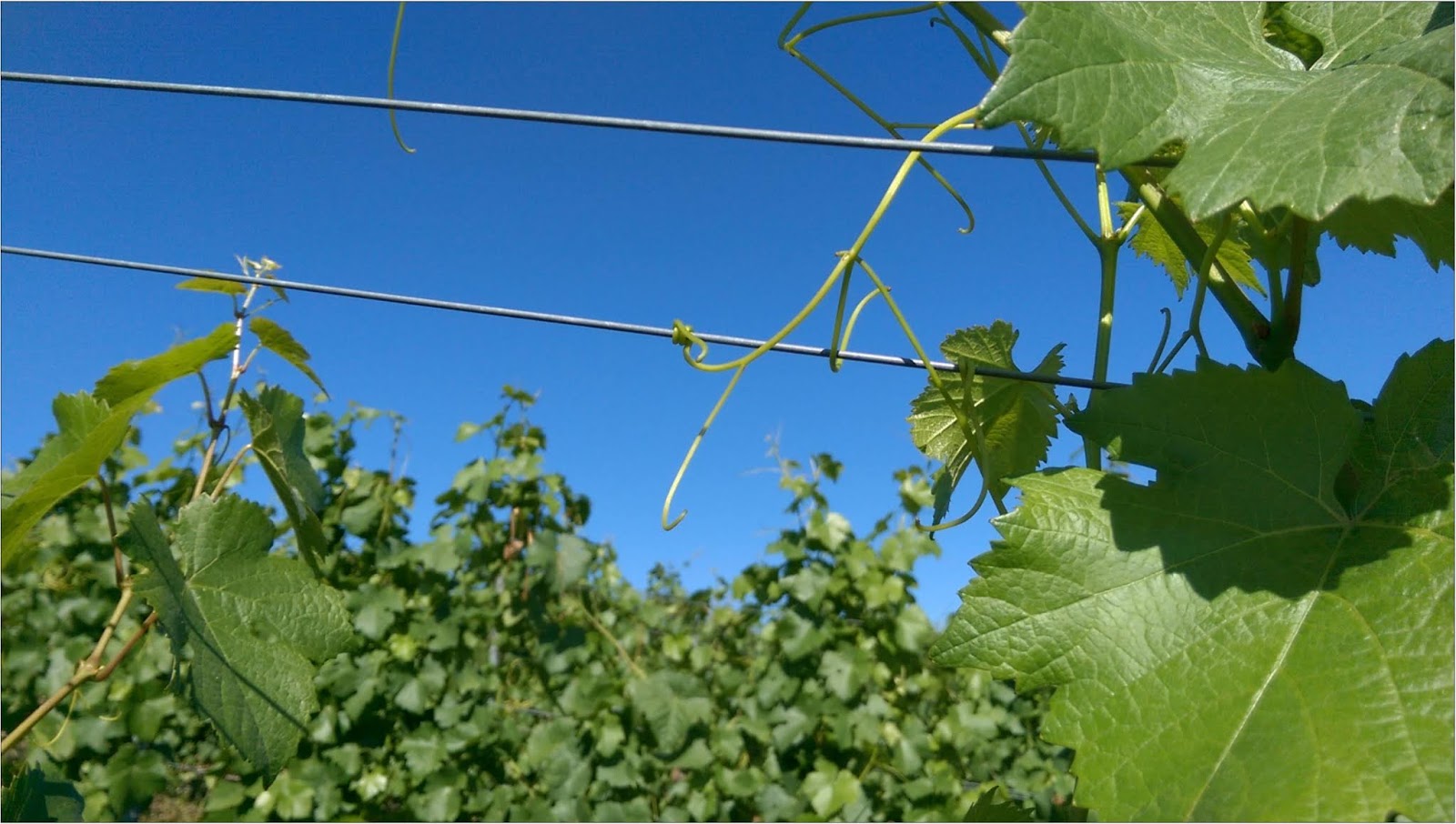
The month was June. The season was progressing just fine and then it was time for miles and miles of high tensile wires. We use 14-gauge high tensile wires for our trellis catch wires and we run three pair – Chug-a-lug, Chug-a-lug! The first set is not so bad. The wires are clipped into our conveniently pre-notched galvanized steel posts at 8 inches above the 30 inch fruiting wire providing a comfortable 38 inch working height.

The fruiting wire is where one lucky shoot from last year is wrapped and tied down. All the new shoots for 2018 emerge from this fixed position located 30 inches above the vineyard floor. Except the ones that don’t. Those are called water shoots in most viticultural textbooks. As a practical matter in the vineyard, they are called suckers and emerge from the rootstock graft union that is about 3 inches above the vineyard floor. One deep knee bend later and they are forcibly removed with all the precision and care a sucker can reasonably expect.

Right. Our focus in June is 38 inches off the vineyard floor. We are positioning our shoots in a vertical orientation with wires bedangled to our posts and then and only then do we use New Zealand fence clips to pinch our catch wires together. And we mean close together as a New Zealand fence clip is just one inch wide (that’s 2.54 centimeters or 25.4 millimeters for the metrically oriented among us.) Once those shoots are positioned and clipped into place they have about 4 inches of space to move laterally within the trellis wires. And that’s all they get for the rest of the growing season. Now behave! (Or what?)


We could bore you with how many lineal miles and thousands of clips we deploy (a lot!), but that is not the real focus. The real focus of these catch wires and clips is to contain all of the vine’s growth in a stable and linear trellis design so that Ernie can go and hedge their shoot tips off! But not until all of the shoots have been positioned and the one, the two, the three sets of wires are clipped into place. The last wire is clipped at the top of the post which is 72 inches above the vineyard floor. We give the vines another 18 inches of growth to match the 90” wide rows for a perfect 1:1 vine height to row width ratio.

Shoot positioning is a very important part of canopy management that, if done properly and on time, leads to fully developed wine berry aromatics and flavors at harvest. Canopy management is a means to an end that ends up with a 90 inch tall canopy, unless you are a Viognier vine. Then Ernie has a special program just for you.

And now it’s July, oh my, how the time does fly. A vineyard is quite simply a physical implementation of a mental construct. And Ernie’s mental construct now includes 55,000 vines planted in 44 blocks covering 35 acres over a 20 year span – more or less. Focus and attention to detail can only get you so far. Not knowing what is not possible is the driving force behind any great and monumental endeavor. And luck does favor the prepared mind. Remind me again, how did we get here? And, where exactly is here?

Which brings us to the first hedge of the season. Ernie’s mental construct does not allow for a lot of farmin’ around. During the growing season, time is more of a continuum than a fixed schedule. Up before the sun, or is that a full moon? A steaming bowl of pre-dawn gruel with the obligatory quart of dark monster morning accelerant and he is off burning diesel. Actually, that is bio-diesel in Oregon. So, it should be a surprise to no one that he has the hedger mounted in the front of the tractor and the mower mounted off the back. And then get this, he only drives every other row because his hedger does both sides and the top of the 90 inch tall canopy in a single pass! And he mows the grass and vine cuttings as he goes! Very effective, and more importantly, highly farmin’ efficient.

 Click on the image to watch Ernie in action, hedging and mowing
Click on the image to watch Ernie in action, hedging and mowing.

Time waits for no man, and neither do the vines. Just about as soon as Ernie covers the entire vineyard (about 50 lineal miles over 4 days) with that first hedge, it is time to get back out there – and maybe change the oil. To understand the vine’s growth habit is easy, they are natural born climbers. Vines have tendrils and apical dominance. As humans, we have opposable thumbs and varying degrees of critical reasoning capability as exemplified by our duly elected representatives – from either side of the aisle.

What this means for the vine is that the shoots at the very end of the cane are going to get the most energy (apically dominant) to climb whatever they can find and attach themselves with their tendrils. What this means for the humans is that the first hedging pass just takes off the most intrepid climbers. Once those shoot tips are taken off, the next set of shoots grow into their space at 90 inches above the vineyard floor. Oh my, how you have grown. So, Ernie saddles up for another hedge and mow pass. Rinse and repeat until the vines redirect their energy from growing more leaves to ripening their seeds so they can reproduce. And we can make wine.


August brings a mixed bag of weather conditions and with it a crash course in the jet stream. For those not living on the west coast, you may not get to experience the amazingly stunning sunrises, sunsets and moon shots during fire season. Fire is like water - something to respect and also harness its great power. Left unchecked, these forces of nature are devastating.


Now the jet stream is also what used to be known as the trade winds. The trade winds powered great sailing ships across the vast oceans to new lands where goods (and some inherent services) were traded. Sitting where we do in Oregon, the jet stream is of significant importance to the growth and production of fine wine. Note: Those French oak barrels we use for aging wine are from repurposed oak forests destined to become ship’s masts. That’s why fiberglass and composite metals were invented that eventually evolved into jet aircraft. Giddy-up!

From right after harvest through April, we call the jet stream the Pineapple Express. This is because the winds are blowing from the west, starting just around the island of Kauai, picking up quite a bit of moisture and depositing it onto the freshly burned acreage of the West Coast. We average about 45 inches of rainfall during those months. Timing is everything.

Now the jet stream vacillates quite a bit from as far south as San Francisco and spanning the entire West Coast up to Seattle in the lower 48. Occasionally it is as far north as the Strait of Juan de Fuca and that is when the Canadians get theirs.

The jet stream is the arbiter of nighttime temperatures in the Pacific Northwest. The farther north the jet stream points, the more heat is brought up from the central valley of California. If the jet stream is aimed farther south, this opens up the locker of cold air from the Gulf of Alaska moderating our temperatures and promoting an onshore flow of cool air and humidity.


During the month of August, the jet stream has more impact on our vines and resulting wine than most any other event we can think of, and we do not think of volcanic eruptions – that is right out. The last one was May of 1980 courtesy of Mt. St. Helens and that was a big ash mess!

If the jet stream points north of us, we also experience the after effects of California’s wildfires. The smoke that emanates from hundreds of square miles being burned each year is trapped in the atmosphere. This particulate matter has a whole host of effects including contributing to global warming due to the heat being unable to escape our atmosphere.


The particulate matter, while not smelling of smoke, also contributes to global dimming. The particulate matter prevents the full effect of the sun’s rays from reaching the surface, thus providing less natural light. Have you noticed that every new crop of smartphones has bigger and brighter screens? They seem brighter, right? Or is it just less bright during the day?

In the vineyard this means high daytime, and more importantly, high nighttime temperatures leading to increased growing season heat - aka degree day accumulation. The vine’s response to heat is to increase the rate of sugar accumulation. However, aroma and flavor development is a function of time on the vine. The goal is to plant wine berry varieties in a climate where the wine berry’s sugar accumulation and aroma and flavor development are commensurate. This means harvesting fully expressive aromas and flavors at moderate alcohol potentials (sugar concentrations) at the end of the region’s growing season. Our growing season ends in November when we harvest our Northern Rhône clones of Syrah and Viognier.

The one saving grace is that the smoke aroma has dissipated before the particulate matter gets to Oregon. And, we hope this year our neighbors choose not to light their burn piles until we finish harvesting our wine. Enough, is in fact, enough.

Now let’s swing the other way. If the jet stream points south to San Francisco, we get the cool to cold air coming down from Alaska via Canada and Seattle. This makes for a more classic Oregon vintage. Cool mornings with a bit of onshore flow create fog or a “Marine Layer.” And that tells us that the nighttime temperatures were slowing down the rate of sugar accumulation in the wine berry, thus enabling longer hang time for aroma and flavor development.

But when Canada has wildfires burning, as far away as Saskatoon, we see what’s coming, and check out the moon. And that is how Seattle got pegged with some of the worst air quality on the planet in 2018. The West Coast was burning from both ends and the jet stream delivered all of that particulate matter right to Elliot Bay in Seattle.

And that was pretty much what captivated our attention these past three months, vintage 2018. Oh, and we did pull off a few leaves, some varieties more than others, but not too much and certainly all at the right time. As you read this we are thinning off fruit that we do not want to end up in our fermenters. The wings, of course, are destined for the Bellpine Pearl Rosé. 


And now, we present the numbers. We are going month by month with rainfall included as we go, concluding with a growing season to date Degree Day chart as a cherry on top. As some of the more astute readers may have noticed, there are times when our numbers are, ah… a little less than precise. A little bit of the fudge you might say. There are three reasons for this:

Rounding Error – This is where numbers with different sets of decimal precision (sig figs) are added together resulting in less than 2 decimal precision. Truncation is also a problem, as most of us know pi to be the two digit 3.14, not the full expression out to 1 million sig figs which you can view here: https://www.piday.org/million/. Check it out on March 14th – national pi day, 3 /14. Or January 23rd, national pie day.

Sampling Error – This covers a wide range of issues, but most often it reflects a bad read from the weather station. We are pretty sure it was not 20 below in July. Or as most engineers will tell you, any data point that is 3 or more standard deviations out of the norm is categorically classified as “Sampling Error” and summarily discarded from the final analysis. What happened to that hockey stick?

Calculation Methodology – In determining our Degree Days, Ernie has devised an awesome set of formulas that calculate degree days from every 12 minute reading the weather station transmits, corrected for sampling error as explained above. The typical month provides 3,600 datapoints (30 days x 24 hours x 5 reads per hour) to better model the 24 hour temperature curve. February provides a new term “Systemic Variability” due to the phenomenon called Leap Year.

That is Ernie’s world. You just get one number to worry about. This may cause some incompatibility when trying to compare our degree day numbers with those who just average the high and low point of the day. Why just average when you can ride the curve?

June was fairly moderate with a high temperature of 98.6 degrees recorded on June 24th and a low temperature of 37.9 degrees recorded on June 1st. The rain was early and often with 0.91 inches failing over three days ending June 11th and another 0.09 inches to close out the month on June 25th. Total rainfall to date was 7.33 inches.

June logged 392.05 degree days, which when added to the 392.30 degree days from April and May gives us a 784.35 degree day growing season total. With that many 392s, there has got to be a Hemi convention going on somewhere.


Now July was a different matter. Our high temperature peaked at 106.9 degrees on July 29th and our low temperature was 41.0 degrees captured on July 3rd. Our rain gauge was dry; we got a whole lot of nothing. July piled on a whopping 611.13 degree days, providing a growing season to date degree day accumulation of 1,395.48. And this is about the time that those forest fires shifted into high gear. Queue the wind…


August was starting to show the pattern we have seen emerge over the past couple of vintages. The heat starts to pull back and we see a little more onshore flow providing moderate daytime temperatures and cool nighttime temperatures. However, we had to wait until September for this weather pattern to emerge in 2016 and 2017.

August added 559.00 degree days for a growing season to date total of 1,954.48 degree days. We had a trace of rain. We know that because we saw a few drops hit the window. We are sticking with 7.33 inches growing season to date.


And here is how the degree days were looking for the growing season through the August period from the past 5 vintages: 1,783 (2017), 1,822 (2016), 1,997 (2015), 1,886 (2014) and 1,737 (2013.)

Now if September continues to be moderate to cool, we could see another extended ripening period that will feature fully developed aromatics, flavors and textures. This may mean less Oregon Rosé is produced.

If September gets back on a tear and runs up the heat, we will most likely have pre-mature fermentation due to excessive sugars and underdeveloped aromas and flavors. Look for more Oregon Rosé in the pipeline.

Either way, we know what the vines are going to do. They are going to go about their business ripening their seeds, building sugars and developing aromas and flavors. And we are about to find out what Mother Nature is going to do. Her play is fairly limited to varying degrees of wind, rain, sun, clouds, heat and cold. But she is unbridled in her combinations and permutations.

That leaves us, the hapless winegrower/winemaker who is positioned as the interpreter of the vintage. Our options, at this point in the growing season, are fairly limited. The one big choice we get to make is when to harvest. Once we make that decision, then things just fall right into place – sort of. What could possibly go wrong?

Kindest Regards,

Dena & Ernie

Friday, August 3, 2018

Amalie Robert Estate Vintage Update: 2018 Pinot Noir In Flagrante!


Hello and Welcome,  

This is a 2018 Vintage Update from Amalie Robert Estate. A FLOG communication.  

We have spied the first blazing Pinot Noir berry on Friday, August 3rd - Julien calendar day 215. And it was the cutest thing, ever! All nestled in among the rest of the green berries, our harbinger of the vintage was all aglow.


Why yes, in fact, it was a Wadenswil clone Pinot Noir wine berry. We just love that clone, especially when grafted onto the legendary 5C rootstock. 5C may be slower to mature than those less endowed, shallow rooted rootstocks, but that means longer hang time, more aroma and flavor development and less alcohol potential. Who could ask for anything more?

And now that we have seen that blazing berry, it is time to bait the yellowjacket traps! And let us introduce the little Vespula blighters in their full regalia. And to set the record straight, these are classified as wasps, not hornets. Hornets are a whole other mess of trouble best handled with a flamethrower from a safe distance in suitable protective clothing. That funny guy from Tesla makes one…


If you happen to be stung by one of these Vespula, take a few microseconds to notice the thorax coloring scheme. It could be the sting is not so bad from Vespula atropilosa or Vespula pensylvanica. But if Herr Vespula germanica or Vespula vulgaris tags you, well there is gonna be some extended whoopin’ and a hollerin’ we can tell you that for sure, for sure good buddy!

Now these little wasps pack a punch, but a little research can pay healthy dividends. First off, these insects are ground dwellers. They nest under shrubs and bushes. Their most favorite shrubbery happens to be the ubiquitous blackberry. Not just any blackberry mind you, but the Himalayan or Armenian blackberry - Rubus armeniacus.

The native, and most preferred, culinary blackberry species in the Great Pacific Northwest is the Rubus ursinus. Commonly known as the Pacific Blackberry. Clearly the taxonomy folks were taking a little artistic license from the bears of the Great Pacific Northwest when classifying this plant. So be it – never let the truth get in the way of a good story. Vespula horribilis anyone?


The reason our little Vespula prefers the Rubus from Armenia is that they grow along the ground in a prostrate manner. They cover a tremendous amount of area with large thorny leaves and shoots that deter predators and provide them safe haven. The first, best predator of the Vespula is the common skunk. The risk, apparently, is worth the reward and we give these monochromatic wasp hunters a wide berth.

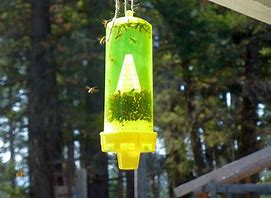
Right, now we know where they live. The eradication of the Vespula is virtually impossible and while a worthy goal, it is the equivalent of trying to boil the ocean. We are just trying to make wine. So one day, there was some clever fellow who devised a totally tubular yellowjacket trap. Bravo!


What we see depicted here is successful communication. The trap has been baited with a strong yellowjacket aphrodisiac. The yellowjackets are picking up on what’s going down and they want in on the action. All is right with the world. But wait, there is more. Enter the wild Oregon caught Chinook salmon.

You see these traps come from the factory with a synthetic attractant. And while most of the Vespula are good with that Herr Vespula germanica is having none of it. And it just so happens we know his weakness, it is freshly ripened wild Oregon caught Chinook salmon.

Our local fish monger knows when the first Pinot Noir wine berries start to turn color because that is when we show up at his door looking for fresh wild Oregon caught Chinook salmon scraps to trap our little Vespula. Of course, we take a fillet as well to have with Pinot Noir – for quality control purposes, of course.

Alright, let’s bring it home. We start out with about 20 of these totally tubular Vespula condos and start packing them full of salmon scraps. This is best done about an hour before daylight in a Vespula proof enclosure. Then we have specially modified coat hangers that fit through the molded hole at the top of the trap (those guys thought of everything.) Then, just as first light is being cast onto the vineyard we hang the traps on our south facing steel end posts very near the Rubus from Armenia.

It takes a while for the first early adopters to arrive. They buzz around investigating this new addition to their environment. Then around noon time, the sun has warmed up that steel end post and the wild Oregon caught Chinook salmon scraps inside the trap start to “ripen.”

Then look out! Herr Vespula germanica has picked up the scent and he is coming in hot! From this point forward, it is just a matter of hours before the trap is full and we must reload.

While it is quite heartwarming to see these traps fill up so quickly, this in fact is one of the necessary harvest pre-functions. Once all the blackberries are gone, there is only one fruit left to eat and that is the wine berry. The Vespula will attack the wine berry which has done nothing wrong, just ripen in the sun. They will eat all of the pulp inside and leave a hollowed-out skin. They like the sweet, but can’t seem to handle the skin tannin.


The problem arises when the harvest humans start to interact with the Vespula environment while the Vespula is consuming said wine berry. The problem is exacerbated when several Vespula, under the direction of Herr Vespula germanica, are feasting on adjacent clusters. You can hear the distinctive whoopin’ and a hollerin’ from quite a ways off.

So, we have about 45 days of ideal weather to “harvest” as many of these Vespula as we can so that they are not around during harvest operations. The other way to go about this is to use a can of aerosol hair spray and a lighter - mini flamethrower if you will. But as Ernie would remind you, experience is what you get when you don’t get what you want. So we have moved on to the wild Oregon caught Chinook salmon scraps.

We are still predicting a late September to early October start to harvest, but in the agrarian world, anything can happen between now and then - and most likely will. Are we going to get some rain? Oh, we hope so!

Now if you just can’t wait, you can check in on the spaghetti harvest here. While they do not have to contend with the dreaded Vespula, they do have the spaghetti weevil, and Vespas. Watch out!


Kindest Regards,

Dena & Ernie

Wednesday, June 6, 2018

Amalie Robert Estate Vintage Update: 2018 Flowers


Hello and Welcome,

This is a Vintage Update from Amalie Robert Estate. A FLOG Communication.

It is just a matter of time now. Some would say time and money, or that time is money. But at the end of the day there will be 105 days’ worth of time to spend the money before we start The Great Cluster Pluck of 2018.


And it was that Chardonnay vine that was first out with flowers again this year. What is it with that grape? But there it is, and soon the other 51,892 vines of Gewürztraminer, Pinot Meunier, Pinot Noir, Syrah and Viognier will be blooming.

At this point in the growing season, everyone wants to know if we are ahead or a behind, so here are the numbers. The first flowers revealed themselves on June 6th, a belated birthday bouquet for Dena. Last year the first flowers were spotted on June 11th, so we are a little ahead of last year. A distinction without a difference.

June 6th is Julian calendar day 157. Note 2018 is not a leap year. If it were a leap year, the flowers would have still appeared on Julian calendar day 157, but it would have been June 5th not June 6th and messed up the entire harvest planning and operations. We most certainly dodged a bullet there.

On average, the vines need 105 days to finish their work. Their job is to ripen up their seeds to reproduce and then go dormant for 6 months. Our job is to look at the end of 105 days to see if we have great aromas and flavors in those little wine berries so we can ferment the shugar out of them.

To put all this into a farming perspective, 105 ARBs are the equivalent of 17.5 six-packs. (ARB – Adult Recreational Beverage. You know, beer!)

Now we do the heavy lifting of adding 105 farming days to Julian calendar day 157 and end up with Julian calendar day 262. So easy a winemaker can do it! And as everyone knows, Julian calendar day 262 is September 19th.

That’s when the potential harvest window will magically appear in the vineyard. And Ernie will be keenly looking through it at the wings of Pinot Meunier and Pinot Noir to make our Bellpine Pearl Rosé. Dena has informed him, in no uncertain terms, that this year’s Pearl should return to its original Blanc de Noir color from 2015. What a GREAT idea!

Then all manner of grapes will start pouring in. Most probably the G’wzr will be first, followed by some young vine Wadenswil clone along with Dick Erath’s clone 95. Then we will factor in the weather and a little Kentucky windage to bring in the rest of the vineyard.

The last fruit in will most certainly be the Côte Rôtie block. Most likely on Julian calendar day 314. That gives us 52 days of harvest and winemaking operations to get ‘er done before we experience the deluge of winter rains. But for now, it’s looking like an ARB harvest window is about to open.


Kindest Regards,

Dena & Ernie

Thursday, May 31, 2018

Amalie Robert Estate Climate Update: 2018 May

Hello and Welcome,
 
This is the 2018 May Climate Update from Amalie Robert Estate. A FLOG communication. 

“The future is grass. Grass, buddy.” Who remembers this quote from the movie Tequila Sunrise? Well, Ernie has been saying it with his best Raul Julia impersonation for the entire month. We have had warm sunny days combined with abundant soil moisture. The grass does not let these conditions go unnoticed. The result was a grass uprising!


The flail mower is a wonderful thing. It is a specialized piece of farm equipment that only does one thing. But it does it really well. And that is to cut a 5 foot wide swath of grass, buddy. And since our vineyard rows are 7.5 feet apart, a 5 foot cut is ideal. As we have proven in a previous post, and Ernie has the empirical evidence to back it up, one pass through the vineyard is about 20 lineal miles – at 3 miles per hour.

Mathematically, this is about 7 hours worth of farming. Farming, by the way, is what you are doing when you are not growing wine. But it’s not 7 hours, It’s more like 10 to 12 hours, and that’s if you can make whatever repairs are needed without leaving the farm for parts. And you have had the forethought to order sufficient diesel to perform said farming. And they deliver once a week – how convenient!

Ernie has made three mowing passes to cut down this grass uprising, and there will be another 3 passes once he starts hedging. That’s a lotta grass, buddy.

And the sock monster has claimed a pair (nonmatching mind you) of socks. We have yet to receive a ransom note, but that should be coming along any day now. In the mean time, this leaves us with a pair of hunting socks. Because we are hunting for the pair that looks just like them!

We have begun training our vines’ newfound Spring growth into the trellis. After just about 20 years of this activity, you would think the vines would have it figured out by now. Not so. They seem to have a classic failing, which we have seen in our previous careers. They lack focus and attention to detail.


But their rate of growth is just astounding! And if you look at it from their perspective, would you want to be constrained in 3 sets of catch wires pinched together with a few plastic clips? Confining your growth to a vertical wall of leaves about 6 inches deep and 60 inches tall to maximize sun exposure and minimize the chance of your wine berries inflicted with mildew or other fungi?

The correct answer is YES! Yes, I want that! But alas, they do not.
 

If given the chance, they would just grow along the ground like some nondescript ubiquitous vine until they happen upon some unsuspecting tree. Then they would grab on with their tendrils and start growing up the trunk. Meanwhile the wine berries would be on the ground, compromised by some mildew colony where they would rot and meet their unworthy demise. Surely better to be trellised, plucked by hand and then fermented into wine!


Field work is hard, physically demanding work. Field labor is tight at this particular point in history. We can’t tell if there is more agricultural work to be done due to increased acreage under cultivation or there are fewer field workers to do the work. Most likely a bit of both. And it gives us the opportunity to review the law of supply and demand, in situ.

The vines however, are unburdened by this reality. They are just growing and growing and growing. They have forgotten all about the hedger. But Ernie hasn’t. He has dreams about arresting their unbridled growth. It should be just about the end of June, or maybe the start of July. But their day is coming in the form of 10 blades spinning at a bazillion miles per hour. And the flail mower will be hooked on the back mulching the vine cuttings with all that grass, buddy.

An acre of vines at Amalie Robert Estate can be thought of as 5,808 lineal feet. This means if we put all of our vines in one row, an acre’s worth of vines would be 5,808 feet long. If you were to walk a mile that would be 5,280 lineal feet. So, logically, an acre of vines can be thought of as 1.1 miles long. If it helps, bear in mind that a vineyard is just a physical implementation of a mental construct. But the field work is real.

To put this viticultural activity in perspective, we are going to do some farming math. You most likely won’t need your thinking cap, but if it is nearby this would be the time to grab it as you refill your wine glass - even if you must open another bottle to do so.
 

Now each acre of vines is bedangled with 3 sets of catch wires for a total of 6 wires per acre. These catch wires do the hard work for holding our vines in place so Ernie can go out there and hedge them down to size – repeatedly. Right, so that is 6.6 miles of manually raised catch wires per acre. Note: These wires must also be taken down at the end of the year, but that is too much math to do all at once, and we don’t want anyone’s head to explode. Duct tape can help with that, by the way.

Since we rely on hard working field workers to raise these wires and position the vines’ growth inside of them, this process takes a while. Depending on a wide range of factors that would make your head explode, the average time it takes to put up 3 sets of catch wires is just about 2.5 minutes per vine, based on a 10 year average. Since we have 1,452 vines per acre, that takes us about 3,630 minutes per acre, or about 7.5 field worker days. Pretty easy so far, right?

Now we reveal the magic number: 35.74. That is the number of acres of vines we farm. Using the magic number, we can learn that we have 235.88 miles of wires to raise (and eventually lower.) We can also know that we need about 268 field worker days to raise these wires and harness the vines’ growth. So if you come to visit the winery during the month of June and Ernie asks if you want to take a walk in the vines, now you know what you are really signing up for. As always, you will want to wear comfortable shoes and gloves might be a good idea.

What we cannot know is how many field workers we will have on any given day. Which leads us to not knowing what day the wires will be raised and Ernie can start hedging. Switching from Thinking Cap to Duct Tape, buddy.

And lo and behold we have EVEN MORE numbers! Ernie guessed the rainfall amount from the last day of May would be 0.30 inches. But when Dena checked the rain gauge, she said it was 0.28 inches. Clearly it’s time for Dena’s annual eye exam.

And we have accumulated 282.2 degree days for the month of May. When added to our April degree days of 110.1, this yields 392.3 degree days for the 2018 growing season. The high temperature for the month of May was 93.0 degrees Fahrenheit and the low temperature was 37.2 degrees. A fine start to the year.


Rainfall for the month of May was 0.53 inches if you ask Dena, or 0.55 inches if you ask Ernie. The growing season to date rainfall as collected from April through May is 6.33 inches, more or less.

Kindest Regards,

Dena & Ernie


Monday, April 30, 2018

Amalie Robert Estate Climate Update: 2018 April

Hello and Welcome, 
This is the 2018 April Climate Update from Amalie Robert Estate. A FLOG communication. 
Springtime in Wine Country is almost as exciting as harvest. There are sunny days and rainy days. Warm temperatures and cool temperatures. Hail is mostly a Springtime event, however we are sure that with all of the uncertainty in the world, that it may very well become a fall event. As in “What the hail!?”

 End posts, they're not just for wires.
Click on the image to see our vineyard floor overseer in action.

And then there is budbreak. This is the sign we are looking for from Mother Nature. It shows us that the vines have wintered over from last year’s Cluster Pluck and they are ready for the growing season. As the first couple of leaves unfurl, the vines look like they are sporting a line of little green butterflies. This lasts about 14.7 seconds, and then they start growing like the fruit bearing vines they are. Raising catch wires is the next task on the horizon and approaching rapidly.

But wait, let’s enjoy the moment. Springtime in wine country also gives us a wonderful palate of blooms on all sorts of plants. Mother Nature really puts on a show! Colors, textures and aromas from all sorts of flora attract the ever busy bee and the cycle of pollination is carried out dutifully.


And Ernie has his own cycle this time of year. His job is to feed our vines. Sounds quite simple, and it is, really. But just like everything in farming, the devil is in the details. Let’s review, shall we?

His first job is to incorporate the cover crops he drilled in last fall. Note this pre-supposes that the cover crop got drilled in last Fall. And it did. Last fall the vineyard was treated to a cover crop blend of Austrian winter peas and barley. The idea here is to have the peas set Nitrogen in the soil and the barley to take it up and hold it until the spring.

Nitrogen is mobile in the soil. That means the winter rains will wash it away if there is not some plant to take it up from the soil. Just think of the peas as a solar panel generating electricity and the barley as the battery that holds that energy until the spring. That’s when Ernie comes along and turns the soil so that the Nitrogen is released into the soil and the vine roots can pick it up. That’s the goal, feeding our vines without the use of chemical fertilizers. These cover crop plants also hold the soil on the hill in the face of daunting winter rains. Ha, it’s a twofer!

So, Ernie’s first pass is with the virtually indestructible chisel plow. What a great piece of farming equipment. It is relatively inexpensive, does not require power from the tractor and is really hard, but not impossible, to break. This implement attaches to the crawler and Ernie drives it about 2 miles per hour through every other row. Ideally these are the rows with the cover crop and not the rows with the permanent grass.

Click on the image to see Ernie and the chisel plow in action.

The chisel plow also performs double duty. The primary objective is to open our silty clay loam Bellpine soil to make it easy for the (easy to break) rototiller pass. Seven shanks go down about 8 to 10 inches and open up the soil.

While those shanks are down there, they also perform a little root pruning. Vines are always trying to find soil moisture and the shallow roots pick up the easy soil moisture during the spring and fall. Ernie is having none of it. He wants deep roots to help the vines find soil moisture during the dry months of August and September. Ernie schedules his annual trip to the dentist after this pass to restore any loose fillings that may have gone missing.

Right, now it is on to the rototiller pass. The first step is to inspect and replace any broken tines from the fall cover crop regime. If he is lucky, he can skate by without having to replace any clutch disks. But this is farming, and usually if not for bad luck, there is no luck at all.

Click on the image to see Ernie and the rototiller in action.

The rototiller, for all its agrarian vagaries, does a very good job of incorporating the nitrogen rich cover crop plants into the soil where all manner of microbes, worms and other no-see-ums are waiting for them. It’s dinner time on the vineyard floor!

And it looks nice, all fluffed up like that. It is important to have a little air exchange in the soil. Most microbes are aerobic and they need oxygen to function properly. The rototiller does this at no extra charge. And it helps to level the rows and our side hills. Ernie had to terrace some parts of the vineyard due to the steep side slopes. The rototiller helps move the soil from the uphill side to the downhill side, making a level surface to drive on. The rototiller is not such a bad implement after all.

Next Ernie hooks up the Schmeiser seed drill! Woohoo! We are going to drill some cover crop now! This is the third and final pass in the cover crop rows, putting down the new summer cover crop seeds.

Click on the image to see Ernie and the Schmeiser in action.

Amalie Robert Estate is a dry farmed vineyard, we are “True to the soil and True to the vintage. ®” So the summer cover crops have to get by on the morning dew we receive from our on-shore flows coming in from the Pacific Ocean. These cover crops also have to provide nutrition for the voracious, carnivorous insects that roam the vineyard.

Lady bugs, earwigs, mites and all other manner of insects are on guard against cane borers and parasitic mites that feed on our vines. These good bugs are the front line of defense in keeping our vines healthy and producing world class wines.
                                                                                                            
And when they can’t find bad bugs to eat, you still have to feed them. That’s one reason we use Buckwheat and Vetch for our summer cover crop blend. These plants need very little water, produce pollen (which is protein) for our army of good bugs and will set Nitrogen to feed our vines in the fall.

When it is all said and done, Ernie makes 3 passes in every other row to set our vineyard floor straight for the growing season. It’s about 18 acres worth of land, or 20 lineal miles that he is cycling through. Those 3 passes combine to make a total of about 60 lineal miles, at about 2 miles per hour. This saves him from having to use chemical fertilizers to feed our vines, and that is a good thing. And he has to mow the permanent rows, twice, at 3 miles an hours - go speed racer! If you sent Ernie an e-mail in April and did not get a response, now you know why. What a Springtime workload this man has!

Ernie, right in the middle of it.

Now before we get onto the task of shoot positioning, raising catchwires, and harnessing all of the vine’s Springtime growth, let’s do the numbers while we still have time.

The high temperature for April was 82.90 degrees recorded on the 24th at 3:24 pm. The low temperature was 31.50 degrees recorded on the 3rd at midnight. After gently massaging 3,600 data points, we find an April degree day accumulation of 110.10 degree days. The second half of the month was responsible for 71% of the heat accumulation, logging 78.65 degree days.


And we start the 2018 growing season with our soils holding a good amount of moisture. Rainfall for April totaled 5.80 inches. As a dry farmed vineyard, our objective is to manage the available soil moisture through the summer growing season.

If we can make it to September, we usually can get a little rainfall to extend our ripening period into October. As we are all painfully aware after these last few vintages, sugar accumulation is a function of heat, and aroma and flavor are a function of time on the vine.

Kindest Regards,

Dena & Ernie